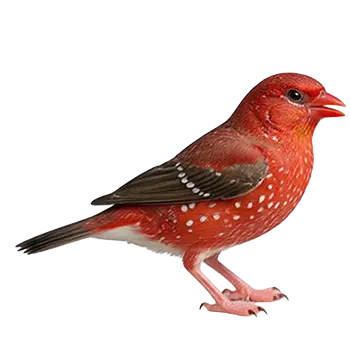

The juvenile stage of the Strawberry Finch begins at fledging, typically around 18 to 21 days after hatching, and extends through the first complete molt into adult plumage at roughly four to six months of age. This period represents one of the most dynamic phases in the bird's life, encompassing the transition from dependent nestling to self-sufficient flock member. The fledgling Strawberry Finch emerges from the nest in plain, brownish-buff juvenile plumage that bears little resemblance to the spectacular crimson and white-spotted plumage of the adult male or the more subtly beautiful coloration of the adult female.
The first days after fledging are marked by tentative, clumsy flight and a heavy reliance on parental feeding. Newly fledged chicks often perch near the nest entrance or on nearby branches, calling insistently for food while the parents shuttle back and forth. Their flight muscles are still developing, and early flights tend to be short, uncontrolled bursts that end with an ungraceful landing on a perch, the cage floor, or even the food dish. This clumsiness is entirely normal and resolves quickly as the young birds build strength and coordination over the following week.
During this vulnerable transition period, the enclosure setup becomes critically important. Remove or cover any open water containers deeper than half an inch, as a fledgling that lands in a water dish can become waterlogged and drown before it can extract itself. Ensure that food stations are accessible from multiple perch heights so that fledglings finding their footing can reach seed and soft food without navigating challenging flights. If the breeding enclosure includes other pairs or species, monitor closely for aggression directed at the newly fledged young, as some birds become territorial around food stations or preferred perching spots.
The parental feeding period after fledging typically lasts one to two weeks, during which the young birds gradually learn to crack seed and forage independently. This weaning process is rarely abrupt. Instead, the parents reduce feeding frequency over time as the juveniles demonstrate increasing competence at self-feeding. Some parent birds, particularly experienced hens, may begin a second clutch while still feeding fledglings from the first round, which can divide their attention. In colony settings, other adult birds occasionally assist in feeding fledglings, though this behavior is less predictable in Strawberry Finches than in some other estrildid species.