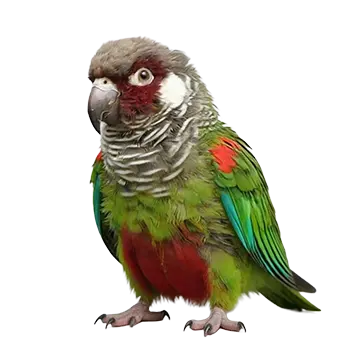

A Scaly Breasted Parakeet reaches full adulthood at approximately twelve to eighteen months of age, after completing its first adult molt and achieving sexual maturity. The adult stage encompasses the longest portion of the bird's life, spanning from this point through roughly ten to twelve years of age before the gradual onset of senior changes. During these prime years the bird is at its physical peak, displaying the full brilliance of its emerald green plumage, the crisp yellow scalloping across the breast, and the energetic, acrobatic behavior that makes this species such an engaging companion.
The adult Scaly Breasted Parakeet is a bird of considerable personality. In the wild, these lorikeets are gregarious, fast-flying inhabitants of the forests, woodlands, and suburban gardens along Australia's eastern seaboard. They forage in noisy, social flocks, feeding on the nectar and pollen of flowering eucalyptus, melaleuca, banksia, and other native trees. This natural history shapes nearly every aspect of their care in captivity, from the specialized diet they require to the high levels of social interaction and physical activity they need to remain healthy and psychologically balanced.
Establishing a stable daily routine is one of the most effective things a caregiver can do for an adult Scaly Breasted Parakeet. These birds thrive on predictability. Consistent wake and sleep times, regular feeding schedules, dependable out-of-cage exercise periods, and familiar social interactions provide the framework of security within which the bird feels confident to express its natural behaviors. Disruptions to routine, while sometimes unavoidable, should be managed gradually when possible, as sudden changes can trigger stress behaviors including excessive vocalization, feather destructive behavior, and appetite loss.
The adult years are also the stage during which the long-term consequences of early care become most apparent. A bird that was properly socialized, weaned onto a varied diet, and given the opportunity to develop strong flight muscles during its juvenile period will typically be a confident, adaptable, and physically robust adult. Conversely, gaps in early care can manifest as behavioral challenges, dietary rigidity, or physical limitations that require patient management throughout the adult stage.