
Understanding the Adult Stage

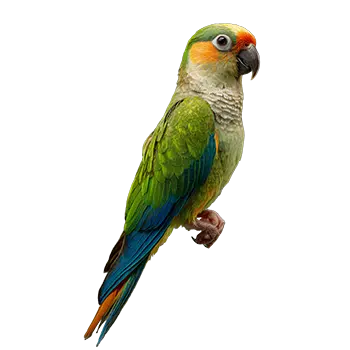
The Half-Moon Conure reaches full physical and sexual maturity between one and two years of age, entering a prime period that can span well over a decade with proper care. During these years, the bird's personality is fully formed, its adult plumage is established, and its behavioral repertoire has largely stabilized. The distinctive orange frontal band, the olive-green body plumage, and the blue-edged flight feathers are at their most vivid during the prime adult years, reflecting robust health and complete feather development.

Adult Half-Moon Conures are energetic, social, and remarkably interactive companions that demand consistent daily engagement from their caregivers. In the wild, Eupsittula canicularis lives in cohesive flocks that forage, roost, and travel together, and the captive bird channels this same social drive into its relationship with its human household. An adult conure that receives adequate attention, mental stimulation, and physical exercise is typically confident, affectionate, and entertaining. One that is neglected or understimulated may develop behavioral and health problems that erode the quality of the companionship.

The adult years are also the period during which the consequences of earlier husbandry decisions become fully apparent. A bird that was properly weaned, well-socialized, and trained during its juvenile months will enter adulthood with a strong behavioral foundation and a resilient temperament. Conversely, gaps in early care often surface during adulthood as entrenched behavioral challenges including phobias, biting habits, food selectivity, or excessive vocalizing. While these issues can still be addressed in adult birds through patient, positive-reinforcement-based behavior modification, prevention during the formative months is always preferable to rehabilitation later.

The prime adult years offer the caregiver and the bird the longest sustained period of stable companionship. By investing in a well-structured daily routine, a nutritionally complete diet, regular veterinary oversight, and an environment rich in enrichment and social opportunity, you lay the groundwork for a relationship that deepens over time rather than deteriorating under the weight of neglected needs.

Diet & Nutrition Optimization

An adult Half-Moon Conure's dietary requirements stabilize relative to the growth-driven demands of the juvenile period, but the importance of nutrition does not diminish. In fact, the long-term health consequences of dietary choices become more significant during adulthood, because the cumulative effects of nutritional excesses or deficiencies accrue over years and may not produce visible symptoms until organ damage is advanced. A disciplined approach to feeding during the prime years is one of the most impactful things a caregiver can do for the bird's longevity and quality of life.

The foundation of the adult diet should be a high-quality formulated pellet appropriate for small to medium parrots, comprising roughly 60 to 70 percent of total daily intake. Pellet formulations provide balanced macro- and micronutrient profiles that address the specific metabolic needs of psittacines, including appropriate calcium-to-phosphorus ratios, essential amino acids, and fat-soluble vitamins that are chronically deficient in seed-based diets. Select a pellet that uses whole-food ingredients and avoids artificial dyes, which offer no nutritional value and have been associated with allergic reactions in some birds.

Fresh produce should make up the remaining 25 to 35 percent of the diet. Dark leafy greens such as collard greens, mustard greens, and dandelion leaves provide calcium and vitamin A precursors. Cooked legumes and whole grains offer plant-based protein and complex carbohydrates. Bell peppers, broccoli, and snap peas deliver additional vitamins and the textural variety that keeps eating engaging for an intelligent bird. Fruits can be offered in small amounts as treats, but their high sugar content makes them poor candidates for dietary staples. Rotate the fresh food selection frequently to expose the bird to a broad nutritional spectrum and to prevent the fixation on a single preferred item that can lead to an unbalanced intake.

Obesity is the single most common nutritional disorder in captive conures and one of the most damaging to long-term health. Half-Moon Conures that are fed ad libitum seed diets or excessive treat quantities are highly susceptible to weight gain that leads to hepatic lipidosis, atherosclerosis, and reduced exercise tolerance. Monitor the bird's body condition regularly by gently palpating the keel bone. In a bird at healthy weight, the keel should be easily felt but not sharply prominent. If the keel is buried beneath a layer of subcutaneous fat, a diet adjustment is overdue. Your avian veterinarian can help establish a target weight range and a feeding plan to achieve it.

Fresh, clean water must be available at all times, changed at minimum twice daily to prevent bacterial contamination. Some Half-Moon Conures enjoy bathing in their water dish, which accelerates fouling and necessitates more frequent changes. Providing a separate bathing dish or misting the bird with lukewarm water several times a week satisfies the bathing instinct while keeping the drinking water clean.

Behavioral Enrichment & Mental Health

The cognitive demands of an adult Half-Moon Conure are substantial, and meeting them is not optional if the goal is a healthy, well-adjusted companion. In the wild, these conures spend the majority of their waking hours engaged in complex activities, foraging across diverse food sources, navigating through forest canopy, maintaining social bonds within the flock, and scanning for predators. Captivity eliminates most of these challenges, and without deliberate enrichment, the bird's considerable mental energy turns inward, often manifesting as destructive or self-directed behaviors.

Foraging enrichment should be a central component of the adult bird's daily routine. Rather than serving food in an open dish where it can be consumed in minutes, distribute the daily food ration across multiple foraging opportunities that require effort to access. Wrap pellets in paper, hide fresh vegetables inside foraging boxes, thread food onto skewers that must be manipulated, or scatter food across a foraging tray layered with shredded paper. These strategies extend feeding time from minutes to hours and engage the same problem-solving circuitry that wild foraging activates.

Physical enrichment extends beyond toys in the cage to include supervised out-of-cage time in a bird-safe environment. Adult Half-Moon Conures need a minimum of two to three hours of out-of-cage time daily to exercise, explore, and interact socially. A dedicated play stand or play gym equipped with perches, ladders, swings, and hanging toys provides a structured out-of-cage environment. For flighted birds, safe indoor flight opportunities exercise the cardiovascular and muscular systems in ways that perching and climbing cannot replicate.

Social enrichment is the third essential pillar. Half-Moon Conures are flock animals that require meaningful interaction with their human family or, in some cases, a congenial avian companion. The quality of social time matters as much as the quantity. Passive proximity, simply being in the same room while ignoring the bird, does not satisfy the conure's social needs. Active engagement through training sessions, conversation, shared activities, and physical affection gives the bird the interactive stimulation it craves and reinforces the companion bond.

Recognizing the early signs of enrichment deficiency is critical for preventing escalation into serious behavioral disorders. A bird that develops repetitive stereotypic movements, becomes excessively vocal when left alone, begins barbering or plucking its feathers, or shows escalating aggression during handling is communicating unmet needs. These behaviors are not character flaws but symptoms of an environment that is failing to provide what the bird's biology requires. Address the underlying deficiency before the behavior becomes self-reinforcing, and consult with an avian behaviorist if initial adjustments do not produce improvement.

Ongoing Training & Relationship Building

Training is not a phase that ends when the juvenile Half-Moon Conure masters step-up and target touch. In an adult bird, continued training serves as one of the most powerful tools for maintaining mental acuity, strengthening the human-bird bond, and preventing the behavioral stagnation that leads to problems. Each training session is a structured social interaction in which the bird earns positive outcomes through cooperative behavior, reinforcing the idea that engagement with its caregiver is both safe and rewarding.

Expand the adult bird's repertoire beyond basic commands with trick training, which channels the Half-Moon Conure's natural intelligence and playfulness into entertaining and cognitively enriching behaviors. Turning around on command, waving, retrieving a small object, and navigating a simple obstacle course are all achievable goals for this species. Break each new behavior into the smallest possible steps and shape the bird's progress with consistent positive reinforcement, using small food treats, verbal praise, or head scratches depending on what the individual bird finds most motivating.

Station training, in which the bird learns to go to and remain at a designated location on cue, has enormous practical value for an adult companion parrot. A stationed bird can be safely managed during cage cleaning, meal preparation, guest arrivals, and other situations where having the bird perched predictably in one place is advantageous. Teaching a reliable station also builds the bird's impulse control, which is a cognitive skill that generalizes to other contexts and contributes to a calmer, more manageable household companion.

Cooperative care training transforms routine husbandry tasks from adversarial struggles into voluntary partnerships. Teaching the bird to present its feet for nail inspection, extend a wing for examination, step onto a scale for weighing, and enter a carrier willingly eliminates the stress and risk of injury associated with forcible restraint. These behaviors are taught through the same incremental, positive-reinforcement approach used for trick training, and they pay off enormously during veterinary visits, grooming sessions, and travel. A bird that has been cooperative-care trained experiences far less chronic stress over its lifetime than one that must be toweled and restrained for every interaction with its own body.

Consistency in training methodology is more important than session frequency. Short, focused sessions of five to fifteen minutes several times a week produce better results than infrequent marathon sessions that fatigue the bird and erode motivation. End every session on a positive note, ideally with the bird successfully performing a behavior it knows well, so that the association with training remains enthusiastic rather than frustrating.

Common Adult Health Concerns

Adult Half-Moon Conures in their prime years are generally robust birds, but their long lifespan means that even minor health management lapses can compound over time. Understanding the most common health challenges facing captive conures allows caregivers to implement preventive strategies and recognize early warning signs before conditions become advanced and more difficult to treat.

Respiratory infections are among the most frequently diagnosed illnesses in adult conures. Aspergillosis, a fungal infection caused by inhaling Aspergillus spores from contaminated food, bedding, or poorly ventilated environments, is particularly common and can be insidious in its early presentation. Bacterial respiratory infections may result from exposure to aerosol irritants, including cooking fumes, scented candles, air fresheners, and cigarette smoke. Maintaining excellent air quality in the bird's environment, with adequate ventilation and the complete elimination of airborne irritants, is the most effective preventive measure. Any signs of respiratory distress, including tail-bobbing, nasal discharge, audible breathing, or changes in vocalization quality, warrant prompt veterinary attention.

Psittacine Proventricular Dilatation Disease is a viral condition that affects the nerves supplying the gastrointestinal tract and can also involve the central nervous system. Symptoms may include weight loss despite a normal appetite, undigested food in the droppings, crop stasis, and neurological signs such as ataxia or seizures. The disease is caused by Avian Bornavirus, which can be transmitted between birds through fecal-oral contact and possibly through feather dust. Diagnosis involves a combination of blood testing, imaging, and clinical assessment. While there is no cure, supportive care and anti-inflammatory treatment can manage symptoms and extend quality of life in some cases.

Heavy metal toxicosis is a preventable but potentially fatal condition that occurs when a conure ingests particles of lead or zinc from cage hardware, jewelry, zippers, curtain weights, or other household items. Half-Moon Conures are inveterate chewers, and their curiosity leads them to mouth almost any accessible object. Symptoms include lethargy, weakness, green or bloody droppings, seizures, and sudden death. Prevention requires a thorough audit of the bird's environment to remove all potential sources of heavy metals and the use of stainless steel or powder-coated cage hardware exclusively.

Feather destructive behavior, while often categorized as a behavioral issue, frequently has medical underpinnings that must be investigated before attributing the problem solely to psychological causes. Skin infections, internal parasites, liver disease, hormonal imbalances, allergies, and nutritional deficiencies can all trigger or contribute to feather plucking and barbering. A comprehensive veterinary workup including blood panels, skin cytology, and sometimes radiographs should be completed before implementing a purely behavioral treatment plan.

Annual Veterinary Care

Routine veterinary care during the adult years serves two essential purposes. It provides the professional oversight needed to catch emerging health problems before they become critical, and it generates a longitudinal health record that makes future diagnostic decisions faster and more accurate. An annual wellness examination is the minimum standard of care for a healthy adult Half-Moon Conure, with more frequent visits recommended if any health concerns arise between scheduled appointments.

The annual wellness exam should include a complete physical assessment covering body condition, feather quality, skin integrity, nares and choana, eyes, ears, beak condition, vent area, and musculoskeletal function. Blood work, including a complete blood count and a comprehensive chemistry panel, establishes reference ranges specific to the individual bird and reveals trends over time that population-level normal ranges would miss. What is normal for one bird may be abnormal for another, and serial data points are far more diagnostically useful than a single isolated result.

Fecal analysis remains an important component of the annual visit. A gram stain and direct smear can identify bacterial imbalances, yeast overgrowth, or parasitic organisms that may be subclinical but are steadily undermining the bird's health. Culture and sensitivity testing may be warranted if abnormal organisms are identified, allowing the veterinarian to select the most effective antimicrobial treatment rather than relying on empirical broad-spectrum therapy.

The annual visit is also the appropriate time to discuss any behavioral changes observed at home, review the bird's diet and make adjustments as needed, and address husbandry questions that have accumulated since the last appointment. Many avian veterinarians recommend annual radiographs starting in mid-adulthood to screen for early signs of atherosclerosis, hepatic enlargement, or respiratory abnormalities that may not yet be producing clinical symptoms. These proactive measures are especially valuable in a species with a multi-decade lifespan, where catching a problem five years earlier can mean the difference between effective management and irreversible organ damage.

Maintain a personal health binder for your Half-Moon Conure that includes copies of all laboratory results, vaccination records if applicable, weight logs, and notes from each veterinary visit. This binder should travel with the bird if you change veterinarians, move to a new city, or need to seek emergency care from an unfamiliar clinic. A complete medical history allows any veterinarian to make informed decisions quickly, which can be life-saving in an acute situation.

Hormonal Behavior & Seasonal Changes

Even in non-breeding companion birds, hormonal fluctuations are a normal part of adult life for Half-Moon Conures and can produce behavioral changes that catch unprepared caregivers off guard. In the wild, breeding season is triggered by environmental cues including increasing day length, abundant food availability, and the presence of potential mates. In captivity, artificial lighting, year-round food abundance, and the presence of a bonded human can inadvertently stimulate hormonal activity outside the normal seasonal window, leading to chronic reproductive behavior that is both physically and psychologically taxing for the bird.

Hormonal behavior in an adult Half-Moon Conure may manifest differently depending on the individual and its sex. Common signs include regurgitation directed at a favored person or object, territorial aggression around the cage, nesting behavior such as shredding paper and seeking enclosed dark spaces, increased vocalizing, and heightened sensitivity to handling. In females, chronic hormonal stimulation can lead to excessive egg laying, which depletes calcium reserves and poses the serious risk of egg binding, a medical emergency in which an egg becomes lodged in the reproductive tract.

Environmental management is the first line of defense against chronic hormonal behavior. Maintain a consistent light cycle of ten to twelve hours of light and twelve to fourteen hours of darkness, using cage covers or moving the bird to a quiet, dark room for sleep. Avoid providing enclosed spaces such as huts, boxes, or tents that mimic nesting cavities. Limit access to warm, mushy foods during hormonal periods, as these can mimic the abundance of food that signals breeding condition. Reduce stroking along the bird's back, wings, and tail, as these areas are erogenous zones whose stimulation reinforces hormonal arousal. Head and neck scratches are a safer form of physical affection.

If environmental modification alone does not adequately manage hormonal behavior, consult your avian veterinarian. Hormonal implants and other medical interventions are available for birds experiencing severe or chronic reproductive activity that threatens their health. These treatments should be viewed as supplements to environmental management, not replacements for it, and should always be administered under veterinary supervision after a thorough health assessment.

Understanding that hormonal behavior is biologically driven rather than willful misbehavior helps caregivers respond with patience rather than frustration. A bird that becomes nippy, territorial, or obsessively attached to an object during a hormonal surge is acting on deeply embedded instincts, not choosing to be difficult. Punishing hormonal behavior is ineffective and damages the bird's trust. Instead, manage the environment, wait for the phase to pass, and maintain the training and handling routines that provide structure and predictability during a period when the bird's internal landscape feels unsettled.

Always consult a qualified professional before making any health-related decisions. This content is provided for informational reference only and should not replace professional guidance specific to your animal.