
Leaving the Nest

A Gouldian Finch fledges at around three weeks of age looking nothing like the bird it will become. Juvenile plumage is a muted grey-green across the back and wings, with a paler ash-grey head, a dull buff underside, and none of the purple, yellow, turquoise, or black that defines the adult. The beak is dark rather than the pale, red-tipped or yellow-tipped bill of the mature bird. This drabness is not a defect; it is camouflage for a young bird that must survive several months in open savanna before it can afford to advertise itself.

Newly fledged Gouldians fly surprisingly well from their first attempts, which catches out keepers accustomed to the tumbling incompetence of some other species. Within a day or two of leaving the box they are moving confidently between perches. What they lack is judgment. Fledglings misjudge distances, land badly, and are prone to crashing into cage bars and windows when startled. This is the period in which to remove glass hazards, cover large expanses of wire with something visible, and avoid sudden entries into the birdroom.

Most fledglings return to the nest box or to a covered corner to roost for the first several nights, and there is no reason to prevent this. Leave the box in place until the young birds are consistently roosting on perches, usually within a week or two. Removing it prematurely can leave a group of fledglings huddled on the cage floor overnight, where they are colder and more vulnerable.

The parents continue to feed their fledged young for a further two to three weeks. During this period you will see the classic begging display of a young estrildid finch: wing-quivering, head-twisting, and an insistent buzzing call directed at any passing adult. This behavior is normal and should not be interrupted. Removing fledglings from their parents too early is one of the most common causes of failure in this stage, because a bird that appears to be pecking at seed is not necessarily swallowing enough of it to survive.

Weaning and Independent Feeding

Independence in Gouldian Finches arrives gradually and later than many keepers expect. Fledglings begin experimenting with solid food within days of leaving the nest, picking at millet sprays and soft food while still receiving most of their nutrition from their parents. Genuine self-feeding, meaning the bird is meeting its own caloric needs without parental supplementation, is typically reached around forty days of age and sometimes closer to six weeks. Until that point, separating a youngster from its parents risks a rapid decline that is easy to miss until the bird is already in trouble.

The most reliable test of weaning is behavioral rather than visual. Watch the young bird for extended periods at the food dish. A weaned Gouldian husks seed efficiently, swallowing the kernel and discarding the shell, and it does so repeatedly over several minutes. A bird that is not yet weaned will pick up seed, manipulate it, and drop it whole, or will abandon the dish quickly and resume begging. Empty seed hulls in a dish look identical whether the bird ate the kernel or dropped it, so hull volume tells you nothing on its own.

Offer weaning birds the softest and most accessible foods available. Soaked and sprouted seed, spray millet, egg food, and finely chopped greens require less skill to process than hard dry seed and bridge the transition well. Place food in multiple locations at different heights, including low dishes, because inexperienced juveniles do not reliably find a single station and will not compete successfully with adults for it. Cuttlebone and mineral grit should be freely available throughout, as the juvenile molt ahead of them makes heavy demands on mineral reserves.

Weight is the objective measure that behavioral observation cannot replace. If your birds are settled enough to permit brief, low-stress handling, weighing recently weaned juveniles every few days catches the sliding bird before it becomes the dead bird. A healthy juvenile Gouldian holds somewhere in the region of thirteen to eighteen grams depending on line and body type. A downward trend over consecutive weighings, even within a normal-looking range, is the signal to return the bird to its parents or to intensify soft-food provision.

Once the young birds are confirmed self-feeding, moving them to a separate juvenile flight is usually wise. Adult cocks frequently become intolerant of fledged young once the hen begins preparing a second clutch, and harassment at this stage is both stressful and occasionally injurious. A dedicated flight also allows you to feed the growing birds a richer diet than you would give resting adults, without over-conditioning the parents into another breeding cycle.

The Juvenile Molt and Emerging Color

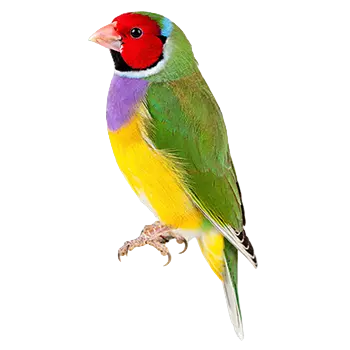
The juvenile molt is the defining event of adolescence in this species and the most physiologically demanding thing a young Gouldian will do before it breeds. It typically begins somewhere between eight and twelve weeks of age, though the timing varies considerably with hatch date, nutrition, and line. Over the following weeks the bird replaces essentially its entire plumage, trading the grey-green juvenile feathering for the green mantle, purple breast, yellow abdomen, turquoise nape band, and colored head mask of the adult.

Progress is rarely tidy. Color emerges in patches, and a bird midway through the molt looks distinctly moth-eaten, with bare tracts on the head and neck, blood feathers in the wings, and a patchwork of old and new plumage. This appearance is normal and should not be mistaken for feather plucking or disease. What is abnormal is symmetrical bald patches that do not regrow, feathers with pronounced stress bars, or a molt that stalls partway and remains unchanged for weeks. All three point to nutritional shortfall, parasite burden, or chronic stress.

The molt is when the bird's head color becomes apparent, and that color is worth understanding. Wild Gouldian populations are predominantly black-headed, with red-headed birds forming a substantial minority and yellow or orange-headed birds occurring only rarely. Red head color is sex-linked in its inheritance while black is autosomal, which is why head color in a captive-bred clutch does not follow simple expectations. Juvenile birds may show an incomplete or muddy mask during the transition; wait until the molt is fully finished before drawing conclusions about a bird's final coloring or its breeding value.

Nutrition during this period should be at its most generous. Feather is largely keratin, and building an entire coat of it requires sulfur-containing amino acids that a plain seed mix supplies poorly. Egg food, sprouted seed, a quality protein supplement, and free-choice mineral and vitamin provision all pay for themselves in feather quality. Many breeders also supplement with a low dose of iodine or a proprietary molt supplement during this window, since iodine deficiency has a documented association with poor feathering and thyroid enlargement in finches.

Expect the birds to be quiet, less active, and less resilient throughout. Mortality in Gouldians is measurably concentrated around the juvenile molt, which is the origin of the species' historical reputation for delicacy. Keep the temperature stable and warm, minimize disturbance, avoid introducing new birds or changing the group composition, and do not transport or sell birds midway through the process. A young Gouldian that comes through its first molt in good condition is a substantially more robust animal on the other side.

Housing the Growing Juvenile

Juvenile Gouldians need flight distance more than they need floor space or cage furniture. In the wild these are birds of open woodland that cover real ground between feeding and watering sites, and the muscle and cardiovascular development that happens during adolescence depends on being able to fly properly rather than hop. A long horizontal flight of at least four feet, and preferably longer, does far more for a growing group than a taller cage of the same volume. Perches should be placed at the ends to create a clear flight path rather than scattered through the middle where they break it up.

Group housing is the norm and the preference. Gouldians are flocking birds and juveniles particularly benefit from being kept together, where they establish the social competence that solitary birds never acquire. A juvenile flight of six to twelve young birds of similar age works well. Mixing juveniles with unrelated adults is less reliable, especially where breeding adults are present, and mixing very different age classes tends to leave the youngest birds displaced from food and preferred perches.

Perch variety supports foot health at an age when the tendons and joints are still developing. Use natural branch of varying diameters, roughly a quarter to a half inch, rather than uniform dowel. Manzanita, apple, willow, and eucalyptus are all suitable once thoroughly cleaned. Position perches so that droppings do not fall into food or water, and leave the central airspace clear. Avoid sandpaper perch covers entirely; they abrade the plantar surface of the foot and contribute to pododermatitis without providing any meaningful nail wear.

Temperature stability remains critical through adolescence. Juvenile Gouldians are less cold-tolerant than adults and considerably less so during the molt. Keep the flight in the region of 70 to 80 degrees Fahrenheit, with humidity around 50 to 60 percent, and pay particular attention to overnight lows in unheated birdrooms. Provide twelve to fourteen hours of light on a consistent schedule, ideally including a full-spectrum source, and offer shallow bathing water daily, which juveniles use enthusiastically and which supports feather condition through the molt.

Flock Behavior and Social Development

Adolescence is when a Gouldian Finch learns to be part of a flock, and the lessons are surprisingly specific. Young birds acquire the group's foraging habits, its alarm responses, its roosting arrangements, and the fine-grained etiquette of who may perch where. Birds that miss this education, typically because they were raised alone or moved between groups repeatedly, tend to become adults that are either chronically nervous or inappropriately pushy, and both traits translate into poorer breeding outcomes later.

Song development begins during this stage and is one of the more reliable early sex indicators. Young cocks start producing subsong, a quiet, rambling, structurally loose vocalization that gradually crystallizes into the adult song over the following months. Hens do not sing, producing only calls. Since juvenile plumage gives no reliable sexual signal and even post-molt birds can be ambiguous in some color mutations, listening for subsong in a quiet room is often the first practical clue to a young bird's sex.

Gouldians are unusually peaceable finches and serious aggression between juveniles is uncommon. What you will see is displacement behavior at perches and food dishes, brief bill-fencing, and chasing, all of which are normal and self-limiting. Watch instead for a single bird that is consistently excluded, that feeds only when others have finished, or that roosts apart from the group. Social exclusion in a flocking species is both a symptom of illness and a cause of decline, and an isolated juvenile should be examined rather than left to sort itself out.

Environmental variety supports behavioral development without requiring the toys and enrichment devices appropriate to parrots. Gouldians engage with millet sprays hung in different positions, with bundles of seeding grasses, with fresh branches that change the layout of the flight, and with bathing opportunities. Rotating these elements every week or two keeps young birds exploring and foraging rather than sitting. What they do not want is handling; the enrichment that matters to a Gouldian happens between birds and within the environment, not between bird and keeper.

Health Risks Specific to Adolescence

The adolescent period carries a distinct risk profile, and understanding it explains most of what happens to Gouldians between fledging and their first birthday. The animal is simultaneously growing, replacing all of its feathers, adjusting to independent feeding, and often being moved to new housing or a new home. Any one of these is manageable; stacked together they compress the bird's margin for error, and subclinical problems that an adult would tolerate become fatal.

Air sac mite is the condition most closely associated with the species and disproportionately affects young birds. Sternostoma tracheacolum colonizes the trachea, bronchi, and air sacs, and the clinical picture is clicking or wheezing respiration, tail-bobbing, open-mouthed breathing, loss of voice in young cocks, and reduced flight tolerance. Because Gouldians hide illness well, an owner often notices only when the bird is already heavily burdened. Diagnosis and treatment belong with an avian veterinarian, who will typically use a topically applied avermectin at a carefully calculated dose; over-the-counter mite sprays and cage hangers are ineffective and sometimes harmful.

Intestinal parasites and protozoa are the second major group. Cochlosoma, contracted most often from society finch fosters, characteristically strikes recently fledged birds with profuse watery droppings and rapid weight loss. Coccidiosis and giardiasis present similarly. Because a fifteen-gram bird has essentially no fluid reserve, enteric disease at this age kills through dehydration within a day or two. Fresh fecal examination is quick, inexpensive, and the single most useful diagnostic in a juvenile that is losing condition.

Stress-related conditions round out the list. Candidiasis and bacterial overgrowth follow immune suppression during molt, particularly where soft food hygiene is poor. Feather abnormalities including retained sheaths, stress bars, and stalled molts follow nutritional deficiency. Sudden death without preceding signs, unfortunately common in this stage, is frequently traced afterward to a combination of chilling, transport, and molt occurring together.

The practical response is preventive rather than reactive. Quarantine every incoming bird for at least thirty days with fecal screening and respiratory assessment. Do not sell, buy, or transport birds mid-molt. Keep the environment warm and stable through the entire adolescent period. Feed generously with soft foods that are replaced twice daily rather than left to sour. And weigh birds periodically, because in a species this good at concealing illness, a number on a scale is often the only honest report you will get.

Preparing for Adulthood

By roughly six months of age a Gouldian Finch has usually completed its juvenile molt and is wearing full adult plumage, and by nine to twelve months it is sexually mature. Maturity and readiness, however, are not the same thing. Most experienced breeders will not pair a Gouldian until it is at least twelve months old, and often wait until after its first full adult molt, because birds bred at the earliest possible age tend to produce smaller clutches, feed less reliably, and burn out faster. Restraint at this stage buys years of productive life later.

Sexing becomes straightforward once adult plumage is complete. Cocks are more saturated in color throughout, with a deeper purple breast, brighter green mantle, and a longer central tail filament. Hens are noticeably paler, particularly across the breast, and their beak tip darkens during the breeding season while a cock's remains bright. Behavior confirms it: only cocks sing and perform the bobbing, bill-wiping courtship display. Where color mutations blur the visual differences, song remains the reliable indicator.

The transition to an adult maintenance diet should be gradual rather than abrupt. A young bird coming out of its molt still needs generous protein, but a bird held indefinitely on full breeding condition food will come into breeding readiness before you want it to, and chronic over-conditioning contributes to fatty liver disease later. Step soft food back to a few times weekly, keep a good quality small-seed mix as the base, and maintain continuous access to cuttlebone, mineral grit, and fresh greens.

This is also the point to make decisions about the bird's future. Youngsters intended for breeding should be assessed for size, feather quality, vigor, and head color, and should be settled into their eventual housing well before any pairing is contemplated. Birds intended as pets or aviary display animals can be integrated into a mixed-age flock now that they are fully feathered and self-sufficient. Either way, a Gouldian entering adulthood in good condition, socially competent, parasite-free, and unhurried through its first year has every prospect of a long and healthy prime.

Always consult a qualified professional before making any health-related decisions. This content is provided for informational reference only and should not replace professional guidance specific to your animal.