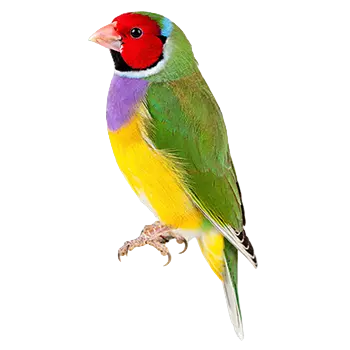

Gouldian Finches generally live five to eight years in captivity, with well-managed birds occasionally reaching ten. A bird is reasonably considered senior from around four to five years of age, which means that the geriatric portion of a Gouldian's life can occupy a third of it. Because the species conceals weakness so effectively and because the changes of aging are gradual, many owners do not register that a bird has become old until something goes visibly wrong.
The earliest signs are behavioral and easy to attribute to personality rather than age. An older Gouldian flies shorter distances and less often, chooses a favored perch and stays on it, spends more of the day resting, and is slower to react to disturbance. Cocks sing less frequently and their song may lose complexity. The bird still feeds, still preens, and still interacts with the flock, but the overall tempo of its day has slowed. Comparing an individual with younger flockmates makes the difference obvious in a way that watching it alone does not.
Physical changes follow. Plumage gradually loses saturation, with the purple breast and green mantle becoming less brilliant after each successive molt, and the feathers themselves often sit less smoothly. The scales on the legs and feet coarsen and thicken. Some older birds develop a faint cloudiness in the eye. Nails tend to overgrow because the bird uses its feet less vigorously, and the beak may show minor irregularities. Muscle mass over the keel diminishes even where body weight holds steady, which is why running a finger gently along the breastbone tells you something a scale alone will not.
Aging also brings reduced physiological reserve, and this is the practical crux of geriatric finch care. An older Gouldian tolerates cold less well, recovers from stress more slowly, is more susceptible to opportunistic infection, and has less margin if it misses a day of adequate feeding. Nothing about that requires dramatic intervention. It requires a lower threshold for concern, a more stable environment, and a willingness to adjust husbandry to a bird that no longer has the resilience of a two-year-old.