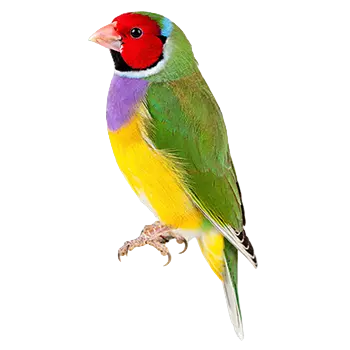

A Gouldian Finch reaches full adult plumage at around six months and full physical and sexual maturity somewhere between nine and twelve months. From that point until roughly its fifth year the bird is in its prime: fully colored, at peak flight condition, and if it is going to breed, doing so most reliably. Adults measure five to six inches from bill to tail tip, with a good portion of that length in the tail, and weigh in the range of fourteen to nineteen grams. Body weight varies with line, with European show-type birds often running heavier than smaller wild-type stock.
The adult plumage is what made the species famous. The mantle and wings are a bright grass green, the breast a deep lilac-purple, the abdomen a strong yellow, and a narrow band of turquoise separates the head mask from the green of the back. The head mask itself comes in three natural forms. Black-headed birds dominate wild populations, red-headed birds occur as a substantial minority, and yellow or orange-headed birds are genuinely rare in the wild, appearing at well under one percent. Captive breeding has since produced a wide range of body and breast color mutations, but the underlying head-color genetics remain the same, with red inherited in a sex-linked manner and black autosomally.
Sexual differences are consistent enough to sex adults confidently by eye in normal-colored birds. Cocks carry deeper, more saturated color throughout, with a richer purple breast and a longer central tail filament. Hens are visibly paler, particularly on the breast, and their beak tip darkens toward black during breeding condition while the cock's stays bright. Only cocks sing, producing a quiet, structurally complex song that is easy to miss in a noisy room and unmistakable in a quiet one.
Temperamentally, adult Gouldians are calm, gregarious, and almost entirely non-aggressive toward their own kind and toward other peaceful finches. They are also emphatically not hands-on pets. A Gouldian will not step up, will not seek contact, and finds handling genuinely stressful. What they offer instead is one of the most visually striking aviary displays available and a quiet, low-volume presence that suits households where a parrot's noise would be impossible. Set expectations accordingly and the species is deeply rewarding.