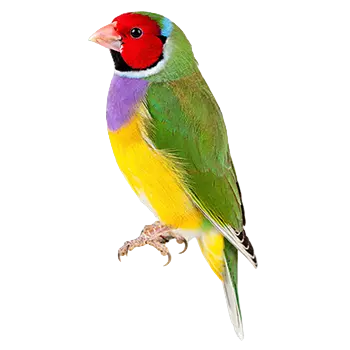

Understanding the End of a Gouldian's Life

Most Gouldian Finches live between five and eight years in good captive conditions, with exceptional individuals reaching around ten. That is a short life by the standards of parrot keeping and a substantial one by the standards of small passerines, and it means that an owner who takes on a Gouldian is signing up for a relationship that will, in the ordinary course of things, end within a decade. Knowing that in advance makes the final chapter easier to handle well.

Death in this species arrives in two broad patterns, and the difference matters for what an owner can do. The first is a gradual decline over weeks or months, typically driven by chronic disease such as hepatic lipidosis, renal failure, or neoplasia, in which the bird loses condition progressively and there is time to provide supportive care and make considered decisions. The second is sudden death, in which an apparently well bird is found dead with no warning. Sudden loss is common in finches and is frequently the endpoint of a concealed illness rather than a genuinely instantaneous event.

That concealment is worth understanding rather than resenting. Gouldians are small prey animals whose evolutionary strategy is to appear healthy for as long as physiologically possible, because a bird that visibly falters in a wild flock is the bird a predator selects. The consequence in captivity is that visible symptoms often mark a late stage rather than an early one, and that owners who lose a bird suddenly are usually not guilty of inattention. They were watching an animal built to give nothing away.

It also means that the last stage of a Gouldian's life can be genuinely brief once it becomes apparent. A bird that has been quietly compensating may decompensate over a day or two. Thinking through in advance what you would want to do, which veterinarian you would call, and how far you would want to pursue diagnostics in a fifteen-gram animal is not morbid. It is what allows a calm decision at a moment when calm decisions are otherwise hard to reach.

Recognizing Decline

The signs that a Gouldian is approaching the end of its life are, in isolation, the same signs that indicate any serious illness. What distinguishes the terminal picture is that they accumulate, persist, and fail to respond to treatment. In a bird with a known chronic diagnosis, or an old bird whose decline has been tracked over months, this pattern becomes recognizable.

Sustained weight loss is the most objective indicator. An adult Gouldian weighing fourteen to nineteen grams that drops progressively over successive weighings, and in whom the keel becomes prominent and sharp beneath the breast muscle, is losing body mass it cannot recover. Alongside this, appetite falls away. The bird spends less time at the food dish, picks at food without swallowing, or stops eating entirely. A finch that has not eaten for a day is in serious trouble regardless of the underlying cause, because metabolic reserves at this size are measured in hours.

Behavioral changes are equally telling. A declining Gouldian sits fluffed with feathers held out from the body to conserve heat, keeps its eyes half-closed, and sleeps through periods when the flock is active. It stops singing. It gives up its high perch and moves lower, and eventually spends time on the cage floor, which for an arboreal bird is a significant marker. It withdraws from the flock, stops allopreening, and no longer responds to disturbance in the way it once did.

Physical signs follow. Breathing may become labored, with tail-bobbing on each breath or an open beak. Droppings change in volume, color, or consistency, or dwindle as intake falls. Plumage becomes unkempt as the bird stops preening. Balance may fail, with the bird gripping a perch unsteadily or sitting propped against a cage wall. Some birds show neurological signs including head tilt or weakness on one side.

None of this is a reason to abandon veterinary assessment. Many of these signs, appearing for the first time in a bird that has not been in decline, indicate a treatable condition rather than a terminal one, and a Gouldian sitting fluffed on the floor may be a bird with a parasite burden or an infection that will respond well to treatment. The judgment that a bird is dying rather than ill belongs at the end of a diagnostic process, not at the beginning of one, and it is a judgment best made with a veterinarian rather than alone.

Hospice Comfort and Environment

Once it is clear that a Gouldian is not going to recover, the goal of care shifts from cure to comfort, and the most valuable interventions are simple ones. Warmth is first among them. A dying bird loses the ability to thermoregulate effectively and will use its remaining energy trying to stay warm, so raising the ambient temperature to around 85 to 90 degrees Fahrenheit relieves a substantial burden. A hospital cage, a heat pad beneath one end of a small enclosure, or a ceramic emitter positioned so the bird can move toward or away from the heat all work. Provide a gradient rather than uniform heat, and never place a heat source where the bird cannot escape it.

Move everything the bird needs within reach. A finch that can no longer fly or perch reliably should have food and water dishes at floor level, immediately adjacent to where it is resting. Soft towelling or folded paper on the cage floor provides grip, cushions falls, and gives the bird something to settle into. Remove high perches that invite a fall, or lower them to a few inches above the floor. Keep the cage small enough that nothing is far away, which is one of the few situations in which reduced space genuinely serves a Gouldian.

Reduce stimulation. Move the cage to a quiet, dimly lit room away from household traffic, noise, and other pets. Handle the bird as little as possible, since restraint is stressful and physically demanding for an animal with no reserve. A partial cage cover often helps a frightened bird settle. Keep the lighting soft and consider leaving a very low night light so the bird is not disoriented in complete darkness.

The question of whether to keep a dying Gouldian with its flock has no single answer. These are social birds, and the presence of familiar companions can be settling. On the other hand, a bird that cannot compete may be jostled from its position or displaced from food, and it is much harder to observe closely within a group. A workable compromise is to house the bird separately but within sight and sound of the flock, so that it retains the social context without the physical competition.

Pain and distress management is a veterinary matter and should not be improvised. Avian analgesics exist and can be dosed appropriately for a bird this size by a practitioner experienced with passerines. Do not administer human medications, over-the-counter remedies, or alcohol-based tonics; the therapeutic margins at fifteen grams are extremely narrow, and well-intentioned home dosing is a common cause of unnecessary suffering at the end of a bird's life.

Nutrition and Hydration in the Final Stage

A dying Gouldian frequently stops eating, and because a bird of this size carries almost no energy reserve, that alone will determine the timeline. The aim in the final stage is not to force calories into an animal that is shutting down but to remove every obstacle between the bird and food it might still want, and to keep it hydrated for as long as intake remains meaningful.

Offer the softest and most appealing foods available. Soaked and sprouted seed, moistened egg food, soaked spray millet, and finely chopped soft greens all require less effort to process than dry seed. Warm foods slightly, since warmth increases palatability and reduces the thermal cost of eating. Place small quantities in shallow, wide dishes directly beside the bird and refresh them often, as a bird that eats a little at a time will not return to food that has dried or soured.

Hydration matters more than calories in the short term. Provide water in a shallow, stable dish at floor level where the bird cannot fall into it, and change it frequently. Some birds that will not drink from a dish will take droplets offered on the tip of a soft brush or a syringe held at the edge of the beak, though this should be done gently and only if the bird is responsive; forcing fluid into an unresponsive bird risks aspiration and does no good. Where dehydration is significant, a veterinarian can administer subcutaneous fluids, which is far safer than any home approach.

Assisted feeding is a decision to make with a veterinarian rather than unilaterally. Crop feeding a fifteen-gram bird requires appropriate equipment, correctly mixed and warmed formula, and a technique that avoids aspiration, and it involves restraining an animal that finds restraint frightening. In a bird with a treatable condition and a realistic prospect of recovery, it can be genuinely life-saving. In a bird that is dying, it often adds distress without extending comfortable life, and declining to do it is a legitimate and compassionate choice.

Accept, ultimately, that appetite loss is part of the process. There comes a point at which a bird's refusal of food is not a problem to be solved but information about where it is. Recognizing that point, rather than escalating intervention against it, is usually the kinder response, and it is the point at which the conversation about euthanasia becomes appropriate.

Working With Your Avian Veterinarian

The final stage of a bird's life is the worst possible time to be searching for a veterinarian who treats finches, which is the strongest argument for finding one early. Many practices that see parrots regularly have limited experience with passerines, where handling itself carries risk and where sample volumes are minute. If you keep Gouldians, identify a practitioner with passerine experience while your birds are well, and keep the after-hours contact details somewhere you can find them quickly.

When a bird is declining, the first job is still diagnostic. A number of conditions that look terminal in a Gouldian are treatable, including air sac mite, enteric protozoal infection, and bacterial disease, and it is worth establishing what you are dealing with before concluding that nothing can be done. A veterinarian will weigh what diagnostics are reasonable against the stress they impose, and in a very frail bird may recommend treating empirically rather than pursuing a definitive answer. That is a legitimate approach and not a shortcut.

Be explicit with your veterinarian about your goals. There is a real difference between wanting every avenue pursued and wanting the bird kept comfortable without further investigation, and neither position is wrong. Stating it plainly allows the veterinarian to recommend a course that matches what you actually want rather than a default. Ask directly what the realistic prognosis is, what the treatment would involve, how much handling it would require, and what the bird's experience of it would be.

The risks of intervention deserve honest weighting at this size. Restraint, anaesthesia, radiography, and blood sampling all carry higher risk in a small, debilitated bird than in a healthy one, and there are situations in which the diagnostic process is more likely to cause death than the disease is in the following days. A good avian veterinarian will tell you this. Discussing it before the bird is critical produces better decisions than discussing it in an emergency.

Keep a written record throughout. Weights, dates, the sequence in which signs appeared, changes in droppings and appetite, treatments given and how the bird responded. In a species that conceals illness, this record is often the most informative thing you can hand a veterinarian, and it also helps you see the trajectory clearly, which is difficult to do from memory when you are worried about an animal you care about.

Euthanasia and Natural Death

Euthanasia is available for finches and is worth considering seriously rather than dismissing on the grounds that the bird is small. It is performed under general anaesthesia, usually with an inhalant agent delivered by mask or chamber so that the bird loses consciousness gently before any injection, and it is quick and painless when carried out by an experienced avian practitioner. Ask about the specific protocol beforehand if it would help you feel more settled about the decision.

The indications are the ones you would apply to any animal. Persistent inability or refusal to eat, uncontrolled respiratory distress, an inability to perch or maintain an upright posture, evident pain that cannot be managed, a confirmed terminal diagnosis with a poor prognosis, and a continuous decline that has not responded to treatment all point toward it. The relevant question is not how long the bird might survive but what the remaining time would consist of.

Many Gouldians die naturally at home, often overnight or during a period when nobody is watching, and this is neither a failure of care nor necessarily a worse outcome. A bird kept warm, quiet, undisturbed, and near its familiar surroundings often has a more peaceful end at home than it would after a car journey and a clinic visit. If you choose this path, the practical obligation is to ensure the bird is genuinely comfortable: warmth, accessible food and water, soft footing, low light, and minimal handling.

What is not acceptable is any attempt at home euthanasia. Methods circulated informally among keepers are unreliable, frequently cause suffering, and are illegal in many jurisdictions. If you have concluded that a bird should not continue, the route is a veterinary appointment, including an emergency one. If cost is an obstacle, say so directly to the practice; many will work with an owner on the price of a euthanasia rather than have an animal suffer, and some areas have charitable schemes for exactly this situation.

Decide in advance, if you can, what you want to do with the body, because the decision is harder in the moment. Options include home burial where local regulations permit and where the depth and location prevent disturbance, individual or communal cremation through your veterinary practice, and pet cemetery interment. If the death was sudden or unexplained and you keep other birds, a post-mortem examination is worth considering; identifying an infectious cause can protect the rest of the flock and is often the most useful thing a lost bird can still do for its companions.

Afterward: The Flock and the Owner

The remaining birds should be your first practical concern after a death. Gouldians are strongly social, and the loss of a long-standing companion, particularly a bonded partner, produces observable changes: reduced activity, calling, less singing, and sometimes a drop in appetite. Watch the survivors closely for the following week or two, weigh them if you can, and ensure they are eating. A bird that is grieving and a bird that is incubating the same illness look similar at first, which is precisely why observation matters.

A Gouldian left entirely alone should not stay that way. Solitary housing is genuinely poor welfare for a flocking species, and a single remaining bird will do better with company. Introduce new birds properly rather than hastily, with a full thirty-day quarantine in separate airspace and screening for respiratory disease and intestinal parasites before any contact. Where the loss leaves you with one bird and no plan, rehoming it into an established finch flock is a legitimate and often kind option.

If the cause of death was or might have been infectious, take the practical precautions. Clean and disinfect the cage, perches, and all food and water vessels with an avian-safe product and rinse thoroughly. Review the collection for any other bird showing early signs, particularly respiratory ones, and mention the death to your veterinarian when you next make contact. Air sac mite and enteric protozoa move through a collection quietly, and one loss is sometimes the first visible sign of a wider problem.

Give yourself room to grieve, and do not let anyone talk you out of it on the grounds that the animal was small. Grief tracks the relationship, not the body weight, and people who have kept a Gouldian for years, watched it fledge, learned its habits, and cared for it through a decline feel that loss properly. There is no correct duration and no obligation to be philosophical about a five-year lifespan simply because you knew about it in advance.

When you are ready, and only then, consider what comes next. Some keepers find that a new bird helps, others that it feels wrong for a long while, and both responses are ordinary. If you do continue with the species, the experience you gained is real: you now know what a healthy Gouldian looks like, what early decline looks like, and what you would do differently. That knowledge is the most durable thing a bird leaves behind, and it goes directly into the quality of care the next one receives.

Always consult a qualified professional before making any health-related decisions. This content is provided for informational reference only and should not replace professional guidance specific to your animal.