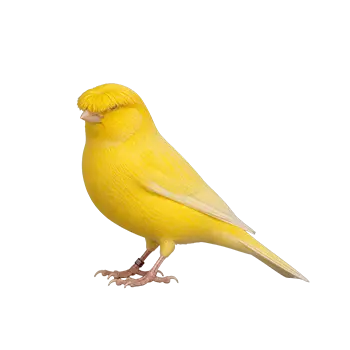

A Gloster Canary reaches full physical and behavioral maturity at approximately one year of age, and the prime adult period extends through roughly the first five to six years of life. During these years, the bird is at its strongest, most vocally productive, and most resilient. The adult Gloster is a compact, cobby bird measuring four to just under five inches in length, with a rounded body profile, short tail, and the distinctive head furnishing that defines the breed. Corona adults sport a full, symmetrical crest that radiates from a central point on the crown, while Consort adults display a smooth, rounded skull with tight, sleek head feathering.
The daily life of a well-kept adult Gloster follows a predictable rhythm that mirrors the natural patterns of light and activity the species evolved with. The bird wakes with the light, feeds actively during the first hour of the day, sings or vocalizes through the mid-morning, feeds again, rests during the early afternoon, and has a second period of activity and feeding in the late afternoon before settling for the night. Providing a consistent routine built around this natural rhythm supports the bird's physical health and psychological stability.
Adult Glosters are generally placid and undemanding companions, but they are not passive ornaments. A healthy adult displays curiosity about its environment, engages in regular preening and bathing, moves actively around its cage, and, in the case of males, sings with sustained energy and enthusiasm. A bird that sits fluffed and motionless for extended periods, ceases singing abruptly outside of the molt season, or shows a marked change in its normal behavioral pattern is communicating that something is wrong. Learning to read your individual bird's baseline behavior is one of the most valuable skills an owner can develop.
The prime adult years are also the period during which the Gloster's temperament is most settled and predictable. Birds that were well-socialized as juveniles will maintain their comfort with handling and routine care. Even birds that were not extensively handled in their youth can often be gentled through consistent, patient interaction during their adult years, though the process takes longer and the results may be more limited. Regardless of the bird's tameness level, adult Glosters thrive on routine and can become stressed by sudden changes in their environment, schedule, or social group.