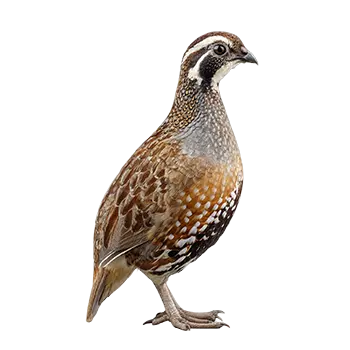

Coming to terms with the Bobwhite Quail's characteristically short lifespan is one of the more difficult aspects of keeping this species. In wild populations, the annual mortality rate frequently exceeds 70 to 80 percent, with most birds living less than two years. Predation, disease, severe weather, and habitat loss all contribute to this high turnover rate. Captive Bobwhites, insulated from many of these pressures, live considerably longer, with well-managed birds routinely reaching three to four years and exceptional individuals surviving to five or six. Even so, keepers accustomed to the decades-long companionship offered by parrots or the multi-year relationships typical of larger poultry species often find the Bobwhite's condensed life cycle emotionally challenging.
The short lifespan of the Bobwhite is not a flaw or a failure of care. It is a fundamental feature of the species' life history strategy, shaped by millions of years of evolution. Bobwhites compensate for high individual mortality with high reproductive output, producing large clutches of eggs that allow the population to recover rapidly from losses. This reproductive strategy, sometimes described as r-selected, contrasts sharply with the long-lived, low-reproductive-output strategy of species like parrots and large raptors. Understanding this biological context helps keepers frame the end of a Bobwhite's life not as a premature loss but as the natural conclusion of a life cycle that, however brief by human standards, is complete on its own terms.
The trajectory toward end of life in a captive Bobwhite may follow a gradual decline, where the bird slowly loses condition, mobility, and vitality over weeks or months, or it may present as a sudden event, where a bird that appeared healthy is found dead or acutely ill with little warning. Both patterns are within the range of normal for the species. Sudden death in an otherwise well-managed bird, while distressing, is not unusual in a species whose wild life expectancy is measured in months rather than years. A necropsy, when feasible, can provide valuable information about the cause of death and whether any management changes are warranted for the remaining flock.
Preparing emotionally for the loss of a Bobwhite Quail is easier when you acknowledge from the beginning of the keeping relationship that the bird's time with you will be measured in a small number of years. This awareness need not diminish the joy of keeping these fascinating, charismatic birds. Instead, it can deepen the keeper's appreciation for each season spent observing the covey's intricate social behaviors, hearing the male's distinctive whistle, and participating in the annual cycles that structure the Bobwhite's compact but richly textured life.