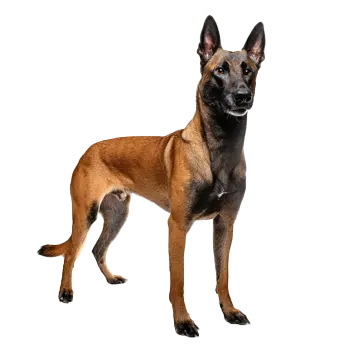
The Mechelse Herder is a medium-to-large dog whose physical structure communicates athletic readiness in every line. This is not a heavy, cumbersome animal. It is a lean, muscular machine built for sustained effort, sudden bursts of speed, and the kind of physical versatility that allows it to herd sheep at dawn, clear obstacles in agility at noon, and maintain a focused protection stance at dusk. Males measure 24 to 26 inches at the withers and weigh between 60 and 80 pounds. Females stand 22 to 24 inches and weigh 40 to 60 pounds. The body forms an almost square profile, with length from the point of shoulder to the point of buttock approximately equal to height.
The head is proportionate and cleanly sculpted, with a flat skull and a moderate stop transitioning into a muzzle of nearly equal length. The muzzle maintains sufficient width and depth for a strong bite without appearing coarse or heavy. The nose is black and fully pigmented. Eyes are medium-sized, almond-shaped, and ideally dark brown, projecting an expression that experienced handlers describe as questioning, alert, and ready. The directness of the gaze can be unnerving to people unfamiliar with the breed, as the Mechelse Herder seems to look through rather than at whatever has captured its attention. Ears are triangular, stiff, and set high on the skull, carried fully erect and proportioned to the head.
The neck is long enough for proud carriage and the range of motion needed for stalking, crouching, and rapid directional changes, yet strongly muscled to support the head during sustained tracking work. The chest reaches to the elbows and is moderately wide, providing the lung capacity for prolonged effort without the barrel shape that would sacrifice agility. Ribs are well-sprung. The back is short, broad, and firmly muscled, connecting to powerful hindquarters with well-angulated stifles that generate explosive forward drive. The loin is broad and tight, providing the core stability that allows the dog to pivot, accelerate, and brake with precision.
The coat of the Mechelse Herder is one of its most practical features. Short, straight, and hard to the touch, the outer coat lies flat against the body and provides weather resistance without requiring extensive maintenance. Beneath the outer layer sits a dense undercoat that insulates against cold and damp conditions. Hair is somewhat longer around the neck, forming a collar, and on the tail and the back of the thighs, where it creates a modest fringe. The color range spans from rich fawn to deep mahogany, with each individual hair tipped in black to create the layered overlay effect that gives the coat its depth. The black mask is a defining feature, covering the muzzle and extending through the ears to frame the face with a sharpness that enhances the breed's alert expression.
Movement reveals the Mechelse Herder at its most impressive. The trot is light-footed, elastic, and ground-covering, with the topline remaining firm and level while the limbs move in planes parallel to the body's axis. At higher speeds, the feet converge toward the centerline, demonstrating efficient tracking. The breed is capable of sudden direction changes at full gallop, an ability that evolved through herding work where controlling unpredictable livestock demanded rapid physical responses. The tail hangs to the hock in repose and raises with animation during activity, though it should never curl over the back.
Feet are round, compact, and well-arched with thick dark pads built for traction across varied surfaces. The overall physical impression is one of contained power and readiness, a dog poised to explode into action the instant a command or situation demands it.
Affectionate With Family
★★★★☆
Forms powerful emotional connections with its household, seeking proximity and inclusion in daily activities. This breed wants to be part of everything its family does and becomes deeply invested in the people it lives with.
Good With Young Children
★★★☆☆
Older children who can participate in active play and training typically do well with this breed. Young children require supervision because the Mechelse Herder's energy and herding reflexes can overwhelm small kids.
Good With Other Dogs
★★★☆☆
Generally manageable around familiar dogs, especially those it has grown up with. Encounters with unfamiliar dogs may produce assertive posturing, and some lines carry a tendency toward same-sex tension.
Shedding Level
★★★★☆
Produces a steady stream of fine, short hair year-round, ramping up considerably during the spring and autumn coat transitions. The hair is small but persistent and works its way into virtually every fabric surface.
Coat Grooming Frequency
★★☆☆☆
A weekly brushing session handles the coat's needs during most of the calendar. Shedding season demands daily attention with an appropriate deshedding tool to manage the significantly increased hair volume.
Drooling Level
★☆☆☆☆
Drooling is a non-issue with this breed. The tight, dry lip structure keeps saliva contained, and you will not find wet spots on your furniture or clothing.
Coat Type
★★☆☆☆
The double coat features a hard, flat-lying outer layer and a thick undercoat for weather protection. Hair texture is coarse and dense, with modest lengthening around the neck and on the tail.
Openness To Strangers
★★☆☆☆
Approaches unfamiliar people with measured caution rather than overt friendliness. This breed assesses visitors carefully, and its reserved demeanor with strangers is considered appropriate working temperament.
Playfulness Level
★★★★☆
Highly enthusiastic during play, particularly activities that engage both physical speed and mental focus simultaneously. Tug games, fetch with obedience commands, and chase sequences bring out this breed's best energy.
Watchdog/Protective Nature
★★★★★
Possesses an instinctive, deeply rooted drive to guard territory and protect its people. This is one of the breed's most defining traits, making it a natural choice for professional protection and security work worldwide.
Adaptability Level
★★★☆☆
Can adjust to different living arrangements if its demanding exercise needs are met without fail. Suburban homes work with dedicated owners, though the breed is always happiest with space to move and tasks to complete.
Trainability Level
★★★★★
Among the most trainable breeds alive, capable of learning intricate command sequences and performing under extreme pressure. Requires a handler who communicates clearly and fairly, rewarding effort while maintaining consistent expectations.