Mechelaar

Belgian Malinois

Quick Facts

🐕 Breed Group
Herding Group
📏 Size Category
Large
📏 Height
Males: 24-26 inches, Females: 22-24 inches
⚖️ Weight
Males: 60-80 lbs, Females: 40-60 lbs
⏱️ Life Expectancy
12-14 years
🧣 Coat Type
Short, straight, hard outer coat with dense undercoat
🎨 Coat Colors
Fawn to mahogany with black overlay, black mask and ears
😀 Temperament
Confident, intelligent, hardworking, alert, protective
🏃 Exercise Needs
Very High
🎓 Training Difficulty
Moderate to High
👶 Good with Children
Good with older children when properly socialized
🐾 Good with Other Pets
Can coexist with proper introduction; may be territorial

Other Names & Breed Recognition

Mechelaar is the Flemish Dutch word meaning simply one from Mechelen, and it identifies this breed by its geographic roots in the Belgian city where the short-coated variety of the Belgian Shepherd was developed and refined. In the Dutch-speaking regions of Belgium and the Netherlands, calling this dog a Mechelaar is as natural as an English speaker calling it a Malinois, the French-derived name that became the international standard. Both words point to the same city. Mechelen is the Dutch name. Malines is the French name. The dog carries both linguistic traditions in its identity.

The breed travels under a collection of names that reflect its complex cultural and organizational history. Mechelse Herder, meaning shepherd dog from Mechelen, is the fuller Dutch designation and is the name used in Belgian and Dutch breed registries and kennel clubs. Chien de Berger Belge Malinois is the complete French designation used by the Federation Cynologique Internationale. In the United States and Canada, the dog is registered as the Belgian Malinois, a name that separates it as a distinct breed from the other Belgian Shepherd varieties. In casual conversation, owners and handlers worldwide often simply call the dog a Mal or a Mali.

The organizational recognition of this breed varies significantly depending on which kennel club you consult. The FCI considers the Mechelaar one of four varieties of a single breed, the Belgian Shepherd Dog, classified under Standard Number 15 in Group 1, Section 1. The four varieties are the Malinois (short-coated fawn), the Groenendael (long-coated black), the Tervuren (long-coated fawn), and the Laekenois (rough-coated fawn). The American Kennel Club took a different path in 1959 when it chose to register each variety as a separate breed. The Belgian Malinois sits in the AKC Herding Group, where it has competed since the group's creation in 1983 after transferring from the Working Group. The United Kennel Club, The Kennel Club in the United Kingdom, and the Canadian Kennel Club all recognize the breed as well.

For Dutch-speaking Belgians and the people of Mechelen itself, the name Mechelaar carries a regional pride that transcends cynology. Mechelen is historically significant in Belgian culture, and having a world-renowned working dog variety carry its name is a source of local identity. The term appears in Flemish breed literature, in conversation among Belgian handlers, and in the registries maintained by Dutch-language kennel organizations. While Malinois has become the globally dominant name, Mechelaar remains the original Dutch linguistic root, and encountering it signals a connection to the breed's authentic Flemish heritage.

Mechelaar Organizations & Standards

The organizational framework surrounding the Mechelaar reflects the breed's dual identity as both a beloved European shepherd variety and an elite modern working dog. In Belgium, the Societe Royale Saint-Hubert serves as the national kennel club and maintains registration records for the Belgian Shepherd Dog in all four varieties. Belgian breed clubs like the Belgische Herder Club Nederland and the Nederlandse Vereniging voor Belgische Herdershonden oversee breeding standards, health protocols, and competition in the Dutch-speaking world where the Mechelaar name carries everyday currency.

The FCI breed standard, which governs the breed across most of the world, describes a well-proportioned, medium-sized dog with proud carriage and an elegant square profile. The average desired height at the withers is 62 centimeters for males and 58 centimeters for females, with tolerances of 4 centimeters above and 2 centimeters below. The standard requires a working test, underscoring the FCI's insistence that this remains a functional breed rather than a purely aesthetic one. Under FCI classification, all four Belgian Shepherd varieties share Standard Number 15 and may theoretically interbreed, though such crosses are carefully regulated and rarely practiced today.

In the United States, the American Belgian Malinois Club functions as the AKC parent club and has established comprehensive requirements for responsible breeding. The ABMC participates in the Canine Health Information Center program, requiring CHIC certification that includes OFA or PennHIP evaluation for hips, OFA clearance for elbows, and an eye examination by a board-certified ophthalmologist with results registered through CERF or OFA. Beyond these mandatory tests, the ABMC strongly recommends that breeders discuss epilepsy history, cancer occurrence with particular attention to hemangiosarcoma, thyroid status, and cardiac health with prospective puppy buyers.

The AKC breed standard emphasizes a square-built dog with an exceedingly proud carriage of head and neck. The overall structure should convey strength without heaviness, combining muscular development with an athletic elegance that suggests the breed's capacity for sustained, intense physical effort. The standard is explicit about the acceptable color range, permitting fawn to mahogany with black overlay, and requires the distinctive black mask and ears that give the Mechelaar its characteristically sharp, alert facial expression. The Kennel Club in the United Kingdom places the breed in its Pastoral Group and maintains its own standard that aligns closely with the FCI description, while the Canadian Kennel Club recognizes the breed within its Herding Group. Across all registries, the consistent theme is a breed valued first for working capability and temperament, with physical structure judged primarily on its contribution to functional performance rather than aesthetic refinement alone.

Kennel Club Recognition

  • American Kennel Club (AKC): Recognized in 1959, Herding Group
  • United Kennel Club (UKC): Recognized, Herding Dog
  • Canadian Kennel Club (CKC): Recognized, Herding Group
  • FCI: Recognized, Group 1: Sheepdogs and Cattledogs
  • The Kennel Club (UK): Recognized, Pastoral Group

Mechelaar Physical Description

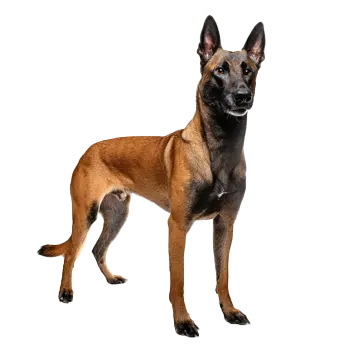
The Mechelaar presents a picture of functional athleticism distilled into a medium-to-large frame that communicates readiness and capability at first glance. This is a dog built for sustained work, not for aesthetic excess. Every element of its physical construction serves the breed's demanding roles in herding, protection, and service. Males stand between 24 and 26 inches at the withers and weigh 60 to 80 pounds, while females measure 22 to 24 inches and weigh 40 to 60 pounds. The body is almost perfectly square in proportion, with the length from the point of the shoulder to the buttocks approximately equal to the height at the withers.

The head is clean-cut and strong, carried proudly on a well-muscled neck that flows smoothly into the body. The skull is flattened rather than rounded, roughly equal in length to the muzzle, and the stop is moderate. The muzzle tapers slightly toward the nose but maintains enough width for a powerful bite. Eyes are medium-sized, almond-shaped, and brown, ideally dark brown, giving the Mechelaar the intense, questioning expression that handlers find so striking. The gaze is direct, evaluating, and alert. Ears are stiff, triangular, and set high on the head, carried erect and proportional to the head size.

The body is built for power and endurance in equal measure. The chest is deep, reaching to the level of the elbows, with well-sprung ribs that provide generous lung capacity. The topline is firm and level from withers to croup, and the loin is broad, short, and strongly muscled. The hindquarters are powerful without being bulky, with well-angulated stifles that produce the explosive drive needed for sudden acceleration, sharp turns, and sustained running.

The hallmark black mask covers the muzzle and extends around the eyes, creating a sharp contrast against the fawn-to-mahogany base coat that immediately distinguishes the Mechelaar from the other Belgian Shepherd varieties. The coat itself is short, straight, and hard-textured, lying flat against the body with a dense undercoat that provides insulation against weather extremes. Hair is slightly longer around the neck, forming a modest collar, and on the tail and backs of the thighs. The black overlay, where each individual fawn hair is tipped in black, creates a rich, layered coloring that appears to shift in depth depending on the angle of light.

Movement defines this breed. The Mechelaar's gait is free, lively, and elastic, covering ground efficiently with balanced reach and drive. At a trot, the breed shows its signature light-footed efficiency, with the topline remaining firm while the limbs converge toward the centerline at higher speeds. The breed is capable of sudden directional changes at full speed, a trait refined through centuries of herding work where quick turns could mean the difference between a controlled flock and scattered livestock.

The tail is strong at the base, medium in length, reaching at least to the hock. At rest it hangs naturally with a slight curve at the tip. In action, the tail raises but should not curl over the back or hook to one side. The feet are round, well-arched, and tight, with thick, dark pads that stand up to rough surfaces and hard work. Toes are compact and provide the secure footing that working Mechelaars need on varied terrain, from slippery tile floors in police operations to wet grass in herding situations.

The overall impression is of a dog that could spring into explosive action at any moment, combining elegance with undeniable physical authority. There is a quality of contained energy in the standing Mechelaar that experienced handlers recognize immediately, a coiled readiness that distinguishes this breed from dogs of similar size and build.

Affectionate With Family
The Mechelaar bonds intensely with its family and craves closeness with its people. This is a dog that wants to be wherever you are, participating in whatever you are doing, not watching from another room.
Good With Young Children
Can be good with children when raised alongside them, though the breed's high energy and herding instincts may lead to nipping or bumping younger kids during excited play. Supervision is essential.
Good With Other Dogs
Typically tolerant of familiar dogs, especially housemates, but can display territorial or dominant behavior around unfamiliar dogs. Same-sex aggression occurs in some lines.
Shedding Level
Sheds consistently throughout the year with significant increases during spring and fall coat blows. The short hair is fine and sticks to everything, making regular cleanup part of life with this breed.
Coat Grooming Frequency
Weekly brushing manages the coat during most of the year. Daily sessions become necessary during seasonal shedding periods to keep loose hair under control.
Drooling Level
The Mechelaar produces virtually no drool. The breed's clean, tight muzzle structure keeps saliva where it belongs.
Coat Type
Short, straight, and hard to the touch with a dense undercoat that provides insulation. The hair lies flat against the body and is slightly longer around the neck, forming a modest collar.
Openness To Strangers
Naturally watchful and reserved around people it does not know. The Mechelaar evaluates unfamiliar visitors carefully before warming up, which is correct working temperament for the breed.
Playfulness Level
Thrives on interactive play and brings considerable intensity to games involving chasing, tugging, and retrieving. Play often doubles as training for this breed, which is happiest when its body and brain work simultaneously.
Watchdog/Protective Nature
The Mechelaar's guarding instinct is deeply ingrained and one of the breed's defining characteristics. This dog will instinctively protect its home, property, and family with conviction and courage.
Adaptability Level
Adaptable to various living situations provided its substantial exercise needs are consistently met. Can live in suburban settings with committed owners but struggles without adequate physical and mental outlets.
Trainability Level
Exceptionally trainable with a handler who understands working dog temperament. Learns rapidly and retains complex sequences of commands. Responds best to firm, fair, reward-based methods from an experienced handler.

Mechelaar History & Development

The name Mechelaar places this breed squarely in the city of Mechelen, located in the province of Antwerp in the Flemish-speaking region of Belgium. Understanding where that name comes from requires reaching back to the late nineteenth century, when Belgian farmers and shepherds across a small, densely populated country relied on versatile dogs to guard their farms, herd their small flocks, and pull their carts. These local shepherd dogs varied considerably in appearance, particularly in coat type and color, but shared a common working heritage that stretched back centuries.

In 1891, Professor Adolphe Reul of the Belgian veterinary school at Cureghem undertook the ambitious task of cataloging and classifying these native shepherd dogs. Working with the newly founded Club du Chien de Berger Belge, Reul examined and categorized the dogs of the Belgian countryside, eventually establishing that the varieties could be distinguished primarily by coat type and color. The short-coated fawn dogs concentrated around Mechelen became the Malinois variety. The name Mechelaar and its fuller form Mechelse Herder entered the registry alongside the French designation Malinois, both serving as geographic identifiers for the same population of dogs.

The Malinois variety was actually the first of the four Belgian Shepherd types to breed consistently true to type, and for a period in the early twentieth century, the other varieties were collectively referred to as other-than-Malinois. This speaks to the Mechelaar's foundational importance in establishing the Belgian Shepherd as a recognized breed. By approximately 1910, the type and character of all four varieties were considered fixed, and formal standards were established that codified what breeders in Mechelen and the surrounding area had been selecting for through generations of practical stockwork.

The twentieth century transformed the Mechelaar from a regional farm dog into one of the most sought-after working breeds on the planet. During World War I, Belgian Malinois served the Belgian army as messenger dogs, ambulance dogs, and sentry animals, demonstrating courage and trainability that caught the attention of military observers from other nations. American soldiers encountered these dogs during the war and brought some back to the United States, though the breed's American population remained small for decades. The first Malinois arrived in the US around 1911, and the AKC granted initial recognition in 1959.

The latter half of the twentieth century saw an explosion in the Mechelaar's reputation as a supreme working dog for law enforcement and military operations. Police departments and defense forces worldwide discovered that this breed combined trainability, physical toughness, biddable temperament, and powerful protective drive in proportions unmatched by other breeds. The Belgian Malinois has become the preferred breed for the United States Secret Service, numerous military special operations units, and police K9 programs globally. Perhaps the breed's most famous moment came during the 2011 military operation that eliminated Osama bin Laden, where a Malinois named Cairo served as part of the Navy SEAL team.

Through all of this global expansion, the name Mechelaar has remained alive in the Flemish-speaking world as the authentic Dutch identifier for this variety. While Malinois dominates international usage because of the historical French influence on cynological terminology, the Dutch name persists in Belgian breed clubs, Flemish conversation, and Dutch kennel registries as a reminder that this breed's story begins in the streets and farms of one specific Belgian city.

Mechelaar Temperament & Personality

The Mechelaar's temperament is what has made it arguably the most successful working dog breed of the modern era, and it is simultaneously the reason why this dog is completely wrong for most households. Understanding this contradiction is the single most important thing any prospective owner can do before bringing one of these dogs home. The breed's exceptional qualities in the hands of skilled handlers become serious liabilities in homes that are not prepared for the intensity, drive, and behavioral complexity that define this dog from puppyhood through old age.

At the core of the Mechelaar's personality is a work drive that borders on compulsive. This is a dog that needs a job. Not wants a job, not appreciates a job, but fundamentally requires structured physical and mental work to maintain psychological stability. The breed was developed to herd livestock, guard property, pull carts, and perform whatever tasks Belgian farming life demanded, and that versatile work ethic has been amplified rather than diluted by decades of selection for police, military, and protection sport performance. A Mechelaar without adequate work develops behavioral problems that are legendary within the breed community, including destructive behavior that can involve literally dismantling furniture, obsessive-compulsive behaviors like shadow chasing and tail spinning, excessive barking, and redirected aggression.

Intelligence in the Mechelaar is not the eager-to-please, cooperative intelligence of a Golden Retriever. It is a sharp, probing, problem-solving intelligence paired with a low stimulus threshold that means this dog processes its environment at extraordinary speed and reacts accordingly. The breed is hyper-aware of changes in its surroundings, from the sound of a footstep on the sidewalk to a subtle shift in its handler's body language. This sensitivity makes the Mechelaar magnificent in detection work, tracking, and protection, but it also means the dog can become reactive, overstimulated, or anxious in environments that offer too much unstructured sensory input without an outlet for processing it.

Bonding patterns are intense and often disproportionate. Many Mechelaars attach most strongly to one person, the individual who works with them, trains them, and provides the structured engagement the breed craves. This primary bond can be extraordinarily deep, with the dog displaying an almost telepathic responsiveness to the handler's moods, intentions, and commands. Other family members may receive loyalty and affection but will often notice the clear preference. With strangers, the breed is characteristically reserved and evaluating, and this wariness is considered entirely correct temperament by breed standards. Unprovoked aggression is a serious fault, but measured suspicion is not.

The protective instinct deserves particular attention because it is both one of the breed's greatest assets and its most significant liability in pet homes. A Mechelaar will instinctively defend its territory, its family, and particularly its primary handler. This is not trained behavior in most individuals. It is hardwired. Without proper socialization and ongoing management, this protective drive can manifest as resource guarding, territorial aggression toward visitors, or excessive reactivity on walks. Experienced handlers channel this drive productively through protection sport, schutzhund, or structured training. Inexperienced owners often find themselves overwhelmed by a dog that takes its guarding responsibilities far more seriously than they anticipated.

The breed's emotional sensitivity is frequently underestimated by people drawn to the Mechelaar's tough, athletic image. These dogs are deeply affected by the emotional state of their handlers and the dynamics within their household. Inconsistent training, harsh corrections, or chaotic home environments produce anxious, unpredictable Mechelaars. Calm, confident, fair handling produces dogs that are stable, responsive, and genuinely joyful partners.

Mechelaar Family Life & Living Requirements

Bringing a Mechelaar into a family home is a decision that should be made with complete honesty about the lifestyle changes this breed demands. These are not dogs that slot neatly into the background of a busy household. They occupy the foreground of daily life, requiring active engagement, consistent management, and a level of exercise commitment that goes well beyond what most breeds need. Families that succeed with this breed tend to be active, structured, and experienced with working dogs. Families that struggle are typically those who were drawn to the breed's impressive appearance and reputation without fully appreciating the daily reality.

Housing requirements for the Mechelaar are driven primarily by the breed's exercise needs rather than its physical size. The dog itself is not enormous and does not need a mansion. What it needs is consistent access to vigorous physical activity and mental stimulation. A suburban home with a securely fenced yard can work if the family commits to multiple daily exercise sessions totaling several hours. Apartment living is technically possible for an experienced handler with an ironclad exercise routine, but it is not recommended for the vast majority of owners. The breed's alertness to every sound in a multi-unit building, combined with its protective nature, creates a situation ripe for barking problems and neighbor complaints.

With children, the Mechelaar can be a loyal and engaged companion when raised alongside them and when the children are old enough to participate in structured activities. The breed's high energy level and herding instinct mean that toddlers and very young children present genuine management challenges. A excited Mechelaar may nip, bump, or attempt to herd small children during play, not out of aggression but from deeply ingrained behavioral patterns. Families with young children should plan for constant supervision during interactions and invest heavily in teaching both the dog and the children appropriate boundaries.

Other pets in the household require thoughtful introduction and ongoing management. Many Mechelaars coexist peacefully with dogs they have been raised with, particularly if social structure is clear and consistent. However, some individuals display same-sex aggression or resource guarding that makes multi-dog households challenging. Cats and small animals may trigger prey drive in Mechelaars with strong chase instincts, though early socialization can mitigate this significantly. Each dog's individual temperament determines what household configurations work.

The most critical family life consideration is time commitment. A Mechelaar that spends most of its day alone in a yard or crate while the family works and attends school will deteriorate behaviorally. These dogs need their people present, engaged, and active. Families considering this breed should honestly evaluate whether their daily schedule allows for the hours of interaction, training, and exercise that keep a Mechelaar mentally and physically satisfied.

Mechelaar Training & Exercise Needs

Training a Mechelaar is one of the most rewarding experiences available to a skilled dog handler and one of the most overwhelming for someone unprepared for the breed's intensity. The raw trainability is extraordinary. These dogs absorb new commands with remarkable speed, retain complex behavior chains, and display a capacity for nuanced learning that places them among the most capable breeds in the world. The challenge is not teaching the Mechelaar what to do. It is managing the energy, drive, and sensitivity that accompany that intelligence.

The breed responds best to handlers who combine clarity with fairness. A Mechelaar needs to understand exactly what is expected and needs to see consistent follow-through from the person giving the commands. Positive reinforcement methods anchored in reward-based motivation produce the best results, as the breed's sensitivity to correction means that harsh physical methods create defensive, reactive, or shut-down dogs rather than compliant ones. Many successful Mechelaar trainers use a combination of food rewards, toy drive, and verbal praise, adjusting the motivational strategy to match the individual dog's preferences and the demands of the training context.

Socialization is not optional with this breed. The Mechelaar's natural wariness toward strangers and tendency toward territorial behavior require early, thorough, and ongoing exposure to varied people, environments, sounds, and situations. A socialization program for a Mechelaar puppy should be more intensive than for most breeds, with particular emphasis on positive experiences with unfamiliar people entering the home, encounters with other dogs in controlled settings, and exposure to the kinds of novel stimuli that the dog will encounter throughout its life. Undersocialized Mechelaars develop the reactive, fearfully aggressive behaviors that give the breed a bad reputation among people who encounter poorly raised individuals.

Exercise requirements are among the most demanding of any breed. A minimum of two hours of vigorous physical activity daily is the baseline expectation, and many Mechelaars thrive with significantly more. Simple leash walks do not come close to meeting this breed's needs. Running, swimming, agility, flyball, protection sport, tracking, herding, and structured fetch sessions that incorporate obedience commands provide the combination of physical exertion and mental engagement that the Mechelaar requires. The breed excels in competitive schutzhund, French Ring Sport, dock diving, and virtually any canine sport that rewards speed, athleticism, and handler responsiveness.

Puppies require careful management of exercise intensity to protect developing joints and bones. While a Mechelaar puppy's energy level may suggest it is ready for marathon training sessions, forced running, repetitive jumping, and high-impact activities should be limited until skeletal maturity at around 12 to 18 months. Puppy exercise should emphasize controlled play, short training sessions that build foundational behaviors, and socialization experiences rather than endurance work. The transition to adult exercise levels should be gradual, allowing the growing body to build strength progressively.

Mechelaar Health Concerns

The Mechelaar is considered a robust and healthy breed overall, with a life expectancy of 12 to 14 years that reflects generations of selection for functional performance over appearance. The breed's relatively low coefficient of inbreeding compared to some popular breeds contributes to its general hardiness. However, several health conditions are documented in the breed and require attention from responsible owners and breeders.

Hemangiosarcoma is an aggressive cancer originating in blood vessel cells that the ABMC specifically identifies as a breed concern. This cancer most commonly affects the spleen, heart, or skin, grows silently, and is often diagnosed only when a tumor ruptures and causes internal hemorrhage. Middle-aged to older Mechelaars are most commonly affected. Hypothyroidism, an underactive thyroid gland causing metabolic disruption, also occurs in the breed and produces symptoms including weight gain, lethargy, skin changes, and coat deterioration. Treatment with daily thyroid hormone replacement is effective and restores normal function.

Common Health Issues

  • Hip dysplasia is a genetic malformation of the hip socket that creates joint instability - Progressive inflammation, and arthritis. OFA or PennHIP evaluation of breeding stock is required by the ABMC for CHIC certification to reduce incidence in the breed.
  • Elbow dysplasia encompasses developmental abnormalities of the elbow joint complex causing forelimb lameness and pain. OFA evaluation is required for CHIC certification - And affected dogs typically show difficulty during or after physical activity.
  • Idiopathic epilepsy is an inherited seizure disorder that typically emerges between six months and three years of age - The ABMC specifically identifies epilepsy as a breed concern and recommends breeders discuss seizure history openly with buyers.
  • Cataracts involve progressive opacification of the eye lens - Often hereditary in origin, leading to vision impairment and potential blindness. Surgical removal can restore sight in many cases when caught early through routine ophthalmologic examination.
  • Progressive retinal atrophy - PRA, causes gradual degeneration of retinal photoreceptor cells, beginning with reduced night vision and progressing to complete blindness. No treatment exists, making genetic screening of breeding stock essential.
  • Pannus, or chronic superficial keratitis - Involves inflammatory cell infiltration of the cornea that worsens with ultraviolet light exposure. Left untreated, pannus can progress to blindness, but topical medication and UV protection can manage the condition.
  • Hemangiosarcoma is an aggressive cancer of blood vessel lining cells - Most commonly affecting the spleen, heart, or skin. The ABMC identifies this cancer as a specific breed concern, and it often presents without symptoms until tumor rupture causes internal hemorrhage.
  • Hypothyroidism results from an underactive thyroid gland and causes metabolic disruption including weight gain - Lethargy, and coat deterioration. Daily thyroid hormone replacement medication effectively manages the condition once diagnosed through blood testing.

Preventive Care & Health Monitoring

  • OFA or PennHIP hip evaluation and OFA elbow evaluation are required by the American Belgian Malinois Club for CHIC certification - All breeding stock should have these evaluations completed and results made publicly available.
  • Eye examination by a board-certified veterinary ophthalmologist is the third mandatory CHIC requirement - Screening for cataracts, progressive retinal atrophy, pannus, and persistent pupillary membranes.
  • Epilepsy history should be discussed openly between breeders and buyers per ABMC recommendation. Dogs with a history of seizures should not be bred - And pedigree tracking of seizure occurrence helps reduce the condition's incidence.
  • Annual thyroid screening via blood panel is recommended for adult Mechelaars - As hypothyroidism is common enough in the breed to warrant routine monitoring even in dogs showing no symptoms.
  • Abdominal ultrasound screening for older Mechelaars can help detect hemangiosarcoma or splenic abnormalities before tumor rupture - Potentially allowing for earlier surgical intervention.
  • Regular veterinary wellness examinations at least annually - Transitioning to biannual visits after age seven, establish baseline health data and allow early detection of developing conditions across all body systems.

Mechelaar Grooming & Maintenance

The Mechelaar's short, hard coat is one of the breed's practical advantages, requiring minimal grooming effort compared to its long-coated Belgian Shepherd relatives. The coat was developed for function on Belgian farms and in working environments where elaborate grooming would have been impractical. That said, minimal does not mean zero, and a consistent maintenance routine keeps the coat healthy while providing regular opportunities to check the dog over for injuries, parasites, or developing health issues.

Weekly brushing with a firm bristle brush or rubber grooming mitt handles routine coat care effectively. This removes loose hair, distributes the skin's natural oils, and stimulates circulation in the skin. During the twice-yearly seasonal coat blows in spring and fall, shedding increases dramatically and daily brushing becomes necessary to manage the volume of loose undercoat. An undercoat rake or deshedding tool designed for short double-coated breeds works efficiently during these heavy shedding periods. Despite the short coat length, the amount of hair a Mechelaar produces during peak shedding surprises many first-time owners. The fine, short hairs embed themselves in fabric, carpet, and upholstery with particular tenacity.

Bathing should occur only when genuinely needed, such as after the dog has rolled in something foul or accumulated significant dirt from outdoor work. Over-bathing strips the coat's natural protective oils and can lead to dry skin and irritation. When bathing is necessary, a mild canine shampoo preserves the coat's natural texture and weather resistance. The coat dries quickly due to its short length, which is another practical benefit in working contexts where a wet dog needs to get back to the job.

Nail care requires consistent attention. Mechelaars that work or exercise primarily on soft surfaces will not wear their nails down naturally, leading to overgrowth that affects gait and joint mechanics. Trimming or grinding every two to three weeks maintains appropriate nail length. Many working dog handlers prefer nail grinding to clipping because it produces a smoother finish and allows more precise control, reducing the risk of cutting the quick on dark-nailed dogs.

Ear cleaning should be performed weekly, with particular attention after outdoor activities where debris could enter the ear canal. The Mechelaar's erect ears allow good airflow, which reduces the risk of ear infections compared to drop-eared breeds, but regular checks remain important. Dental hygiene deserves the same consistent attention as coat and nail care. Brushing the teeth several times weekly with a canine toothpaste prevents the buildup of tartar and plaque that leads to periodontal disease, an issue that the Belgian Malinois is noted to be somewhat predisposed to. Starting all grooming routines during puppyhood ensures the dog accepts handling calmly and willingly throughout its life.