Mali

Belgian Malinois

Quick Facts

πŸ• Breed Group
Herding Group
πŸ“ Size Category
Medium to Large
πŸ“ Height
Males: 24-26 inches, Females: 22-24 inches
βš–οΈ Weight
Males: 60-80 pounds, Females: 40-60 pounds
⏱️ Life Expectancy
12-14 years
🧣 Coat Type
Short double coat
🎨 Coat Colors
Rich fawn to mahogany with black overlay and black mask
πŸ˜€ Temperament
Confident, alert, intelligent, protective
πŸƒ Exercise Needs
Very High
πŸŽ“ Training Difficulty
Moderate - responds best to experienced handlers
πŸ‘Ά Good with Children
Yes, with proper socialization and supervision
🐾 Good with Other Pets
Varies - requires early socialization

Other Names & Breed Recognition

Mali is the clipped, casual shorthand that handlers, trainers, and devoted owners use when referring to the Belgian Malinois. You will hear it shouted across training fields, murmured in kennels, and typed into search bars by people who already know exactly what breed they are looking for. It is not an official registry designation, but it carries weight in the communities where these dogs work and live. The nickname strips the formality from the breed's full title and replaces it with something fast and familiar, matching the temperament of the dog itself.

The Belgian Malinois is one of four varieties of Belgian Shepherd, all sharing a common ancestry but distinguished by coat type and color. The Malinois is the short-haired, fawn-with-black-overlay variety, named for the city of Malines (Mechelen in Flemish) in Belgium where the type was most consistently bred by local shepherds. The American Kennel Club recognizes the Malinois as a separate breed from the other three Belgian varieties, which include the Tervuren, the Groenendael, and the Laekenois. Outside the United States, many registries classify all four as coat varieties within a single breed called the Belgian Shepherd Dog.

Beyond Mali, the breed goes by several other informal names. Malinois itself is the most widely used shortened form of the full registered name, Belgian Malinois. In military and law enforcement circles, you may also hear the dog referred to simply as a Mal. Belgian Shepherd Dog is the umbrella term used internationally. The FΓ©dΓ©ration Cynologique Internationale classifies the breed under Group 1 as a Sheepdog, while The Kennel Club in the United Kingdom places it in the Pastoral group under the name Belgian Shepherd Dog (Malinois).

The rise of the Mali nickname tracks closely with the breed's explosion in popularity over the past two decades. As Belgian Malinois moved from relative obscurity into mainstream awareness through military service, viral videos, and high-profile working roles, the casual shorthand followed. Today, saying Mali in any dog-aware community immediately identifies both the breed and a certain lifestyle expectation. People who use the name know these dogs demand commitment, structure, and active partnership.

Mali Organizations & Standards

The American Belgian Malinois Club serves as the AKC-recognized parent club for the breed in the United States. The ABMC maintains the breed standard, coordinates health initiatives, and provides breeder referral services to prospective owners. The club actively promotes responsible ownership and emphasizes that the Belgian Malinois is not a breed for casual or inexperienced dog owners. Their messaging consistently stresses that a Mali demands active engagement, structured training, and a handler who understands working-dog temperament.

The AKC breed standard describes the Mali as a well-balanced, square dog that is elegant in appearance with a proud carriage of the head and neck. The standard specifies a strong, agile frame that is well muscled, alert, and full of life. Males should stand 24 to 26 inches at the shoulder, with females measuring 22 to 24 inches. The ideal coloring runs from rich fawn to mahogany with black-tipped hairs creating an overlay effect, complemented by a pronounced black mask covering the lips, corners of the mouth, and eyelids in a single dark zone. The ears are black and the coat is short, straight, and hard enough to resist weather, with a dense undercoat providing insulation.

Health testing is a central concern for the breed community. The ABMC requires three tests for CHIC certification: an OFA or PennHIP evaluation for hips, an OFA evaluation for elbows, and an eye examination by a board-certified veterinary ophthalmologist with results registered through CERF or OFA. The club additionally recommends that prospective puppy buyers discuss epilepsy history, hemangiosarcoma occurrence, thyroid function, cardiac health, and temperament stability with any breeder they are considering. These conversations are not optional courtesies but necessary due diligence for a breed where health and temperament intersect so directly with daily life.

Internationally, the FCI standard for the Belgian Shepherd Dog describes a medium-sized, harmoniously proportioned animal combining elegance and power. The FCI recognizes all four Belgian Shepherd varieties under a single breed number, with the Malinois distinguished by its short coat. The standard emphasizes dry, strong musculature fitted into a square frame, built to endure the variable atmospheric conditions of the Belgian climate. The Kennel Club in the United Kingdom follows similar structural guidelines, emphasizing a well-muscled, toned dog without exaggeration, and places the breed in its Pastoral group. The Canadian Kennel Club recognizes the breed in its Herding Dogs group with standards closely aligned to the AKC version. Across every major registry, the emphasis remains consistent: this is a working dog first, and its physical structure must support that function.

Kennel Club Recognition

  • American Kennel Club (AKC): Recognized in 1959, Herding Group
  • United Kennel Club (UKC): Recognized, Herding Dog
  • Canadian Kennel Club (CKC): Recognized, Herding Dogs
  • FCI: Recognized, Group 1: Sheepdogs and Cattledogs
  • The Kennel Club (UK): Recognized, Pastoral

Mali Physical Description

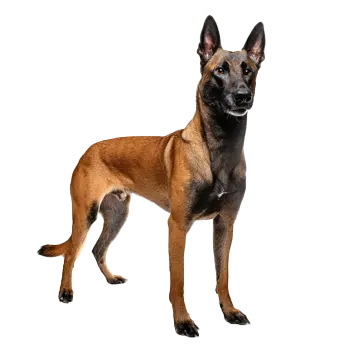
The first thing most people notice about a Mali is the intensity in its eyes. Before you register the athletic frame or the rich fawn coat, those dark, almond-shaped eyes lock onto you with a focus that feels deliberate. They radiate attentiveness and readiness, reflecting a brain that is always processing, always scanning. The black rims around the eyes contribute to the sharpness of the expression, and the overall effect is a dog that looks permanently switched on.

The head is long without being heavy, cleanly chiseled with flat cheeks and a moderate stop between the skull and the muzzle. The muzzle tapers slightly but carries enough depth to provide a powerful bite. The nose is solid black with no discolored areas. The ears sit high on the skull, triangular and stiffly erect, adding to the alert silhouette that defines the breed. When a Mali turns its head to track movement, those ears pivot like radar dishes, capturing sound from every direction.

The body is built for sustained athletic performance. Square in proportion, the Mali stands as tall at the withers as it is long from the point of the shoulder to the rear point of the pelvis. The chest reaches down to the elbow, providing ample lung capacity for endurance work. The topline is firm and level from withers to croup, with a slight slope toward the hindquarters. The loin is solid and well muscled. There is no bulk here, no heaviness. Every line suggests speed, agility, and controlled power. The Mali looks like what it is: a dog designed to work all day and still have something left in reserve.

The forequarters feature moderately sloping shoulders that allow a long, reaching stride. The legs are straight with oval bone, presenting a clean, athletic profile from every angle. The pasterns are short and slightly sloped, acting as shock absorbers during high-impact activities. The hindquarters provide the propulsive force, with well-muscled thighs and relatively sharp hock angles that drive the dog forward with efficiency. The feet are round and tight, with thick pads built for varied terrain.

The coat is one of the breed's most practical features. Short, straight, and hard enough to repel weather, it lies flat against the body and requires minimal maintenance compared to the long-coated Belgian varieties. The hair is very short on the head, ears, and lower legs, growing slightly longer around the neck where it forms a subtle collarette, and on the tail and backs of the thighs. The undercoat is dense enough to provide insulation without adding bulk. The ideal color is rich fawn to mahogany with black-tipped guard hairs that create a characteristic overlay, darkest on the shoulders and back in mature males.

The black mask is one of the breed's most recognizable features. It covers the muzzle, lips, corners of the mouth, and eyelids in a single pronounced zone of dark pigment that gives the face a sharp, defined appearance. Combined with the erect ears and dark eyes, the mask creates an expression of focused intelligence that distinguishes the Mali from breeds of similar size and build. The tail is strong at the base, reaching to the hock, and is carried in a gentle curve during movement without hooking or deviating to one side.

In motion, the Mali is efficient and tireless. The gait is steady, balanced, and powerful, with the hindquarters generating strong rear drive that transmits smoothly through the loin to reaching forequarters. At a trot, the feet converge toward the centerline, and the overall impression is of a dog that could cover ground at this pace indefinitely. There is nothing wasted in the movement, no paddling, no rolling, no inefficiency. Watching a Mali move at speed is watching a purpose-built machine operate exactly as intended.

Affectionate With Family
The Mali bonds deeply with its household and craves constant contact with its people. This is a dog that will follow you from room to room and position itself wherever you are.
Good With Young Children
Malis can coexist well with children in homes where the dog has been properly socialized, though their herding instinct may trigger nipping or chasing behaviors that require management.
Good With Other Dogs
Same-sex aggression and resource guarding can surface in Malis who have not been extensively socialized with other dogs from a young age.
Shedding Level
Malis shed consistently throughout the year and blow their undercoat heavily twice annually, leaving fur on furniture, clothing, and every surface imaginable.
Coat Grooming Frequency
The short double coat requires only weekly brushing under normal conditions, stepping up to daily sessions during seasonal coat blows.
Drooling Level
Malis are a clean-mouthed breed with virtually no drooling under normal circumstances.
Coat Type
The outer coat is short, straight, and weather-resistant, lying close to the body with a dense undercoat that provides insulation in cold and heat.
Openness To Strangers
Most Malis are naturally reserved with unfamiliar people, watching and assessing before deciding whether engagement is warranted.
Playfulness Level
Play for a Mali is intense and purposeful. They thrive on interactive games that challenge their mind and body, from tug to fetch to structured search games.
Watchdog/Protective Nature
The Mali is among the most naturally vigilant breeds alive. They track movement, monitor sounds, and respond to perceived threats with speed and conviction.
Adaptability Level
Malis can adapt to various environments if their exercise and mental stimulation needs are met, but they struggle in sedentary households or confined spaces without outlets.
Trainability Level
Few breeds match the Mali in trainability. They learn rapidly, retain complex commands, and perform with intensity when paired with a skilled handler who uses reward-based methods.

Mali History & Development

The story of the Mali nickname begins not in the pastoral fields of 19th-century Belgium but in the training compounds, military bases, and law enforcement kennels of the late 20th and early 21st centuries. The Belgian Malinois existed as a herding breed for over a hundred years before the shortened name entered common use. Understanding how Mali became the preferred shorthand requires tracing the breed's journey from livestock guardian to the world's most sought-after working dog.

The Belgian Malinois originated in the region surrounding the city of Malines, where local shepherds selectively bred short-coated herding dogs for responsiveness, stamina, and keen intelligence. In 1891, Belgian veterinarian Adolphe Reul gathered over a hundred Belgian sheepdogs to evaluate and classify them. The Malinois variety was among the first to breed true to type, becoming so dominant that other Belgian Shepherd varieties were sometimes grouped under the label of simply not being Malinois. The breed's reputation for consistency and working drive was established before any formal kennel club recognized it.

The American Kennel Club initially registered all Belgian Shepherds as a single breed beginning in 1911, but it was not until 1959 that the Malinois received separate breed recognition. For decades after, the breed remained relatively unknown outside specialized working circles. German Shepherd Dogs dominated police and military roles in the United States, and the Malinois was a niche choice known mainly to herding enthusiasts and European working-dog competitors.

The shift began in the 1990s and accelerated dramatically after 2001. Law enforcement agencies and military units discovered that Belgian Malinois offered advantages in detection, apprehension, and patrol work. Their lighter frame, explosive speed, and relentless drive made them ideal candidates for tasks requiring agility and stamina in demanding environments. As the breed's presence in professional working roles grew, so did the casual shorthand. Handlers who worked alongside these dogs daily needed something quicker than the full breed name. Mali stuck.

The nickname gained massive public traction in 2011 when reports confirmed that a Belgian Malinois named Cairo was part of the Navy SEAL team that conducted the operation against Osama bin Laden. Suddenly, the breed was international news, and Mali became the name everyone was searching. The word carried weight because it came from the people who worked with these dogs under the most extreme conditions imaginable. It was not coined by marketers or breeders looking to sell puppies. It emerged organically from operational use and spread through military and law enforcement culture into the broader public consciousness. That single event did more to cement the Mali nickname than decades of breed club activity or show ring appearances ever could.

Today, Mali functions as both a nickname and a cultural signal. When someone says they have a Mali, they are communicating more than just a breed choice. They are signaling an awareness of what the dog demands and what it can deliver. The name is used interchangeably with Malinois and Mal in training communities, social media groups, and breed-specific forums. Its brevity mirrors the breed's own economy of movement. Nothing wasted, nothing extra, straight to the point.

Mali Temperament & Personality

Living with a Mali means living with a dog whose brain never fully powers down. This is not a breed that lounges through the afternoon and perks up for dinner. The Belgian Malinois operates at a baseline level of alertness that most other breeds reach only in moments of genuine excitement. They watch doors, track movement across rooms, register the sound of a car pulling into the driveway three houses away, and file all of it for future reference. For the right owner, this intensity is captivating. For the wrong one, it is overwhelming.

The Mali bonds with ferocious loyalty, typically forming its strongest attachment to one person while remaining affectionate with the rest of the household. This primary bond is not casual. The dog wants to be where its person is, doing whatever its person is doing. If you work in the yard, the Mali works in the yard. If you sit at a desk, the Mali positions itself where it can monitor both you and the nearest entrance. This attachment, combined with the breed's protective instincts, creates a dog that is always on duty. The Mali does not distinguish between work time and off time because, in its mind, there is no off time.

Intelligence in a Mali is not the eager-to-please variety that makes Golden Retrievers so popular with first-time owners. It is sharper, more demanding, and more likely to test boundaries. The Mali learns commands with startling speed, often after just a few repetitions, but it also learns how to manipulate situations to its advantage. A bored Mali will systematically dismantle its environment, not out of spite, but because its brain requires constant occupation. Owners who fail to provide structured mental challenges will find that the dog creates its own, and those self-assigned projects rarely align with household expectations.

Stranger wariness is hardwired into the breed's temperament. The Mali does not rush to greet unfamiliar people with wagging enthusiasm. Instead, it assesses, watches body language, and decides whether the person represents a threat, a neutral presence, or someone its handler has sanctioned. This reserve makes the breed exceptional in protection and patrol work, but it also means that early and extensive socialization is non-negotiable. A Mali that has not been properly exposed to a wide range of people, environments, and situations during its critical developmental period can become reactive or genuinely aggressive in contexts that a well-socialized dog would navigate calmly.

Prey drive in the Mali runs high, and it manifests in ways that go beyond simple interest in squirrels. This is a dog that will lock onto movement with laser focus, whether the target is a ball, a running child, a cyclist, or a cat crossing the yard. Managing prey drive requires understanding it, not suppressing it. The best Mali owners channel this drive into structured activities like bite work, detection training, or competitive obedience, giving the dog legitimate outlets for impulses that will express themselves regardless of whether an outlet exists. When needs go unmet, the consequences are predictable. Destructive behavior, excessive vocalization, compulsive spinning or pacing, and redirected aggression toward household members or other pets can all surface in a Mali whose physical and psychological requirements are being ignored.

Mali Family Life & Living Requirements

Bringing a Mali into a family is a decision that should be made with the same seriousness as any other major life commitment. This breed reshapes daily routines, demands active involvement from everyone in the household, and does not tolerate being treated as background. The Mali is not a dog that will quietly integrate into an existing lifestyle. The lifestyle integrates around the dog, or the arrangement fails.

Families with older children who understand how to interact respectfully with a high-drive dog can find the Mali to be a loyal and protective companion. The breed's herding instinct means it may attempt to chase or nip at running children, especially during the first few years. This behavior is not aggression but a hardwired response that requires consistent redirection. Families with toddlers or very young children should think carefully before choosing this breed, as the combination of the Mali's intensity and a small child's unpredictable movements creates management challenges that even experienced handlers find demanding.

The Mali needs space, but not necessarily acreage. A securely fenced yard is important because this breed can clear a standard four-foot fence without breaking stride, and a determined Mali will find weaknesses in fencing that other dogs would never notice. Underground electronic fences are inadequate. The dog's drive will override any shock deterrent. Physical barriers of at least six feet, inspected regularly for signs of digging or wear, are the minimum. That said, the yard alone is not enough. A Mali left in even a large yard without human interaction will become frustrated, vocal, and destructive.

Indoor living arrangements should account for the breed's need to be near its people. The Mali is emphatically not a kennel dog and should not be housed outside or isolated from the family. It needs a place in the household where it can observe daily activity while maintaining its role as a participant rather than an outsider. Crate training is valuable for managing the dog during unsupervised periods, especially during adolescence when destructive tendencies peak, but the crate should be a management tool, not a default storage solution.

Other pets in the household require careful consideration. A Mali raised alongside cats or smaller dogs from puppyhood may coexist peacefully, but introductions with new animals should always be supervised and gradual. The breed's prey drive and same-sex aggression tendencies mean that peaceful coexistence is possible but never guaranteed. Multi-dog households work best when the Mali's exercise and stimulation needs are fully met before interactions with other animals, reducing the likelihood of redirected frustration.

Mali Training & Exercise Needs

Training a Mali is not a weekend project or a six-week puppy class. It is an ongoing, daily practice that begins the moment the dog enters your home and continues throughout its life. The Belgian Malinois was bred to work in partnership with a human handler, and training is how that partnership is built and maintained. A Mali without training is not simply an untrained dog. It is a highly capable animal with no direction, and the results of that combination can be genuinely problematic.

Positive reinforcement forms the foundation of effective Mali training. The breed is sensitive to corrections and will shut down or become defensive under harsh handling. Reward-based methods using food, toys, and play produce a dog that works with enthusiasm and confidence. The Mali's intelligence means it picks up new behaviors with remarkable speed, often grasping complex chains of commands within a few sessions. However, that same intelligence can lead to anticipation errors, where the dog begins performing the next expected behavior before the handler gives the cue. Precision in communication matters enormously with this breed.

Socialization is the single most important investment you will make in a Mali's first year. The window between eight and sixteen weeks is critical, but socialization should continue well beyond that period. Exposing the dog to different people, surfaces, sounds, environments, animals, and situations teaches it to process novel stimuli without defaulting to fear or aggression. A well-socialized Mali is confident and discerning. A poorly socialized Mali is a liability. There is no middle ground with this breed on this point.

Exercise requirements are substantial and non-negotiable. A healthy adult Mali needs a minimum of ninety minutes of vigorous physical activity per day, and most will benefit from significantly more. This does not mean a leisurely stroll around the neighborhood. The Mali needs activities that engage both its body and its brain. Running, hiking, swimming, structured fetch sessions, agility courses, bite work, tracking exercises, and competitive obedience all serve this purpose. The breed excels in virtually every dog sport, including herding trials, French Ring, Belgian Ring, Schutzhund, and detection work. Without adequate physical outlets, the Mali's energy turns inward and expresses itself through increasingly creative forms of destruction.

Mental stimulation deserves equal emphasis. Puzzle feeders, scent work, obedience drills with escalating complexity, and training sessions that require the dog to think through problems all serve to tire the Mali's brain. A physically exhausted Mali with an understimulated mind will still find ways to create chaos. The goal is a dog that is satisfied on both fronts, and achieving that requires daily investment from an owner who genuinely enjoys the process.

Mali Health Concerns

The Belgian Malinois is generally regarded as a hardy, athletic breed with a life expectancy of 12 to 14 years, but it carries several breed-specific health concerns that responsible owners and breeders must address through screening, awareness, and proactive veterinary care. Health testing before breeding is not a formality for this breed. It is the primary mechanism by which serious conditions are kept in check.

Progressive retinal atrophy causes gradual degeneration of the photoreceptor cells in the retina, leading to progressive vision loss and eventual blindness. Cataracts and pannus are additional ocular conditions documented in the breed. Annual eye examinations by a board-certified veterinary ophthalmologist are part of the CHIC protocol and represent the best early detection strategy. Hemangiosarcoma, a malignant cancer of the blood vessel lining that frequently targets the spleen, liver, or heart, is another serious concern flagged by the ABMC. This cancer is aggressive, often diagnosed late, and carries a poor prognosis. Bloat, or gastric dilatation-volvulus, poses an emergency risk for the Mali's deep-chested body type. The stomach fills with gas and can twist on itself, cutting off blood supply. Without immediate veterinary intervention, bloat is fatal. Preventive measures include feeding smaller, more frequent meals and avoiding vigorous exercise immediately after eating.

Common Health Issues

  • Hip dysplasia is an inherited malformation of the hip joint where the femoral head does not seat properly in the acetabulum - Resulting in joint laxity, chronic pain, and progressive osteoarthritis that can significantly limit mobility in affected dogs.
  • Elbow dysplasia encompasses several developmental abnormalities of the elbow joint - Including fragmented coronoid process and ununited anconeal process, causing forelimb lameness that typically worsens with exercise and age.
  • Epilepsy presents as recurrent seizures of unknown origin - Usually first appearing between six months and five years of age, requiring lifelong management with anticonvulsant medication and removal of affected dogs from breeding programs.
  • Progressive retinal atrophy is a hereditary degenerative condition affecting the photoreceptor cells of the retina - Leading to gradual loss of night vision followed by complete blindness with no available cure.
  • Cataracts involve progressive clouding of the eye lens - Reducing visual clarity and potentially leading to complete vision loss if left untreated, though surgical removal can restore sight when performed early.
  • Hemangiosarcoma is an aggressive malignant tumor of the blood vessel lining - Most commonly affecting the spleen, liver, or heart, often presenting with few symptoms until the tumor ruptures and causes life-threatening internal bleeding.
  • Gastric dilatation-volvulus is a life-threatening emergency in which the stomach distends with gas and rotates on its axis - Cutting off blood supply to the stomach and spleen and requiring immediate surgical intervention to survive.

Preventive Care & Health Monitoring

  • OFA or PennHIP radiographic evaluation of the hips should be performed on all breeding stock to screen for hip dysplasia - With results submitted to public databases so that buyers can verify parental clearances before purchasing a puppy.
  • OFA elbow evaluation is a required CHIC test for the breed - Screening for developmental joint abnormalities that cause forelimb lameness and arthritis in affected dogs.
  • Annual eye examinations by a board-certified veterinary ophthalmologist - With results registered through OFA, screen for progressive retinal atrophy, cataracts, and pannus, all of which are documented in the breed.
  • Thyroid panel testing should be discussed with your veterinarian - As hypothyroidism has been identified in the breed and can cause weight gain, coat changes, and lethargy that mimic other conditions.
  • Cardiac screening is recommended by the ABMC - Particularly given the breed's susceptibility to hemangiosarcoma affecting the heart, with baseline echocardiograms providing valuable reference data for future comparison.
  • Feeding smaller - More frequent meals and avoiding strenuous exercise within an hour of eating are practical measures to reduce the risk of bloat in this deep-chested breed.

Mali Grooming & Maintenance

The Mali's grooming requirements are refreshingly straightforward compared to its training and exercise demands. The short, weather-resistant double coat is one of the most practical features of the breed, requiring regular but minimal maintenance to keep it healthy and functional. This is not a breed that needs professional grooming appointments or elaborate coat care routines. What it does need is consistent, basic upkeep that prevents minor issues from becoming significant ones.

Weekly brushing with a firm bristle brush or rubber grooming mitt removes loose hair, distributes natural skin oils, and allows you to inspect the coat and skin for any irregularities. During the twice-annual coat blow, when the dense undercoat sheds out in clumps, daily brushing becomes necessary to manage the volume of loose fur. An undercoat rake is the most effective tool during these periods, pulling out dead undercoat without damaging the protective guard hairs. Even with diligent brushing during shedding season, expect to find Mali hair on your furniture, clothing, vehicle seats, and in places you did not think hair could reach.

Bathing should be infrequent and only when the dog is genuinely dirty or has developed an odor. Over-bathing strips the natural oils from the coat and skin, compromising the water-resistant properties that the double coat is designed to provide. When bathing is necessary, a mild dog-specific shampoo followed by thorough rinsing and drying is sufficient. The Mali's coat dries relatively quickly compared to longer-coated breeds, but toweling and air drying in a warm environment prevent any lingering dampness that could lead to skin irritation.

Nail care, ear cleaning, and dental hygiene round out the Mali's maintenance needs. Nails should be trimmed regularly, typically every two to three weeks, to prevent overgrowth that can alter the dog's gait and cause discomfort. The erect ears allow good air circulation and are less prone to infections than drop ears, but weekly inspection and cleaning with a veterinarian-approved ear cleaner prevent wax buildup and catch early signs of trouble. Dental care is often overlooked in working breeds but matters significantly over a 12-to-14-year lifespan. Brushing the teeth several times per week with an enzymatic dog toothpaste, combined with appropriate dental chews, reduces tartar accumulation and the risk of periodontal disease that can affect overall health.