Chien De Berger Belge Malinois

Belgian Malinois

Quick Facts

🐕 Breed Group
Herding Group (AKC); FCI Group 1 - Sheepdogs and Cattle Dogs
📏 Size Category
Large
📏 Height
Males: 24-26 inches, Females: 22-24 inches
⚖️ Weight
Males: 60-80 pounds, Females: 40-60 pounds
⏱️ Life Expectancy
14-16 years
🧣 Coat Type
Short, straight, hard double coat with dense undercoat
🎨 Coat Colors
Fawn to mahogany with black mask and black ear tips; black overlay (charcoaling)
😀 Temperament
Confident, intelligent, driven, loyal, alert, protective, intense
🏃 Exercise Needs
Very High
🎓 Training Difficulty
Moderate - highly trainable but demands experienced handler
👶 Good with Children
Conditional - best with older children in active, experienced households
🐾 Good with Other Pets
Conditional - can coexist with socialization; strong prey and herding drives

Other Names & Breed Recognition

Chien De Berger Belge Malinois is the full French designation for the breed known in English-speaking countries as the Belgian Malinois. The name translates directly as Belgian Shepherd Dog Malinois, identifying both the breed's national origin and its specific variety within the Belgian Shepherd family. Under the Federation Cynologique Internationale classification system, which governs breed standards in most countries outside North America, the Malinois is not a separate breed but rather the short-coated, fawn variety of a single breed called the Chien de Berger Belge, or Belgian Shepherd Dog. This single-breed classification groups the Malinois alongside three other coat varieties: the Groenendael (long-haired black), the Tervuren (long-haired fawn), and the Laekenois (rough-coated fawn).

The name Malinois derives from Malines, the French name for the Belgian city of Mechelen, where this particular variety was most consistently bred by working shepherds during the late 19th century. The city lent its name to the dog, and that name traveled with the breed as it expanded from Belgian pastoral fields to police units, military installations, and eventually private homes worldwide. In Dutch, the breed is called Mechelse Herder or Mechelaar, both referencing the same city of Mechelen. Additional informal designations include Mal, Mals, and Mali, shortened forms widely used by handlers, military personnel, and breed enthusiasts in everyday conversation.

In the United States and Canada, the classification structure differs significantly from the FCI approach. The AKC initially registered all Belgian Shepherd varieties together beginning in 1911, but in 1959 separated them into independent breeds: the Belgian Malinois, the Belgian Sheepdog (Groenendael), and the Belgian Tervuren. The fourth variety, the Laekenois, achieved full AKC recognition as the Belgian Laekenois in 2020. This separation means that American and European breeders may be discussing the exact same dog while operating under fundamentally different registry frameworks, a distinction that has practical implications for international breeding, competition, and registration.

The Belgian Malinois is formally recognized by every major international kennel club, though under varying names and classification structures. The AKC places the breed in the Herding Group. The UKC classifies it in the Herding Dog Group. The FCI assigns it to Group 1, Section 1, among Sheepdogs. The Kennel Club in the United Kingdom places it in the Pastoral Group. If you encounter the designation Chien De Berger Belge Malinois in an FCI document, a European pedigree, or international breed literature, you are looking at the same short-coated, fawn, black-masked working dog that English speakers call the Belgian Malinois.

Chien De Berger Belge Malinois Organizations & Standards

The American Belgian Malinois Club serves as the AKC parent club for the breed in the United States, maintaining the official breed standard, promoting responsible breeding through its Code of Ethics, publishing health research through its health committee, and supporting rescue operations for Belgian Malinois in need of rehoming. The club coordinates specialty shows, obedience trials, and working dog events that showcase the breed's versatility across multiple disciplines. In Belgium, the breed falls under the oversight of the Societe Royale Saint-Hubert, the national kennel club, which maintains the FCI breed standard and coordinates breeding programs that emphasize the breed's working heritage.

The AKC breed standard describes the Belgian Malinois as a well-balanced, square dog that is elegant in appearance, with an alert and proud carriage of the head and neck. The standard specifies height at the withers of 24 to 26 inches for males and 22 to 24 inches for females, with weight proportionate to height, typically 60 to 80 pounds for males and 40 to 60 pounds for females. The standard emphasizes the breed's moderate bone structure, functional musculature, and efficient movement, calling for a dog that appears capable of sustained physical work without the heaviness or bulk associated with guarding breeds. The fawn to mahogany coat with black mask, black ear tips, and black overlay is the only acceptable color pattern.

The CHIC health screening protocol for the Belgian Malinois requires hip dysplasia evaluation through the OFA and recommends elbow evaluation, ACVO eye examination, thyroid panel, and cardiac evaluation. These screenings address the breed's primary hereditary health vulnerabilities and provide prospective buyers with objective data about the genetic and orthopedic status of breeding stock. The American Belgian Malinois Club actively supports health research and maintains a database of health testing results that helps breeders make informed mating decisions.

The FCI standard, which uses the full designation Chien de Berger Belge and treats the Malinois as a variety rather than a separate breed, places particular emphasis on the breed's working character and functional construction. The FCI standard describes the ideal Belgian Shepherd as a dog that is attentive, active, and always ready for action, with the stamina and drive to work tirelessly in demanding conditions. The standard's detailed description of the Malinois variety specifies the short, hard coat with rich fawn coloration, black charcoaling, and the distinctive black mask that frames an alert, intelligent expression.

Kennel Club Recognition

  • American Kennel Club (AKC): Recognized in 1959, Herding Group
  • United Kennel Club (UKC): Recognized, Herding Dog Group
  • Canadian Kennel Club (CKC): Recognized, Herding Dogs
  • FCI: Recognized, Group 1 - Sheepdogs and Cattle Dogs
  • The Kennel Club (UK): Recognized, Pastoral

Chien De Berger Belge Malinois Physical Description

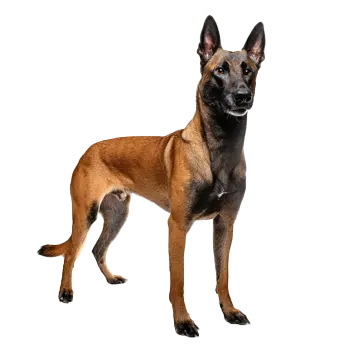
The Chien De Berger Belge Malinois is a medium-to-large breed of elegant, athletic build whose physical structure communicates speed, agility, and sustained working capability. Males stand 24 to 26 inches at the shoulder and weigh 60 to 80 pounds, while females stand 22 to 24 inches and weigh 40 to 60 pounds. The breed's proportions are deliberately square, with the body length from point of shoulder to point of buttock approximately equal to the height at the withers. The Malinois appears lighter and more agile than the German Shepherd Dog, with a higher head carriage, more upright posture, and leaner overall build that reflects its selection for explosive speed and athletic versatility rather than sustained trotting endurance.

The head is clean-cut and strong, proportionate to the body, with a slightly flattened skull and a moderate stop. The muzzle is approximately equal in length to the skull, tapering slightly to a strong jaw that houses a complete set of teeth in a scissors bite. The eyes are medium-sized, almond-shaped, and dark brown, conveying an expression of alertness, intelligence, and intense focus that is one of the breed's most distinctive features. The ears are stiff, erect, and triangular, set high on the skull and proportionate to the head. The neck is round, muscular, and carried with a proud, upright carriage that gives the Malinois its characteristic alert, ready-for-action appearance.

The coat is the primary feature that distinguishes the Malinois from the other Belgian Shepherd varieties. It is short, straight, and hard, lying close to the body with a dense undercoat that provides weather protection. The coat is slightly longer around the neck, where it forms a modest collar, and on the tail and backs of the thighs. The color ranges from rich fawn to dark mahogany, with black charcoaling on the tips of the hair that gives the coat its characteristic overlay. The black mask covers the muzzle and extends around the eyes and onto the ears, and the ear tips are black. The combination of warm fawn undercolor with black overlay and mask produces the breed's striking, immediately recognizable appearance.

The Malinois moves with a smooth, effortless gait that covers ground efficiently at any speed, from a measured walk to a driving gallop. The breed's movement at the trot should show reach in front and drive from behind, with the topline remaining firm and level. At higher speeds, the Malinois displays the explosive acceleration and agile directional changes that make it the dominant breed in professional protection sports and tactical operations. The overall impression of a well-conditioned Malinois in motion is one of controlled power, athletic precision, and an eagerness to work that is visible in every stride.

Affectionate With Family
The Chien De Berger Belge Malinois bonds intensely with its family and shows genuine devotion to the people it considers its own. This attachment is deep and handler-focused, with the breed often forming a particularly strong connection to the person who trains and works it most consistently. The Malinois expresses affection through physical proximity, eager responsiveness, and a constant orientation toward its handler's movements and emotional state. This is not a breed that distributes its attention casually; its loyalty is concentrated and purposeful.
Good With Young Children
The Chien De Berger Belge Malinois is not ideally suited to households with young children due to its intense energy, strong herding instincts, and tendency to nip at heels and chase moving targets. The breed's drive levels are simply too high for the unpredictable environment that small children create, and its herding behaviors can frighten or injure a child even without aggressive intent. Families with older, dog-savvy children who understand boundaries may find the Malinois a loyal and protective companion, but the breed's needs and behaviors make it a poor match for typical young-child households.
Good With Other Dogs
The Chien De Berger Belge Malinois can coexist with other dogs when properly socialized from an early age, though its confidence, intensity, and competitive drive can create tension in multi-dog settings. The breed is not typically aggressive toward other dogs without provocation, but its assertive body language and high energy level can be misread by calmer breeds, leading to friction. Same-sex pairings require careful management. The breed generally does best with a confident, equally active canine companion that can match its energy without competing for dominance.
Shedding Level
The Chien De Berger Belge Malinois sheds moderately throughout the year, with increased shedding during the biannual coat blow in spring and fall when the dense undercoat is released. During these seasonal events, daily brushing is advisable to manage the significant volume of loose undercoat. Outside of shedding season, weekly brushing keeps loose hair at manageable levels. The breed's short coat does not produce the dramatic hair accumulation of longer-coated breeds, but owners should expect a steady presence of dog hair on clothing and furniture.
Coat Grooming Frequency
The Chien De Berger Belge Malinois requires minimal coat maintenance, making it one of the more practical working breeds from a grooming perspective. Weekly brushing with a bristle brush or grooming mitt removes loose hair and maintains coat health under normal conditions. During the biannual coat blow, more frequent brushing with an undercoat rake is needed. Bathing is required only occasionally. The breed needs no professional grooming, clipping, or trimming, and its functional coat was designed for practicality in the field rather than aesthetic maintenance.
Drooling Level
The Chien De Berger Belge Malinois is a clean, low-drool breed with tight lips and a neat mouth structure that produces virtually no excess saliva. Owners will not encounter wet spots on furniture, clothing, or floors from drooling. This tidy quality makes the breed a practical household companion from a cleanliness perspective, and the clean mouth is an advantage in working roles where the dog handles equipment, apprehends suspects, or works in close proximity to handlers.
Coat Type
The Chien De Berger Belge Malinois has a short, straight, hard outer coat with a dense undercoat that provides weather protection without the maintenance demands of the longer-coated Belgian Shepherd varieties. The coat lies close to the body, is slightly longer around the neck where it forms a modest collar, and is shortest on the head, ears, and lower legs. The fawn to mahogany base color with black overlay, black mask, and black ear tips creates the breed's distinctive appearance. The coat is functional and practical, designed for a dog that works hard in all weather conditions.
Openness To Strangers
The Chien De Berger Belge Malinois is naturally reserved with unfamiliar people, maintaining an alert, assessing posture that reflects its protective instincts and discriminating temperament. The breed does not rush to greet strangers and may position itself between its handler and an approaching person until the situation has been evaluated. This reserve is a breed characteristic rather than a socialization failure, though inadequate socialization can tip natural wariness into genuine aggression. Well-socialized Malinois accept new people calmly once their handler signals approval.
Playfulness Level
The Chien De Berger Belge Malinois is among the most intensely playful of all breeds, bringing explosive energy, competitive drive, and tireless enthusiasm to every play interaction. The breed's play is not casual but rather purposeful and intense, driven by the same work ethic that makes it excel in professional service roles. Tug-of-war, fetch, chase games, and interactive toys are all pursued with a ferocity that can surprise owners unfamiliar with the breed's intensity. This high play drive is a significant training asset, as play rewards are often more motivating than food for the Malinois.
Watchdog/Protective Nature
The Chien De Berger Belge Malinois is one of the most effective protection and watchdog breeds in existence, combining acute sensory awareness, fearless confidence, physical capability, and a deep-seated protective instinct. The breed's dominance in military and law enforcement roles worldwide reflects its exceptional combination of alertness, trainability, courage, and controlled aggression. In a domestic setting, the Malinois provides formidable home security through its natural territorial awareness, commanding bark, and willingness to physically confront threats when its family is endangered.
Adaptability Level
The Chien De Berger Belge Malinois adapts to various living situations provided its substantial exercise and mental stimulation needs are met, but its intense drive and energy level impose real constraints on the environments where it can thrive. The breed can live in an apartment if given multiple daily exercise sessions, but a home with a yard and regular access to training facilities or open exercise areas is far more practical. The Malinois adapts exceptionally well to varied working environments, climates, and operational demands, reflecting its versatility as a professional service dog.
Trainability Level
The Chien De Berger Belge Malinois is one of the most trainable breeds in existence, combining exceptional intelligence, intense drive to work, strong desire to partner with its handler, and a learning speed that consistently outpaces other breeds in head-to-head comparisons. The breed excels across the full spectrum of training disciplines including obedience, protection, detection, tracking, agility, and specialized military and law enforcement tasks. The Malinois's trainability is not passive compliance but rather an active, eager engagement with the training process that produces exceptional results with experienced handlers.

Chien De Berger Belge Malinois History & Development

The Belgian Malinois emerged as a distinct variety of Belgian Shepherd Dog during the late 19th century, when Belgian veterinarian Professor Adolphe Reul undertook a systematic survey of the country's native herding dogs. In 1891, Reul examined 117 specimens at a gathering organized by the Belgian Shepherd Dog Club and identified four distinct coat varieties among dogs that were otherwise similar in structure and temperament. The short-coated fawn dogs that predominated around the city of Malines (Mechelen) became the Malinois variety, while dogs from other regions gave their names to the Groenendael, Tervuren, and Laekenois varieties. The first breed standard was written in 1892, establishing the framework that would guide the breed's development into the 20th century.

The Malinois's transition from pastoral sheepdog to professional working dog began earlier and more aggressively than for any other herding breed. Belgian police forces began experimenting with trained patrol dogs in the 1890s, and the Malinois quickly distinguished itself through its combination of trainability, drive, courage, and physical capability. By the early 1900s, Belgian Malinois were serving in police departments across Belgium and were beginning to attract attention from law enforcement agencies in France, Germany, and eventually the United States. The breed's performance in working dog competitions, particularly the French Ring Sport and Belgian Ring Sport programs, further cemented its reputation as the premier working dog of continental Europe.

The two World Wars disrupted Belgian Malinois breeding programs but also demonstrated the breed's value in military service, where it served as a messenger dog, sentry dog, and general utility working dog in conditions that tested its courage and resilience. The breed's population recovered steadily after World War II, with working-line breeders maintaining intense selection for drive, trainability, and physical soundness while show-line breeders focused on conformation and temperament balance. The AKC separated the Belgian Shepherd varieties into distinct breeds in 1959, giving the Belgian Malinois its own breed designation and Herding Group classification in the American registry.

The Belgian Malinois's ascendancy to the dominant position in professional working dog service occurred gradually through the late 20th century and accelerated dramatically in the early 21st century. As the German Shepherd Dog's working capability declined in many lines due to structural exaggerations and temperament softening in show breeding programs, military and law enforcement agencies increasingly turned to the Malinois as a superior alternative. Today, the Belgian Malinois is the overwhelmingly preferred breed for military special operations, elite law enforcement units, and competitive protection sports worldwide. The breed's most famous moment in public consciousness came in 2011 when a Belgian Malinois named Cairo accompanied SEAL Team Six on the mission that located and eliminated Osama bin Laden.

Chien De Berger Belge Malinois Temperament & Personality

The Chien De Berger Belge Malinois possesses one of the most intense and demanding temperaments in the entire canine world. The breed was selected for generations specifically for high drive, explosive energy, fearless courage, and an almost obsessive desire to work, producing a dog whose psychological needs far exceed what most pet owners are equipped to provide. This is not a breed that can be adequately described by conventional temperament labels like friendly, calm, or easygoing. The Malinois operates at an intensity level that is closer to a finely tuned performance athlete than a typical companion dog, and understanding this fundamental characteristic is essential for anyone considering the breed.

The breed's intelligence is exceptional and manifests as rapid learning, creative problem-solving, and an ability to read its handler's body language and emotional state with remarkable accuracy. This cognitive capability makes the Malinois extraordinarily trainable in the hands of an experienced handler but also means the dog is constantly processing its environment, seeking stimulation, and making behavioral decisions based on its own assessment of situations. A Malinois that is not given adequate mental engagement will create its own entertainment, and its choices frequently involve destructive behavior, obsessive-compulsive repetitive behaviors, or redirected drive that manifests as nipping, mouthing, and excessive reactivity.

The breed's protective instincts are powerful, deeply ingrained, and always active. The Malinois maintains a constant awareness of its surroundings, evaluating every person, animal, sound, and movement for potential threat relevance. This vigilance makes the breed an exceptional watchdog and personal protection companion but also means that inadequate socialization can produce a dog that is genuinely dangerous to visitors, delivery personnel, and passersby. The distinction between a well-socialized Malinois that responds appropriately to genuine threats and a poorly socialized Malinois that treats every unfamiliar stimulus as a danger is primarily a function of the quality and consistency of its upbringing rather than an inherent temperament divide.

Within its family, the Malinois is deeply loyal, emotionally attuned, and genuinely affectionate, though its expression of these qualities differs markedly from softer breeds. The breed's affection is shown through constant readiness to work, eager responsiveness to its handler's cues, and a physical presence that is always oriented toward the family member it considers its primary partner. The Malinois does not love passively; it loves actively, through engagement, cooperation, and an intense desire to participate in everything its person does.

Chien De Berger Belge Malinois Family Life & Living Requirements

The Chien De Berger Belge Malinois is a breed that imposes significant lifestyle requirements on its owners, and prospective families must honestly assess whether they can meet these demands before acquiring a dog. The breed requires a minimum of 90 to 120 minutes of vigorous daily exercise, and many individuals, particularly those from working lines, need substantially more. This exercise cannot consist solely of walks but must include high-intensity activities such as running, swimming, retrieving, tug-of-war, agility, and structured training sessions that engage both body and mind simultaneously. A backyard, no matter how large, does not substitute for active, interactive exercise with the dog's handler.

The breed is best suited to experienced dog owners who have previous success with high-drive herding or working breeds and who understand the specific management challenges these dogs present. First-time dog owners, families seeking a low-maintenance companion, and households that cannot provide daily structured activity should not consider the Malinois. The breed's intelligence, drive, and intensity require an owner who can function as a calm, confident leader, provide consistent training and boundaries, and engage the dog in meaningful work or sport that channels its considerable energy into constructive outlets.

Households with children require careful consideration. The Malinois's herding instincts produce a strong tendency to chase, nip, and control the movement of running children, behaviors that are instinctive rather than aggressive but that can frighten and injure young kids. Families with older, dog-savvy children who can interact calmly with the dog and who understand the breed's boundaries may find the Malinois a loyal and protective family member. The breed's protective nature extends naturally to family children, and many Malinois display a watchful, guardian-like attention toward the younger members of their household.

The breed adapts to various living situations provided its exercise needs are met, but a home with a securely fenced yard is strongly preferred over apartment living. The Malinois's intense energy, tendency toward vocalization, and need for physical movement make apartment living challenging for both the dog and its neighbors. The breed handles varied climates well, with its short, dense double coat providing adequate insulation in cool weather while allowing efficient heat dissipation in warm conditions.

Chien De Berger Belge Malinois Training & Exercise Needs

The Chien De Berger Belge Malinois is arguably the most trainable breed in existence when handled by an experienced trainer, combining exceptional intelligence, intense work drive, rapid learning speed, and a deep desire to partner with its handler. The breed dominates every major working dog discipline worldwide, from military and law enforcement service to competitive protection sports, detection work, search and rescue, and advanced obedience. This extraordinary trainability is not passive compliance but rather an active, enthusiastic engagement with the training process that produces results exceeding what most other breeds can achieve.

Training should begin on the day of acquisition and continue throughout the dog's life. The Malinois requires structured learning that challenges its intelligence and channels its drive, and the consequences of neglecting training are severe: an untrained Malinois with unsatisfied drives will redirect its considerable energy into destructive, obsessive, and potentially dangerous behaviors. Positive reinforcement methods using toys, play, and food rewards produce excellent results, and many Malinois are more motivated by toy and play rewards than by food, reflecting the breed's intense play drive. Harsh, confrontational training methods are unnecessary and counterproductive with a breed this responsive and sensitive.

Exercise requirements are among the highest of any breed and are non-negotiable. The Malinois needs a minimum of 90 to 120 minutes of vigorous daily activity, ideally distributed across multiple sessions that combine physical exercise with mental challenge. Suitable activities include running, swimming, fetch, tug-of-war, agility, obedience training, nose work, tracking, and structured protection work. The breed excels in virtually every organized canine sport and finds genuine satisfaction in having a job to perform, whether that job is professional service work or recreational competition. Insufficient exercise is the single most common factor behind behavioral problems in the Malinois.

Socialization is a critical training priority that must begin early and continue throughout the dog's life. The Malinois's natural protective instincts and reserve toward strangers require deliberate, controlled exposure to diverse people, environments, animals, and situations to produce a dog that can distinguish genuine threats from normal social interactions. Without adequate socialization, the breed's protective drive can manifest as indiscriminate aggression toward any unfamiliar person or animal, creating a dog that is genuinely dangerous in public settings.

Chien De Berger Belge Malinois Health Concerns

The Chien De Berger Belge Malinois is generally a healthy, physically sound breed that benefits from its strong working heritage and the emphasis that responsible breeders place on functional capability alongside physical correctness. The breed's impressive average lifespan of 14 to 16 years is exceptional for a dog of its size and activity level, reflecting the overall genetic health of a breed that has been selected primarily for working performance rather than aesthetic extremes. However, like all breeds, the Malinois carries certain hereditary predispositions that prospective owners and breeders should understand.

Hip dysplasia is the breed's most significant orthopedic concern, affecting the hip joint's development and potentially leading to progressive pain, lameness, and arthritis. The condition has a hereditary component that is addressed through radiographic screening of breeding stock. Elbow dysplasia, while less common, is also reported and should be screened for in breeding dogs. Maintaining a lean body condition, providing appropriate exercise that avoids excessive stress on developing joints during the growth phase, and monitoring for any signs of lameness are essential management strategies.

Progressive retinal atrophy and other hereditary eye conditions have been reported in the Belgian Malinois at rates that warrant routine ophthalmologic screening. Annual ACVO eye examinations help detect early changes in retinal health, lens clarity, and other ocular parameters before they progress to functional vision impairment. Epilepsy has been documented in the breed with sufficient frequency to suggest a hereditary component, typically presenting as idiopathic seizures in dogs between one and five years of age. The condition is manageable with anticonvulsant medications in most cases.

Degenerative myelopathy, a progressive spinal cord disease caused by a mutation in the SOD1 gene, has been identified in the Belgian Malinois and causes progressive hindlimb weakness and eventual paralysis in affected dogs, typically presenting after eight years of age. A DNA test is available to identify carriers and affected dogs, enabling breeders to make informed mating decisions. Gastric dilatation-volvulus, while not as common in the Malinois as in deeper-chested breeds, remains a risk that warrants standard bloat prevention measures.

Common Health Issues

  • Hip dysplasia - A developmental malformation of the hip joint that can lead to progressive pain, lameness, and arthritis. Hip evaluation is a required CHIC screening for the Belgian Malinois, and prospective buyers should request OFA or PennHIP documentation for both parents of any litter being considered.
  • Elbow dysplasia - A group of developmental elbow joint abnormalities that cause forelimb lameness and progressive arthritis. The condition has a significant hereditary component and is a recommended screening for the Belgian Malinois. Early detection allows timely surgical and medical management.
  • Progressive retinal atrophy (PRA) - A hereditary degenerative eye condition that causes progressive vision loss and eventual blindness. The condition is reported in the Belgian Malinois, and annual ACVO eye examinations help detect early signs. DNA testing may be available for specific PRA variants affecting the breed.
  • Epilepsy - A neurological condition characterized by recurrent seizures that may be idiopathic or secondary to an identifiable cause. Idiopathic epilepsy has been reported in the Belgian Malinois at rates that suggest a hereditary component. The condition is managed with anticonvulsant medications and typically presents between one and five years of age.
  • Gastric dilatation-volvulus (bloat) - A life-threatening emergency in which the stomach distends with gas and may rotate. The Belgian Malinois's deep chest places it at moderate risk. Preventive measures include feeding multiple smaller meals, using slow-feeder bowls, and avoiding exercise around mealtimes.
  • Degenerative myelopathy - A progressive spinal cord disease that causes hindlimb weakness and eventual paralysis, typically presenting in dogs over eight years of age. A DNA test for the SOD1 gene mutation associated with degenerative myelopathy is available and should be performed on breeding stock.

Preventive Care & Health Monitoring

  • OFA hip dysplasia evaluation - A required CHIC screening test. Radiographic evaluation should be performed after 24 months of age, with results registered with the OFA. Prospective buyers should request documentation showing both parents have passing hip evaluations.
  • OFA elbow dysplasia evaluation - A recommended screening test for breeding stock. Radiographic evaluation of both elbows should be performed and results registered with the OFA.
  • Annual ACVO eye examination by a board-certified veterinary ophthalmologist - Recommended to screen for progressive retinal atrophy, cataracts, and other hereditary eye conditions. Results should be registered with the OFA, and breeders should provide current eye clearances for both parents.
  • DNA test for degenerative myelopathy (SOD1 gene) - A recommended screening test that identifies dogs carrying the mutation associated with degenerative myelopathy. Both parents should be tested before breeding to avoid producing affected puppies.
  • Structured exercise program providing minimum 90-120 minutes of vigorous daily activity - The Belgian Malinois requires substantial daily physical and mental exercise to maintain physical fitness, joint health, and psychological well-being. Insufficient exercise contributes to behavioral problems, destructive behavior, and overall decline in quality of life for this high-drive breed.
  • Early and ongoing socialization program - Controlled exposure to diverse people, environments, sounds, animals, and situations beginning in the critical socialization window and continuing throughout the dog's life is essential to producing a Belgian Malinois that can function safely and confidently in domestic and public settings.

Chien De Berger Belge Malinois Grooming & Maintenance

The Chien De Berger Belge Malinois is a low-maintenance breed from a grooming perspective, designed for functional practicality rather than aesthetic upkeep. The short, hard double coat requires only weekly brushing with a bristle brush or grooming mitt to remove loose hair and distribute natural oils across the skin surface. Bathing is needed only occasionally, typically every few months or when the dog becomes visibly dirty from outdoor work or exercise. The breed requires no professional grooming, clipping, or trimming, and its functional coat was developed to withstand the demands of fieldwork without elaborate maintenance.

During the biannual coat blow, when the dense undercoat is released in preparation for seasonal climate changes, grooming demands increase substantially. Daily brushing with an undercoat rake and slicker brush is advisable during these periods, which typically last two to three weeks in spring and fall. The volume of loose undercoat produced during a shedding event can be surprising for first-time Malinois owners, and proactive brushing significantly reduces the amount of hair deposited on furniture, clothing, and floors. Outside of shedding season, the breed's coat maintenance is genuinely minimal.

Nail care requires regular attention, as the Malinois's active lifestyle should naturally wear nails to some degree but may not prevent overgrowth entirely. Nails should be checked and trimmed every two to three weeks. Dental care follows standard recommendations: daily brushing with a canine-specific toothpaste is ideal, with professional cleanings as recommended by your veterinarian. Ear inspection should be performed weekly, with particular attention to any signs of redness, discharge, or odor.

The breed's overall cleanliness is notable: the tight, hard coat does not trap odors or dirt as readily as softer or longer coats, and the Malinois is generally a tidy breed that maintains itself well between grooming sessions. This practical, low-maintenance coat quality was deliberately selected for in a breed expected to work long hours in varied outdoor conditions without the luxury of regular grooming attention. For owners accustomed to the intensive grooming demands of long-coated or elaborate show breeds, the Malinois's simplicity in this regard is a welcome change.