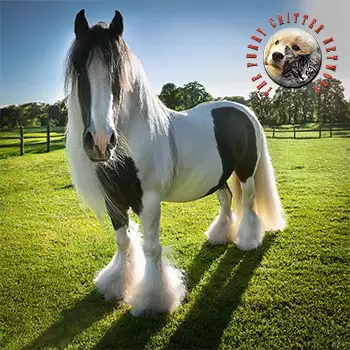

The Gypsy Vanner traces its roots to the Romani and Irish Traveller communities of the British Isles, where it was selectively bred over the course of more than a century. Traveller families needed a horse that could reliably pull the ornately carved living wagons known as vardos across the countryside, sometimes for days at a stretch. The ideal animal had to be strong enough to haul a heavy load, calm enough to stand quietly in camp among children and dogs, and hardy enough to thrive on whatever forage was available along the roadside.
The breed's foundation stock drew from a blend of Shire, Clydesdale, Dales Pony, and Fell Pony bloodlines, among others. Romani breeders were not concerned with formal registries or written pedigrees. Instead, they relied on oral tradition and sharp observational breeding practices passed from one generation to the next. Stallions were chosen for abundant feathering, heavy bone, and an even disposition, while mares were valued for fertility, endurance, and a willingness to work without fuss.
By the mid-twentieth century, the breed had become a distinct and recognizable type, though it remained virtually unknown outside the Traveller community. Horses were traded at traditional fairs such as Appleby and Stow, where deals were sealed with a handshake rather than paperwork. It was not until the 1990s that outsiders began to take serious notice of these striking, heavily feathered horses and efforts to document and formalize the breed gained momentum.
The name itself has evolved over the decades. In the United Kingdom, these horses are most commonly called Gypsy Cobs, while in North America the term Gypsy Vanner became dominant after American enthusiasts Dennis and Cindy Thompson encountered the breed in England in 1996 and began importing foundation stock. Various registries now also use the names Irish Cob and Tinker Horse, depending on the country and the organization involved.