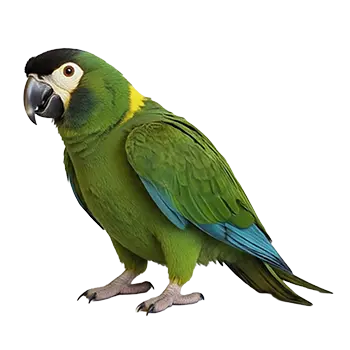

Origins & Natural Habitat

The Yellow-Collared Macaw (Primolius auricollis) is native to a broad swath of central South America, occupying a range that extends across portions of Bolivia, Brazil, Paraguay, and northern Argentina. Unlike the large macaws that dominate the popular imagination, this species belongs to the group informally known as mini macaws, a collection of smaller-bodied species within the family Psittacidae that share the classic macaw silhouette and bare facial patch but in a more compact form. The Yellow-Collared Macaw's preferred habitats include semi-deciduous and gallery forests, cerrado woodland, and the transitional edges between dense forest and open grassland, particularly in the Pantanal and Chaco regions.

The species thrives in areas where mature trees provide nesting cavities and a reliable supply of seeds, fruits, nuts, and blossoms. It is commonly found at elevations ranging from lowland plains up to roughly 1,700 meters in the Andean foothills of Bolivia. Flocks of Yellow-Collared Macaws are a familiar sight in their home range, often observed flying in fast, tight groups above the canopy at dawn and dusk as they commute between roosting and feeding sites. Their calls, a series of sharp, high-pitched shrieks, are a defining sound of the woodland habitats they frequent.

Ecologically, the Yellow-Collared Macaw plays a role as both a seed predator and an inadvertent seed disperser. By cracking open hard-shelled fruits and nuts that many other species cannot access, these macaws help regulate plant populations while occasionally transporting viable seeds to new locations. Their nesting habits, which rely on natural tree cavities or abandoned woodpecker holes, also place them in competition with other cavity-nesting birds and mammals, a dynamic that becomes more consequential as habitat fragmentation reduces the availability of suitable nesting sites.

The taxonomic history of the species reflects the broader challenges of classifying South American parrots. Originally described by the naturalist Johann Cassin in 1853, the Yellow-Collared Macaw was initially placed in the genus Ara before being reclassified into Propyrrhura and eventually into Primolius, a genus it shares with the Blue-Headed Macaw and the Blue-Winged Macaw. These reclassifications reflect advances in molecular phylogenetics that have reshaped understanding of the relationships among Neotropical parrots over the past several decades.

Early History with Humans

The Yellow-Collared Macaw's history with humans is deeply rooted in the indigenous cultures of South America. For centuries before European contact, the peoples of the Chaco, Pantanal, and eastern Bolivian lowlands lived alongside this species, incorporating its feathers into ceremonial regalia, trade goods, and personal adornment. Macaw feathers, prized for their vivid coloration, were among the most valued items in inter-tribal exchange networks that stretched from the Amazon basin to the Andean highlands. While the larger scarlet and blue-and-yellow macaws were the most sought after, smaller species like the Yellow-Collared Macaw also contributed to these feather economies.

Indigenous communities in Bolivia and Paraguay developed a nuanced understanding of the Yellow-Collared Macaw's behavior and ecology long before Western science formally described the species. Knowledge of nesting sites, seasonal movements, and dietary preferences was passed down through generations and informed both hunting practices and early forms of informal aviculture. In some communities, young macaws were taken from nests and hand-raised as household companions, a practice that persisted well into the colonial period and laid the groundwork for the species' eventual role in the global pet trade.

European naturalists first encountered the Yellow-Collared Macaw during the great era of biological exploration in South America during the 18th and 19th centuries. Expeditions mounted by institutions in France, Germany, and Britain traversed the interior of the continent, collecting specimens and documenting the extraordinary avian diversity of the Neotropics. The Yellow-Collared Macaw appeared in the field notes and specimen collections of several of these expeditions, though it attracted less attention than the larger, more visually dramatic macaw species that were already well established in European menageries and aristocratic collections.

The formal scientific description of the species in 1853 came during a period of intense taxonomic activity, as naturalists worked to catalog the flood of specimens arriving from South America. Johann Cassin's description, based on a specimen held at the Academy of Natural Sciences in Philadelphia, placed the bird firmly within the scientific record, though it would be more than a century before the Yellow-Collared Macaw began to attract significant attention outside of ornithological circles.

Cultural Symbolism & Folklore

In the indigenous cultures of the Chaco and Pantanal regions, macaws of all sizes hold symbolic significance tied to themes of color, communication, and the connection between the terrestrial and spiritual worlds. The Yellow-Collared Macaw, with its bright green plumage, golden nape band, and flashes of blue in the flight feathers, has been associated in certain traditions with the vitality of the forest itself. Among some Guarani-speaking peoples, parrots and macaws appear in origin stories as messengers or intermediaries, their raucous calls interpreted as carrying news between the visible world and the realm of ancestors.

Featherwork traditions throughout lowland South America have long incorporated macaw plumage as a material of both aesthetic and spiritual value. The yellow collar feathers of this species, though smaller and less widely traded than those of the Scarlet Macaw or the Hyacinth Macaw, were nonetheless used in localized craft traditions, particularly in the creation of headdresses and body ornaments worn during ceremonies marking seasonal transitions, rites of passage, and communal celebrations. The act of wearing macaw feathers was not merely decorative but was understood as a way of embodying the qualities associated with the bird, including alertness, sociability, and vocal power.

In Bolivian popular culture, the Yellow-Collared Macaw occupies a place as one of the country's recognizable wildlife species, appearing occasionally in regional art, festival imagery, and conservation messaging. The bird's association with the distinctive landscapes of the eastern lowlands, an area that has become increasingly prominent in Bolivian national identity as infrastructure development has connected it more closely to the highland cities, gives it a role as an informal ambassador for the biodiversity of the tropical and subtropical zones.

The broader cultural resonance of macaws in South American art and literature has also touched the Yellow-Collared Macaw, if indirectly. The macaw as a motif appears in pre-Columbian pottery, colonial-era natural history illustrations, and contemporary Latin American visual art. While these depictions often center on the larger species, the Yellow-Collared Macaw benefits from the general cultural cachet of the macaw family, a group of birds that has come to symbolize the tropical Americas in the global imagination.

Rise in Aviculture

The Yellow-Collared Macaw's entry into international aviculture began in earnest during the mid-20th century, as improvements in air transport made it feasible to ship live birds from South America to markets in North America, Europe, and Asia. During the 1960s and 1970s, large numbers of wild-caught Yellow-Collared Macaws were exported from Bolivia and Paraguay to meet growing demand from pet owners and breeders who were discovering the appeal of the mini macaw group. These smaller macaws offered many of the behavioral traits associated with larger species, including playfulness, affection, and vocal ability, in a body size more suited to apartment living and smaller homes.

The species proved to be a relatively adaptable and hardy captive bird, qualities that helped establish it as a viable candidate for breeding programs. By the 1980s, captive-bred Yellow-Collared Macaws were becoming increasingly available in the North American and European pet markets, reducing dependence on wild-caught imports. Breeders noted the species' willingness to reproduce in a range of captive conditions, from small indoor flights to larger outdoor aviaries, and its relatively manageable clutch size and incubation period made it accessible to both professional breeders and dedicated hobbyists.

The passage of the Wild Bird Conservation Act in the United States in 1992 marked a turning point for the Yellow-Collared Macaw and for the parrot trade more broadly. By effectively ending the importation of most wild-caught parrots into one of the world's largest markets, the legislation accelerated the shift toward domestic captive breeding and elevated the importance of maintaining genetically diverse captive populations. Breeders of Yellow-Collared Macaws responded by developing cooperative breeding arrangements and studbook-like record-keeping to ensure the long-term viability of captive lines.

Today the Yellow-Collared Macaw is well established in aviculture worldwide. It is regularly featured at avian expos and bird club events, and a robust community of breeders and keepers shares knowledge through online forums, social media groups, and regional avicultural societies. The species' position within the mini macaw category, alongside the Hahn's Macaw, the Severe Macaw, and the Illiger's Macaw, has given it a distinct niche in the companion bird market, appealing to those who want a true macaw experience without the space and noise demands of the larger species.

Conservation History

The conservation trajectory of the Yellow-Collared Macaw has been shaped by the interplay between habitat loss, the historical wild bird trade, and evolving international protections. For much of the 20th century, the species was trapped in significant numbers across its range, particularly in Bolivia, which served as a major source country for the global parrot trade. Trapping operations targeted both adult birds and nestlings, and while the Yellow-Collared Macaw's relatively large range and adaptable habitat preferences provided some buffer against population collapse, localized declines were documented in areas subjected to heavy trapping pressure.

Habitat conversion has posed a more sustained and pervasive threat. The expansion of cattle ranching, soybean cultivation, and infrastructure development across the cerrado and Chaco regions of South America has progressively reduced and fragmented the woodland habitats on which the Yellow-Collared Macaw depends. The Pantanal, one of the species' key strongholds, has faced increasing pressure from agricultural encroachment, water management projects, and periodic catastrophic fires, events that gained international attention during the devastating fire seasons of the early 2020s.

The Yellow-Collared Macaw is currently listed on Appendix II of the Convention on International Trade in Endangered Species (CITES), which regulates but does not prohibit international trade in the species. The International Union for Conservation of Nature (IUCN) classifies it as a species of Least Concern, reflecting its still relatively broad distribution and apparently stable overall population, though this designation masks regional variation. In parts of its range where habitat loss has been most severe, local populations have experienced meaningful declines that are not fully captured by the species-level assessment.

Conservation efforts targeting the Yellow-Collared Macaw have included habitat protection initiatives, community-based monitoring programs, and efforts to reduce illegal trapping. In Bolivia, several protected areas encompass portions of the species' range, and non-governmental organizations working in the eastern lowlands have incorporated the Yellow-Collared Macaw into broader conservation strategies aimed at preserving cerrado and dry forest ecosystems. The species' relative abundance compared to critically endangered macaws like the Spix's Macaw or the Glaucous Macaw means that it receives less targeted conservation attention, but its fate remains linked to the health of the ecosystems it inhabits.

The Species Today

The Yellow-Collared Macaw occupies a distinctive position in the contemporary world of companion birds. It is widely regarded as one of the best introductory species for those interested in keeping a macaw, offering the bold personality, physical robustness, and interactive nature of the macaw family in a package that is more manageable in terms of size, noise, and housing requirements than the large macaws. Experienced aviculturists often recommend the Yellow-Collared Macaw to prospective parrot owners who are drawn to the macaw temperament but live in settings where a Blue-and-Gold or a Scarlet Macaw would be impractical.

In avicultural circles, the species is valued for its playful and sometimes mischievous disposition. Yellow-Collared Macaws are known for their acrobatic agility, their fondness for toys and puzzles, and their tendency to form strong bonds with their human companions. They are capable of learning a modest vocabulary and can be trained to perform a range of behaviors using positive reinforcement techniques. Their social nature means they generally do well in households where they receive regular interaction, though they can also coexist with other parrots in multi-bird homes if introduced and managed appropriately.

The veterinary and nutritional understanding of the Yellow-Collared Macaw has advanced considerably in recent decades. Avian veterinarians now recognize the species' susceptibility to certain conditions, including proventricular dilatation disease, psittacine beak and feather disease, and nutritional deficiencies related to inadequate diet. Modern husbandry recommendations emphasize a pellet-based diet supplemented with fresh fruits, vegetables, and limited seeds and nuts, along with regular veterinary checkups, UV lighting, and opportunities for flight and exercise.

Looking ahead, the Yellow-Collared Macaw's future as both a wild species and a companion animal will depend on continued habitat conservation in South America and responsible captive breeding practices worldwide. The species serves as a reminder that even relatively common and adaptable parrots are not immune to the pressures of deforestation and climate change, and that the vibrant personality that makes these birds such engaging companions is ultimately rooted in the complex ecological relationships of their native woodlands.

Always consult a qualified professional before making any health-related decisions. This content is provided for informational reference only and should not replace professional guidance specific to your animal.