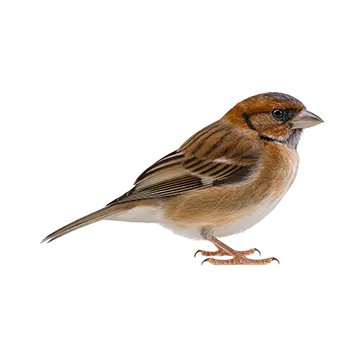

Origins & the White-Rumped Munia

The Society Finch (Lonchura striata domestica) holds the rare distinction of being a bird species that does not exist in the wild. Unlike the vast majority of companion birds, which were captured or bred from wild-caught stock, the Society Finch is entirely a product of selective domestication. Its ancestor is the White-rumped Munia (Lonchura striata), a small, hardy finch native to a broad range stretching from the Indian subcontinent through Southeast Asia, southern China, and into parts of Indonesia. The White-rumped Munia thrives in open grasslands, scrubby edges of agricultural fields, and disturbed habitats near human settlement, a habitat preference that likely brought it into early contact with people who would eventually begin keeping and breeding it.

The White-rumped Munia itself is a gregarious and adaptable bird, feeding primarily on grass seeds and small grains. Its tendency to form large, cohesive flocks and its relative tolerance of confinement made it a natural candidate for domestication in agricultural societies where caged birds served both ornamental and cultural functions. Several subspecies of the White-rumped Munia exist across its extensive range, and there has been scholarly discussion about which specific populations contributed most directly to the domesticated lineage. Genetic studies conducted in the early 21st century suggest that the domestication event likely drew from mainland Asian populations, though the precise geographic origin remains a subject of ongoing investigation.

What sets the Society Finch apart from its wild ancestor is not merely appearance, though the two differ visibly in plumage patterns and coloration. Domestication reshaped the bird's behavior in fundamental ways. Wild White-rumped Munias are competent but not exceptional parents; Society Finches, by contrast, have been selectively bred over many generations for extreme docility, sociability, and a willingness to incubate and rear chicks that may not even be their own. This behavioral transformation is the defining feature of the domestication process and the reason the Society Finch has become one of the most important species in aviculture.

Understanding the Society Finch requires grasping this essential point: it is not a tamed wild bird but a genuinely new creation, shaped by centuries of human selection to fill roles that no wild finch could reliably perform. Its story is one of partnership between human intention and avian adaptability, played out over a remarkably long span of time.

Domestication in Japanese Aviculture

The domestication of the Society Finch is generally attributed to Japanese aviculturists, with most historical evidence pointing to a process that began during the Edo period (1603–1868), though some accounts suggest that Chinese breeders may have initiated the earliest stages of selective breeding before the practice was refined and systematized in Japan. In Japanese, the bird is known as Jushimatsu, a name that translates roughly to "ten-brother bird," an allusion to its remarkably peaceful coexistence in groups. This name reflects what Japanese breeders valued most about the bird: its gentle, communal temperament and its exceptional willingness to share nesting duties.

During the Edo period, Japan experienced a prolonged era of relative peace and cultural flourishing under the Tokugawa shogunate. The keeping and breeding of small birds became a widespread pastime among both the aristocracy and the emerging merchant class. Japanese aviculturists developed an extraordinarily refined approach to bird breeding, and the Society Finch emerged from this tradition as a purpose-bred domestic species. Breeders selected not for flashy plumage or song, as was common in European canary breeding, but for behavioral traits: tameness, willingness to sit on eggs regardless of parentage, and tolerance of close confinement with other birds.

The result of this selection was a bird that differed profoundly from its wild progenitor. Where the White-rumped Munia could be skittish and defensive in captivity, the Society Finch was calm and cooperative. Where wild munias would sometimes abandon nests or reject unfamiliar eggs, the Society Finch proved almost universally willing to foster, incubating and feeding chicks of other finch species as readily as its own. This foster-parenting ability became the cornerstone of the bird's identity and its primary value to aviculturists who needed a reliable surrogate for species that proved difficult to breed in captivity.

Japanese breeders also developed a range of plumage varieties through selective breeding, including chocolate, fawn, chestnut, white, and various piebald combinations. These color morphs were cultivated alongside the behavioral traits that defined the breed, producing a bird that was both visually diverse and temperamentally consistent. The depth and sophistication of Japanese Society Finch breeding during this era laid the groundwork for the bird's eventual global spread.

Spread to Western Aviculture

The Society Finch first reached Europe during the latter half of the 19th century, arriving through trade networks that connected Japan with Western markets following the reopening of Japan to foreign commerce after 1854. European aviculturists, already deeply engaged in canary and cage-bird breeding, were intrigued by this small, docile finch that seemed almost preternaturally willing to breed in captivity. The bird was initially known by a variety of names in European languages, with the English-speaking world settling on both Society Finch and Bengalese Finch, the latter name reflecting an early and somewhat inaccurate assumption about the bird's geographic origins.

By the early 20th century, the Society Finch had established itself as a fixture of European and North American aviculture. Its appeal was straightforward and practical: it was inexpensive, easy to maintain, remarkably prolific in breeding, and invaluable as a foster parent for more delicate or difficult-to-breed finch species. Breeders of Gouldian Finches, in particular, came to rely heavily on Society Finches as surrogates, as Gouldian hens frequently proved unreliable in incubating and rearing their own chicks under captive conditions. This foster role elevated the Society Finch from a charming novelty to an essential tool of the avicultural trade.

The mid-20th century saw the Society Finch's popularity expand further as pet keeping became a mainstream hobby across the Western world. Pet shops stocked Society Finches as ideal beginner birds, suitable for apartments and small living spaces. Their quiet vocalizations, low cost, and minimal care requirements made them accessible to families, students, and elderly keepers who might not have the resources or space for larger, more demanding species. The bird's gentle nature and visible social bonds also made it a popular choice for classroom settings and educational programs.

As the Society Finch spread through global aviculture, regional breeding traditions developed their own emphases. North American breeders expanded the palette of color mutations, while European fanciers in countries like the Netherlands and Belgium refined show standards that judged birds on the clarity and consistency of their markings. Despite these regional variations, the core identity of the Society Finch remained consistent: a gentle, cooperative bird whose value lay as much in its behavior as in its appearance.

Role as a Foster Parent Species

No account of the Society Finch's history would be complete without a thorough examination of its role as a foster parent, a function that has shaped not only the bird's own story but the broader trajectory of finch aviculture worldwide. The Society Finch's willingness to adopt, incubate, and rear the offspring of other species is essentially unmatched in the avian world. This trait, cultivated through centuries of selective breeding, has made the Society Finch indispensable in captive breeding programs for a wide range of finch and small passerine species.

The foster-parenting phenomenon works because Society Finches display an unusually strong and indiscriminate brooding instinct. A pair of Society Finches will typically accept eggs of almost any small finch species placed in their nest, and they will feed and care for the resulting chicks with the same attentiveness they show their own offspring. This behavior extends beyond mere egg-sitting; Society Finch foster parents provide warmth, feeding, and social modeling throughout the rearing period, producing fledglings that are healthy and well-adjusted even though they are genetically unrelated to their caretakers.

The practical impact of this trait has been enormous. Species like the Gouldian Finch, the Cordon Bleu, the Star Finch, and various parrotfinches have all benefited from Society Finch fostering in captive breeding programs. In some cases, the survival of captive populations of rare or delicate species has depended directly on the availability of Society Finch surrogates. Conservation breeding programs for endangered finch species have also employed Society Finches as foster parents, though this approach carries complexities related to imprinting and behavioral development that breeders must carefully manage.

The foster-parenting role has also raised interesting questions among avian behaviorists and geneticists. Research has explored how domestication altered the neural and hormonal pathways governing parental behavior in the Society Finch, and comparative studies with wild White-rumped Munias have shed light on the mechanisms by which selective breeding can reshape instinctual drives. The Society Finch thus serves as both a practical tool and a living laboratory for understanding the biology of parental care.

Scientific Contributions & Research Significance

Beyond its role in aviculture, the Society Finch has made significant contributions to scientific research, particularly in the fields of vocal learning, behavioral genetics, and the biology of domestication. The bird's close relationship to the well-studied Zebra Finch (Taeniopygia guttata), another model organism in avian neuroscience, has made it a valuable comparative subject. Researchers have used the Society Finch to investigate how domestication affects song learning, social behavior, and neural architecture, producing insights that extend well beyond the species itself.

One of the most productive areas of Society Finch research has been the study of vocal learning and song development. Male Society Finches learn their songs through social transmission, acquiring elements from adult males they are raised alongside. This process of vocal learning parallels aspects of human language acquisition, making the Society Finch a useful model for studying the neural and genetic underpinnings of learned vocalization. Comparative studies between Society Finches and their wild ancestor have revealed how domestication has altered song structure, complexity, and the social contexts in which song is produced.

The Society Finch has also featured in research on mate choice, social bonding, and group dynamics. Its extreme sociality and tolerance of crowded conditions make it an ideal subject for experiments examining how birds establish and maintain social hierarchies, form pair bonds, and coordinate group behavior. Studies have demonstrated that Society Finches show preferences for familiar individuals, engage in cooperative behaviors such as allopreening, and modulate their vocalizations based on social context, findings that illuminate the broader evolution of sociality in birds.

In the field of domestication science, the Society Finch offers a compelling case study in how human selection can drive rapid behavioral evolution. Comparisons between Society Finches and White-rumped Munias have documented changes in stress reactivity, exploratory behavior, fear responses, and parental investment that parallel the domestication syndrome observed in mammals such as dogs and silver foxes. These parallels suggest that convergent evolutionary mechanisms may underlie the domestication process across widely divergent taxa, a hypothesis that the Society Finch has helped to test and refine.

The Society Finch Today

In the early decades of the 21st century, the Society Finch remains one of the most widely kept and readily available companion finches in the world. Its enduring popularity rests on the same qualities that originally made it attractive to Japanese breeders centuries ago: gentleness, sociability, ease of care, and reliable breeding in captivity. Pet stores, bird expos, and private breeders across North America, Europe, Asia, and Australia offer Society Finches in a wide array of color mutations, from solid chocolates and fawns to striking crested varieties and intricate piebald patterns.

The avicultural community has continued to refine and expand the Society Finch's genetic diversity through careful breeding programs. Show standards in organizations such as the National Finch and Softbill Society in the United States and comparable bodies in Europe have formalized the criteria by which Society Finches are judged, covering plumage color, feather quality, body conformation, and overall condition. Competitive exhibition of Society Finches, while a niche pursuit, sustains a dedicated community of breeders who approach the craft with seriousness and expertise.

The Society Finch's role as a foster parent continues to be central to its identity in aviculture, though the practice has evolved alongside changing attitudes toward breeding ethics and species conservation. Some aviculturists have raised questions about the long-term effects of foster rearing on the behavior and reproductive fitness of fostered species, prompting more nuanced approaches that balance the practical benefits of Society Finch surrogacy with the goal of producing self-sustaining captive populations. These discussions reflect a broader maturation of the avicultural community and its engagement with conservation science.

For the casual pet owner, the Society Finch remains an ideal entry point into bird keeping. Its modest space requirements, quiet voice, and visible social interactions make it a rewarding companion that asks little in return. For the serious breeder or researcher, the bird offers a depth of genetic and behavioral complexity that continues to yield new insights. Whether appreciated as a charming household pet or studied as a model of domestication, the Society Finch occupies a distinctive and enduring place in the relationship between humans and birds.

Always consult a qualified professional before making any health-related decisions. This content is provided for informational reference only and should not replace professional guidance specific to your animal.