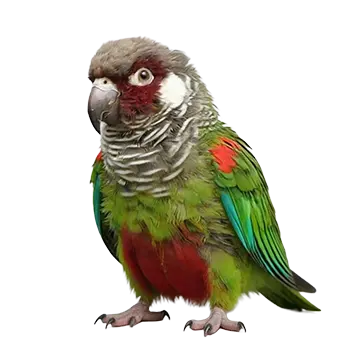

Origins & Natural Habitat

The Scaly Breasted Parakeet (Trichoglossus chlorolepidotus) is a lorikeet species endemic to the eastern seaboard of Australia, ranging from the tropical lowlands of far north Queensland southward through New South Wales and into the northeastern fringes of Victoria. Unlike its more flamboyant cousin the Rainbow Lorikeet, this species presents a predominantly green plumage accented by distinctive yellow scalloping across the breast and belly feathers, a pattern that gives it both its common name and an understated elegance that sets it apart among Australian psittacines.

The species inhabits a diverse array of wooded environments including coastal eucalypt forests, open woodland, paperbark swamps, and suburban parks and gardens where flowering trees provide reliable nectar sources. Its distribution closely tracks the availability of blossoming eucalypts, banksias, grevilleas, and melaleucas, the nectar and pollen of which form the foundation of its diet. Supplementary foods include soft fruits, seeds, and occasional insect larvae gleaned from bark and leaf litter, though the species remains fundamentally nectarivorous.

Scaly Breasted Parakeets are highly social birds that typically forage and roost in flocks, often mixing with Rainbow Lorikeets and other parrot species at productive flowering trees. Their communal roosting behavior can bring hundreds of birds together at dusk, creating noisy, dynamic gatherings in favored stands of tall eucalypts or introduced trees in urban areas. This gregarious nature has been a key factor in their adaptability to human-modified landscapes, allowing them to exploit suburban gardens, orchards, and planted streetscapes as supplementary habitat.

Ecologically, the species plays an important role as a pollinator. As Scaly Breasted Parakeets move between blossoms feeding on nectar, pollen grains adhere to their facial feathers and specialized brush-tipped tongues, facilitating cross-pollination across individual trees and stands. This mutualistic relationship between lorikeets and Australian flowering plants has likely been in place for millions of years, reflecting a deep co-evolutionary history that predates any human presence on the continent.

European Discovery & Scientific Classification

European naturalists first encountered the Scaly Breasted Parakeet during the wave of biological exploration that followed British colonization of Australia in the late 18th century. The species was formally described by the German naturalist Heinrich Kuhl in 1820, who assigned it to the genus Trichoglossus and gave it the specific epithet chlorolepidotus, derived from the Greek words for green and scaled, a direct reference to the bird's characteristic breast patterning. Kuhl's description was based on specimens collected from the coastal regions of New South Wales and shipped to European museums as part of the enormous flow of natural history material leaving Australia during this period.

The taxonomic placement of the Scaly Breasted Parakeet has been relatively stable since Kuhl's original description, though the broader classification of Australasian lorikeets has undergone considerable revision over the past two centuries. Early ornithologists grouped lorikeets within a single, loosely defined family, but modern molecular phylogenetics has clarified the evolutionary relationships within the Loriinae, confirming that Trichoglossus chlorolepidotus is closely allied with the Rainbow Lorikeet complex. Some authorities have at various points placed the species in the genus Psitteuteles, though the consensus in recent decades has returned it to Trichoglossus.

The 19th century saw a steady accumulation of knowledge about the species through the work of field naturalists and collectors operating across eastern Australia. John Gould, the English ornithologist whose monumental work The Birds of Australia remains a foundational reference, illustrated and described the Scaly Breasted Parakeet in considerable detail, noting its dietary specialization and its tendency to associate with larger lorikeet species. Gould's hand-colored lithographs brought the bird to the attention of European audiences who would never see it in the wild, contributing to early interest in Australian birdlife more generally.

By the early 20th century, museum collections across Europe and Australia held substantial numbers of Scaly Breasted Parakeet specimens, providing the raw material for anatomical and distributional studies that refined scientific understanding of the species. The development of field ornithology in Australia, supported by organizations such as the Royal Australasian Ornithologists Union, added behavioral and ecological observations that complemented the specimen-based work, building a progressively more complete picture of this lorikeet's natural history.

Indigenous Australian Knowledge & Cultural Connections

Long before European science assigned a Latin binomial to the Scaly Breasted Parakeet, Indigenous Australian peoples had accumulated detailed ecological knowledge of the species through tens of thousands of years of observation and interaction. Aboriginal communities along the eastern seaboard recognized lorikeets as indicators of seasonal flowering patterns, and the appearance of large flocks at particular trees or groves signaled the availability of nectar resources that were important to human foragers as well. This practical ecological knowledge was embedded in broader cultural frameworks that connected birdlife to landscape, season, and story.

In the oral traditions of several Aboriginal language groups within the species' range, parrots and lorikeets feature as characters in Dreaming narratives that explain the origins of the landscape, the behavior of animals, and the relationships between living things. While specific stories involving the Scaly Breasted Parakeet vary by region and community, the broader cultural recognition of lorikeets as vocal, social, and ecologically significant birds is widespread. The distinctive calls of lorikeet flocks arriving at flowering trees would have been a familiar and seasonally meaningful sound across much of coastal eastern Australia for millennia.

The relationship between Indigenous Australians and native birdlife was not limited to observation and narrative. Parrots were sometimes taken for food, and their feathers were used in ceremonial contexts, though the specific practices varied enormously across the hundreds of distinct Aboriginal nations and language groups that occupied the Scaly Breasted Parakeet's range. Archaeological evidence from rock shelters and middens in eastern Australia confirms that parrots were part of the broader spectrum of fauna utilized by Aboriginal peoples, though distinguishing individual parrot species in the archaeological record remains challenging.

The disruption of Indigenous Australian societies following European colonization severely impacted the transmission of traditional ecological knowledge, including detailed understanding of species like the Scaly Breasted Parakeet. In recent decades, efforts to document and revitalize Indigenous knowledge systems have brought renewed attention to the depth of Aboriginal understanding of Australian birdlife, and collaborative projects between Indigenous knowledge holders and Western scientists have begun to integrate these perspectives into contemporary ecological research and land management.

Development of Aviculture & Captive Breeding

The Scaly Breasted Parakeet entered the world of organized aviculture during the late 19th and early 20th centuries, when Australian birds were being exported in significant numbers to satisfy growing demand among European and American bird keepers. Early aviculturists quickly recognized the species as a manageable and attractive lorikeet, less aggressive than some of its larger relatives and well-suited to aviary life provided that its specialized dietary needs could be met. The challenge of providing appropriate nectar substitutes in captivity was a significant obstacle in the early years of lorikeet keeping, and mortality rates among imported birds were high until suitable liquid food formulations were developed.

The Australian government progressively tightened controls on the export of native wildlife during the 20th century, culminating in a near-total ban on the commercial export of native birds by the 1960s and formalized under the Wildlife Protection (Regulation of Exports and Imports) Act of 1982. This legislation effectively closed the supply of wild-caught Scaly Breasted Parakeets to overseas markets and placed the future of the species in international aviculture squarely in the hands of existing captive populations. Breeders in Europe and North America who had established viable breeding groups prior to the export ban became the foundation of the species' presence in aviculture outside Australia.

Within Australia, the Scaly Breasted Parakeet has remained a popular and accessible aviary bird. Domestic breeders have maintained healthy captive populations and have occasionally produced color mutations, including lutino and cinnamon variants, that have generated additional interest among specialist breeders. The species' relatively straightforward breeding requirements, moderate size, and compatibility with mixed-species aviaries have made it a staple of Australian aviculture, though it has never achieved the same level of mainstream popularity as the closely related Rainbow Lorikeet.

Internationally, the Scaly Breasted Parakeet occupies a niche position in aviculture. European aviculturists, particularly in the Netherlands, Germany, and the United Kingdom, have sustained breeding programs that maintain genetic diversity within captive flocks. In North America, the species is less commonly kept but is available through specialist breeders and occasionally appears at avian expos and bird fairs. The development of commercial lorikeet diets, including dry powder formulations and wet nectar mixes, has significantly simplified the husbandry of all lorikeet species and contributed to the Scaly Breasted Parakeet's continued viability as a companion and aviary bird outside its native range.

Conservation History & Population Trends

The Scaly Breasted Parakeet has fared considerably better than many Australian parrot species in the face of European colonization and the landscape changes that accompanied it. Unlike species dependent on old-growth forest or specific nesting hollows in declining woodland habitats, the Scaly Breasted Parakeet has demonstrated a notable capacity to adapt to modified environments. Its willingness to exploit flowering trees in suburban gardens, parks, and streetscapes has allowed it to maintain and in some areas expand its range, particularly along the urbanized eastern seaboard.

Historical records suggest that the species' distribution has shifted modestly over the past century and a half. In the southern portion of its range, particularly in Victoria and southern New South Wales, there is evidence that Scaly Breasted Parakeets have become more common and more regularly observed than they were in the early 20th century. This range expansion may be linked to climate warming, increased planting of ornamental flowering trees in urban areas, and the provision of supplementary food at backyard feeding stations, all of which have created favorable conditions for a nectar-dependent species.

Conservation assessments by Australian federal and state authorities, as well as by the International Union for Conservation of Nature, have consistently classified the Scaly Breasted Parakeet as a species of Least Concern. Population estimates, while imprecise due to the difficulty of surveying mobile, flocking birds across a large range, suggest a stable or increasing total population numbering in the hundreds of thousands. The species is not considered threatened at any jurisdictional level, and there are no specific recovery programs or conservation interventions directed at it.

Nevertheless, the species is not entirely free from conservation concerns. Competition with the more aggressive Rainbow Lorikeet for nesting hollows and feeding resources has been identified as a potential pressure in areas where both species co-occur at high densities. Habitat loss in certain parts of the range, particularly the clearing of coastal lowland forests for residential and agricultural development, continues to reduce the availability of natural nesting sites. Disease, including outbreaks of psittacine beak and feather disease and avian chlamydiosis, poses an ongoing background risk to wild populations, as it does for many Australian parrots.

The Species Today

Today the Scaly Breasted Parakeet occupies a distinctive position among Australian parrots. It is neither rare nor threatened, yet it lacks the immediate public recognition enjoyed by the Rainbow Lorikeet, the Sulphur-crested Cockatoo, or the Budgerigar. For those who take the time to observe it closely, however, the species reveals a quiet charm and ecological sophistication that reward attention. Its green plumage provides effective camouflage among foliage, and the delicate yellow scalloping of the breast becomes most apparent when the bird is perched in good light or feeding at close range, a subtle beauty that contrasts with the bolder patterns of many Australian psittacines.

In the wild, the Scaly Breasted Parakeet continues to thrive across much of eastern Australia. Urban and suburban populations have become an increasingly visible component of the birdlife in cities such as Brisbane, Sydney, and the Gold Coast, where flowering street trees and garden plantings provide year-round nectar resources. Community bird surveys, including those organized through citizen science platforms, have documented the species' presence in areas where it was previously unrecorded, suggesting ongoing range consolidation and possible expansion.

In aviculture, the Scaly Breasted Parakeet remains a valued species among lorikeet enthusiasts and mixed-collection keepers. Advances in dietary science have made lorikeet husbandry more accessible than ever, and the species' moderate size, engaging personality, and relatively manageable noise level compared to larger lorikeets have sustained its appeal. Color mutations continue to attract specialist breeders, while the nominate green form remains the most widely kept and bred variety.

The species' cultural footprint, while modest compared to more iconic Australian birds, has grown in recent years through wildlife photography, social media, and community engagement with urban birdlife. As Australians and international bird enthusiasts increasingly appreciate the diversity and ecological importance of lorikeets, the Scaly Breasted Parakeet is gaining recognition not merely as a less colorful relative of the Rainbow Lorikeet but as a species worthy of attention and respect in its own right. Its history, from the eucalypt forests of pre-colonial Australia through the cabinets of European naturalists to the aviaries and backyards of the present day, reflects the broader story of how humans come to know, value, and live alongside the other species that share their world.

Always consult a qualified professional before making any health-related decisions. This content is provided for informational reference only and should not replace professional guidance specific to your animal.