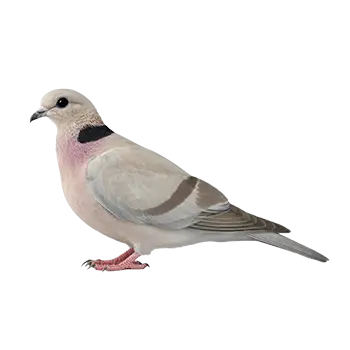

The dove has occupied a privileged position in Western and Eastern literature for millennia, and the Ring-Necked Dove, as one of the most familiar domesticated dove species, has contributed directly and indirectly to this tradition. In classical literature, doves appear in the works of Homer, Virgil, and Ovid, often serving as messengers or symbols of divine favor. The Hebrew Bible and the Christian New Testament employ the dove as a recurring motif, from the Genesis flood narrative to the baptism of Jesus, where a dove descends as a representation of the Holy Spirit. While these ancient texts rarely specify species, the domestic dove that readers and listeners would have visualized was, in many historical periods and regions, the Ring-Necked Dove or a closely related form.
Medieval and Renaissance poetry drew heavily on the dove as a figure of love, innocence, and constancy. The troubadour tradition of southern France and the Petrarchan sonneteers of Italy employed the dove to represent the beloved, the soul, and the ideal of faithful devotion. In the Song of Solomon, widely read as both sacred allegory and secular love poetry, the dove is invoked as a term of endearment, reinforcing associations between the bird and romantic affection that persist in popular culture to this day. The Ring-Necked Dove, with its pair-bonding behavior and gentle temperament, provided a living model for these literary ideals.
In the 19th and 20th centuries, doves continued to appear in poetry and prose, though their symbolic register broadened. Romantic and Victorian poets used the dove to evoke domesticity, grief, and nostalgia, while modernist and postcolonial writers sometimes subverted the traditional symbolism, employing the dove ironically or exploring the tensions between its peaceful associations and the realities of the natural world. Pablo Picasso's famous dove lithograph, created for the 1949 World Peace Congress, drew on and reinvigorated the dove-as-peace symbol for a 20th-century audience, ensuring that the image remained culturally potent.
Contemporary literature continues to reference doves in both realistic and symbolic modes. Novels, short stories, and poems set in domestic environments sometimes include Ring-Necked Doves as background detail or as metaphors for fragility, comfort, or the passage of time. In children's literature, doves appear frequently as gentle characters in stories about kindness, friendship, and the natural world, reinforcing the bird's reputation as one of the most approachable and benign of all avian species.