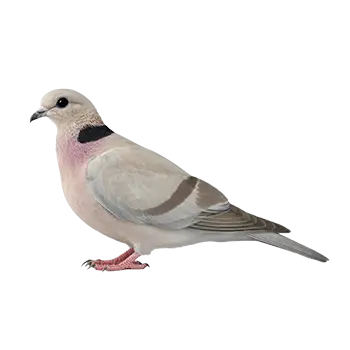

The Ring-Necked Dove (Streptopelia risoria) is widely regarded as one of the oldest domesticated bird species, with a lineage that traces back to the African Collared Dove (Streptopelia roseogrisea) of the arid and semi-arid zones of sub-Saharan Africa and the southern Arabian Peninsula. The wild ancestor inhabits the Sahel belt, stretching from Mauritania and Senegal eastward through Sudan and into Ethiopia and Somalia, favoring dry scrubland, acacia savanna, and the fringes of cultivated land. This hardy, adaptable bird evolved in landscapes defined by seasonal drought, sparse vegetation, and close proximity to human settlements, traits that would prove instrumental in its eventual domestication.
In its natural range, the African Collared Dove feeds primarily on grass seeds, small grains, and the occasional insect, foraging on open ground in pairs or small flocks. Its soft, rhythmic cooing, a two-syllable phrase repeated in steady cadence, became one of the most recognizable sounds of the African bush. The species nests in low shrubs and trees, constructing simple platforms of twigs that reflect its pragmatic approach to reproduction in unpredictable environments. Clutches of two eggs are typical, and pairs may breed multiple times per year when conditions allow.
The ecological flexibility of the African Collared Dove positioned it as an ideal candidate for domestication. Unlike many bird species that require specialized diets or specific habitat features, this dove thrived in marginal environments and tolerated close contact with humans and livestock. Its willingness to feed on spilled grain near villages and its calm temperament around people likely initiated a gradual process of habituation that preceded any deliberate human effort to breed the birds in captivity.
Over centuries of selective breeding, the domesticated Ring-Necked Dove diverged from its wild progenitor in both appearance and behavior. The most common domestic variety exhibits a pale, creamy fawn plumage with a distinctive black crescent or half-collar on the nape of the neck, from which the common name derives. Domestic birds tend to be slightly larger and more docile than their wild counterparts, with a broader range of color mutations that have been developed through careful avicultural selection.