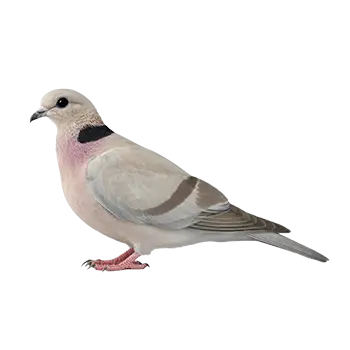

The legal status of the Ring-Necked Dove (Streptopelia risoria) is shaped by its classification as a domesticated species, which distinguishes it from most wild bird species and generally results in a more permissive regulatory environment. In the United States, the Ring-Necked Dove is not protected under the Migratory Bird Treaty Act (MBTA), the federal statute that governs the taking, possession, and sale of most wild native and migratory bird species. Because the Ring-Necked Dove is a domesticated form with no established wild populations in North America that fall under federal jurisdiction, it is treated similarly to other domestic animals for the purposes of federal wildlife law. This exemption is a significant practical advantage for prospective owners, breeders, and sellers, as it eliminates the need for federal permits that would be required for native or migratory species.
However, the absence of federal wildlife protection does not mean that Ring-Necked Dove ownership is entirely unregulated. State and local laws introduce a patchwork of rules that can affect ownership, breeding, sales, and housing. Some states classify all non-native bird species under exotic animal regulations, which may require permits for possession or breeding even when the species in question is fully domesticated. Other states make explicit exceptions for domesticated dove and pigeon species, recognizing their long history of human management and their negligible risk to native ecosystems. Prospective owners should always verify the specific regulations in their state, county, and municipality before acquiring a Ring-Necked Dove.
In the European Union, the Ring-Necked Dove is generally treated as a domestic animal and is not listed under the EU Birds Directive, which provides protections for wild bird species across member states. Individual countries may impose additional requirements, particularly regarding importation, disease testing, and commercial breeding, but outright prohibition of Ring-Necked Dove ownership is uncommon in Europe. In the United Kingdom, the species falls outside the scope of the Wildlife and Countryside Act 1981, which protects native wild birds, and is instead subject to general animal welfare legislation.
In Australia, the regulatory picture is more complex. Australian biosecurity and wildlife laws are among the strictest in the world, and the importation of non-native bird species is tightly controlled to prevent the introduction of diseases and invasive species. While Ring-Necked Doves are bred domestically within Australia, bringing birds into the country from overseas is subject to rigorous quarantine and permit requirements. Individual states and territories may impose additional conditions on keeping non-native bird species, and prospective owners should consult their state wildlife authority for guidance.