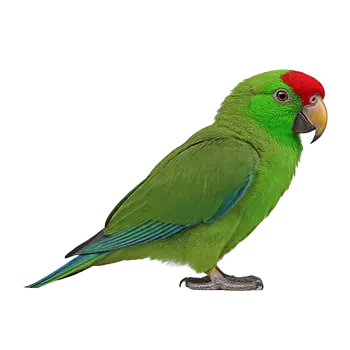

Amazon Parrots on Screen

Amazon parrots as a group have enjoyed a long, if often generalized, presence in film and television. The vivid green plumage, stocky build, and expressive faces of Amazona species make them visually compelling on camera, and their vocal talents lend themselves naturally to comedic and dramatic roles alike. While individual Amazon species are rarely identified by name in mainstream productions, the Red-Lored Amazon's combination of brilliant green body feathers, striking red forehead, and patches of blue and yellow on the head and wings has made it a recognizable candidate whenever a script calls for a colorful, charismatic parrot.

In Hollywood and international cinema, parrots have historically served as shorthand for tropical settings, pirate lore, and eccentric characters. The image of a parrot perched on a shoulder owes its enduring popularity to literary and theatrical traditions stretching back centuries, and green Amazon parrots, including species visually consistent with the Red-Lored Amazon, have been cast in background and supporting roles in adventure films, romantic comedies, and family movies. Production companies have relied on trained Amazons for scenes requiring a bird that can vocalize on cue, sit calmly on a handler's arm, or interact with actors in close quarters.

Television has provided another avenue for Amazon parrots to reach wide audiences. Talk shows, variety programs, and reality television segments featuring trained parrots have periodically introduced Amazon species to viewers who might not otherwise encounter them. Wildlife and pet-focused television programs have occasionally profiled Red-Lored Amazons specifically, highlighting their temperament, vocal abilities, and suitability as companion birds. These appearances, while brief, contribute to a cumulative media footprint that shapes public expectations about what owning an Amazon parrot involves.

The challenge with screen depictions of parrots, including the Red-Lored Amazon, is that they tend to emphasize the entertaining aspects of parrot ownership, particularly talking and performing tricks, while underrepresenting the demands of daily care, the potential for behavioral challenges, and the decades-long commitment these birds require. Media portrayals have historically contributed to impulse acquisitions by viewers charmed by a parrot's on-screen antics, a dynamic that avian welfare organizations have worked to counterbalance through educational outreach.

Representation in Literature & Art

Parrots have occupied a distinctive place in Western literature since at least the Renaissance, when the arrival of New World species in European ports inspired poets, essayists, and natural historians to grapple with the implications of a bird that could seemingly speak. The Red-Lored Amazon, as one of the more commonly encountered Amazona species in Mesoamerica, contributed to the broader literary tradition of the "talking parrot" even when specific works did not identify the species by name. Colonial-era travel narratives from Mexico and Central America frequently described large flocks of green parrots with red-marked faces, and these accounts filtered into the European literary imagination.

In Latin American literature, parrots appear as recurring motifs tied to themes of nature, identity, and the tension between wildness and domestication. Authors from the tropical regions where the Red-Lored Amazon is native have drawn on the everyday familiarity of parrots in village and household settings, using the birds as symbols of communication, freedom, and the interconnectedness of human and natural worlds. The parrot's habit of repeating words and phrases has served as a literary device for exploring questions of authenticity, imitation, and the boundaries of language itself.

Visual art has also reflected the Red-Lored Amazon's presence in its native regions. Pre-Columbian pottery, stone carvings, and mural fragments from Maya and other Mesoamerican cultures depict parrots with features consistent with Amazona species, though precise identification to the species level is seldom possible from stylized ancient artworks. In more recent centuries, botanical and ornithological illustrators have produced detailed depictions of the Red-Lored Amazon as part of comprehensive natural history surveys. The work of artists such as John Gould and Edward Lear, who illustrated numerous parrot species during the 19th century, helped establish a visual vocabulary for Amazona parrots that continues to influence field guides, educational materials, and decorative art.

Contemporary artists working in the conservation and wildlife art traditions have increasingly turned their attention to Amazon parrots, including the Red-Lored Amazon, as subjects that combine visual beauty with ecological urgency. Paintings, prints, and digital illustrations featuring the species appear in gallery exhibitions, fundraising campaigns, and educational publications, using the bird's vivid appearance to draw viewers into conversations about habitat loss, the wildlife trade, and the value of tropical biodiversity.

Nature Documentaries & Wildlife Media

The Red-Lored Amazon has appeared in a number of nature documentaries and wildlife media productions focused on the biodiversity of Central and South American tropical forests. Documentary filmmakers working in the rainforests of Belize, Honduras, Costa Rica, and Panama have captured footage of Red-Lored Amazons in their natural habitat, documenting behaviors including communal roosting flights, pair bonding displays, cavity nesting, and foraging in the forest canopy. These sequences, often accompanied by narration explaining the species' ecology and conservation status, have introduced the Red-Lored Amazon to audiences far beyond its native range.

Several notable wildlife documentary series have featured Amazon parrots as part of broader explorations of tropical avian diversity. Productions from major broadcasters have included segments on the Amazona genus within episodes covering the ecology of Neotropical forests, the intelligence of parrots, or the impact of deforestation on Central American wildlife. While the African Grey and the macaws tend to receive more focused treatment in documentaries about avian intelligence and spectacle respectively, the Red-Lored Amazon benefits from its association with some of the most biodiverse habitats on the planet, ensuring it regular, if often secondary, screen time.

Conservation-focused documentaries have given the Red-Lored Amazon a more prominent role. Films addressing the illegal wildlife trade in Mexico and Central America have highlighted the capture and trafficking of native parrot species, with Red-Lored Amazons among the species shown being confiscated, rehabilitated, and in some cases released. These productions serve a dual purpose, raising public awareness of the pressures facing wild parrot populations while also showcasing the work of conservationists and law enforcement agencies working to protect them.

The rise of streaming platforms and digital media has expanded the audience for wildlife content featuring the Red-Lored Amazon. Short-form documentaries, educational videos produced by conservation organizations, and independent filmmaker projects uploaded to video-sharing platforms have made footage of the species more accessible than ever. This democratization of wildlife media has complemented traditional broadcast documentaries, creating a richer and more varied media landscape in which the Red-Lored Amazon's story can be told from multiple perspectives.

Social Media & Online Communities

The emergence of social media has transformed how the Red-Lored Amazon is perceived, discussed, and celebrated by parrot enthusiasts worldwide. Platforms built around visual content have proven especially effective for showcasing the species' vivid plumage, expressive body language, and vocal performances. Videos of Red-Lored Amazons talking, singing, laughing, and interacting with their human families have accumulated millions of views across multiple platforms, introducing the species to audiences who might never encounter one in person. The immediacy and shareability of this content has made individual Red-Lored Amazons into minor online personalities, with dedicated followings and regular content updates.

Online forums and discussion groups dedicated to Amazon parrots have become essential resources for Red-Lored Amazon keepers, providing spaces where experienced owners share knowledge about diet, health, behavior, and enrichment. These communities serve as peer-support networks for keepers navigating the challenges of living with a long-lived, intelligent, and sometimes demanding companion. Topics range from troubleshooting behavioral issues such as biting and screaming to celebrating milestones like a bird's first clear word or a successful veterinary checkup. The depth and specificity of the knowledge shared in these groups often rivals or exceeds what is available in published avicultural literature.

The social media presence of the Red-Lored Amazon has had both positive and less constructive consequences. On the positive side, the visibility of the species in online spaces has fostered a sense of community among keepers, facilitated the exchange of best practices, and raised awareness of adoption and rescue options. On the less constructive side, the emphasis on entertaining content can create unrealistic expectations about what living with a Red-Lored Amazon entails, presenting the bird's most charming moments while omitting the noise, mess, and behavioral complexity that are equally part of the experience.

Avian rescue organizations and conservation groups have leveraged social media to reach new audiences with messages about responsible ownership, the plight of wild parrot populations, and the importance of supporting captive-bred rather than wild-caught birds. Campaigns featuring Red-Lored Amazons available for adoption, educational posts about the species' natural history, and calls to support habitat conservation in Central America have all found receptive audiences online, demonstrating the potential of digital platforms to serve both the species and the communities that care for it.

The Red-Lored Amazon in Avicultural Publications

Avicultural magazines, journals, and specialty books have been among the most important media channels for disseminating detailed knowledge about the Red-Lored Amazon to a dedicated audience of bird keepers and breeders. Publications such as the AFA Watchbird, Parrots Magazine, and Bird Talk have featured the species in articles covering topics including breeding management, nutritional requirements, behavioral enrichment, and subspecific identification. These publications occupy a niche between academic ornithological literature and general-interest pet media, providing practical, species-specific guidance grounded in the real-world experience of aviculturists.

Comprehensive reference books on Amazon parrots have devoted chapters or substantial sections to the Red-Lored Amazon, treating its taxonomy, distribution, field identification, captive husbandry, and breeding biology in considerable detail. Works aimed at the serious aviculturist provide information on clutch size, incubation periods, chick development stages, weaning protocols, and the management of breeding pairs in aviary settings. These resources have been instrumental in supporting the captive breeding programs that now supply the majority of Red-Lored Amazons entering the companion bird market in countries where wild-caught imports have been banned.

Field guides and regional bird identification manuals represent another important category of published media in which the Red-Lored Amazon appears. Guides covering the birds of Mexico, Central America, and northwestern South America routinely include the species, providing illustrations, range maps, habitat descriptions, and identification tips that distinguish it from sympatric Amazon species such as the White-Fronted Amazon and the Mealy Amazon. These guides serve both birdwatchers and researchers, supporting field identification and contributing to the citizen science observations that inform population monitoring efforts.

The transition from print to digital publishing has broadened the accessibility of avicultural knowledge about the Red-Lored Amazon. Online databases, digital editions of avicultural journals, and species profile websites have made information that was once available only through specialty bookstores or subscription services accessible to anyone with an internet connection. This democratization of avicultural publishing has supported better-informed ownership decisions and has contributed to higher standards of care for Red-Lored Amazons in captivity.

Shaping Public Perception

The cumulative effect of the Red-Lored Amazon's presence across media channels, from film and television to social media, documentaries, and published literature, has been to establish it as a recognized member of the broader Amazon parrot family in the public consciousness. While it does not enjoy the individual fame of species like the African Grey or the Blue-and-Yellow Macaw, the Red-Lored Amazon benefits from the general positive associations that audiences bring to parrots as a group: intelligence, beauty, humor, and companionship. Its specific identity within this group is most clearly defined among aviculturists, birdwatchers, and conservation professionals, while the general public tends to encounter it as part of the broader category of colorful, talking parrots.

Media representations have played a significant role in shaping expectations around parrot ownership, and the Red-Lored Amazon has been both a beneficiary and a casualty of these expectations. The species' genuine charm, vocal ability, and attractive appearance make it a compelling subject for content that celebrates the joys of parrot keeping. However, media depictions that focus exclusively on these appealing traits risk obscuring the substantial commitment required to provide appropriate care for a bird that may live for half a century or more and that requires daily social interaction, mental stimulation, and veterinary attention.

Conservation messaging in media has been particularly important for the Red-Lored Amazon. Documentaries, news reports, and social media campaigns highlighting the ongoing threats of habitat loss and illegal trapping in the species' native range have helped build public support for protective legislation and conservation programs. The emotional connection that viewers and readers feel toward individual parrots, whether encountered on screen or online, can translate into tangible conservation outcomes when channeled toward donations, volunteer efforts, and policy advocacy.

Looking ahead, the Red-Lored Amazon's media presence is likely to continue growing as digital platforms expand and as the global community of parrot enthusiasts becomes increasingly interconnected. The challenge for those who care about the species will be to ensure that media portrayals remain balanced, accurate, and attentive to both the joys and the responsibilities of keeping one of the most engaging companion birds in the Amazon parrot family. Responsible media representation serves not only the interests of individual birds and their keepers but also the broader cause of conserving the wild populations and habitats on which the species ultimately depends.

Always consult a qualified professional before making any health-related decisions. This content is provided for informational reference only and should not replace professional guidance specific to your animal.