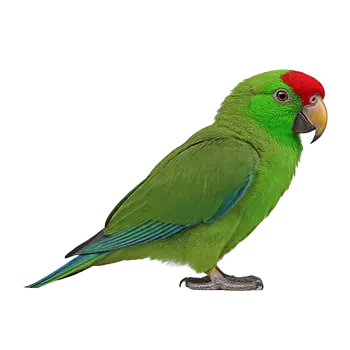

The Red-Lored Amazon (Amazona autumnalis) is a medium-sized parrot native to the tropical and subtropical lowland forests stretching from eastern Mexico through Central America and into northwestern South America. Its range encompasses the Atlantic slope of Mexico from southern Tamaulipas through the Yucatan Peninsula, continues through Guatemala, Belize, Honduras, Nicaragua, Costa Rica, and Panama, and extends into the Pacific lowlands of Colombia and Ecuador. Several subspecies have been described across this extensive range, including Amazona autumnalis autumnalis, the nominate form found from Mexico to northern Nicaragua, and Amazona autumnalis salvini, which occupies the southern portion of the range from Nicaragua through Colombia and into northwestern Venezuela.
The species thrives in a variety of forested habitats, from dense humid lowland rainforest and semi-deciduous tropical forest to mangrove swamps and forest edges bordering agricultural clearings. Red-Lored Amazons are most commonly found below elevations of around 1,100 meters, preferring areas where mature canopy trees provide nesting cavities and a steady supply of fruiting and flowering species. They are particularly associated with riverine corridors and seasonally flooded forest, where food resources tend to be abundant and diverse.
In their native habitat, Red-Lored Amazons are highly social birds that form pairs or small family groups during the breeding season and congregate into larger flocks outside of it. Evening roost flights, during which scores or even hundreds of birds travel to communal sleeping sites in tall trees, are a characteristic spectacle across much of their range. These roosts serve not only as resting places but also as information-sharing hubs where birds may learn about productive feeding locations from other flock members.
The diet of wild Red-Lored Amazons centers on seeds, nuts, fruits, berries, flowers, and leaf buds, shifting with seasonal availability. They play a meaningful ecological role as seed dispersers and, in some cases, seed predators, influencing the composition and regeneration of the forests they inhabit. The species' reliance on tree cavities for nesting makes it particularly sensitive to the loss of old-growth forest, a factor that has shaped both its population dynamics and its conservation trajectory over the past century.