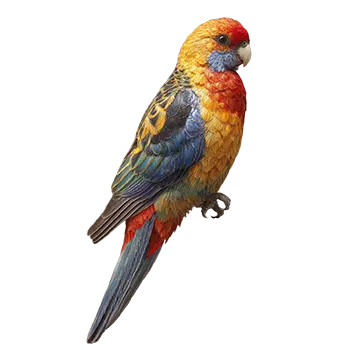

The Golden-Mantled Rosella (Platycercus eximius cecilae) is a subspecies of the Eastern Rosella, one of the most recognizable and widely distributed parrots on the Australian continent. Its range is centered on the inland slopes and tablelands of southeastern Australia, spanning portions of New South Wales and extending into parts of northeastern Victoria. The subspecies occupies a geographic band between the coastal-dwelling nominate Eastern Rosella (Platycercus eximius eximius) and the paler populations found farther inland, inhabiting open woodland, lightly timbered grassland, farmland margins, and orchards at moderate elevations.
The landscape that shaped the Golden-Mantled Rosella is defined by eucalypt woodland interspersed with grassy clearings, a habitat mosaic that provides both nesting hollows in mature trees and abundant ground-level foraging opportunities. These birds feed primarily on grass seeds, cereal crops, fruits, blossoms, and insects, moving across the ground in small flocks with a distinctive undulating flight pattern between feeding sites. Their reliance on tree hollows for nesting ties them closely to older-growth woodland, making the availability of suitable cavities a critical factor in local population density.
The subspecies is distinguished from the nominate Eastern Rosella by its richer, more golden-yellow mantle and nape plumage, which replaces the greenish-yellow tones of the coastal form. The head retains the vivid red characteristic of all Eastern Rosellas, while the breast typically shows a brighter yellow wash that transitions into pale green on the lower abdomen. These plumage differences, though subtle to the casual observer, are consistent across the subspecies' range and reflect adaptation to the drier, more continental interior environment.
The broader Platycercus genus, commonly known as the broadtails, comprises a diverse group of medium-sized parrots endemic to Australia and nearby islands. Fossil evidence and molecular phylogenetics suggest that the genus diversified across the continent as Australia's climate shifted during the late Miocene and Pliocene, with eucalypt woodland habitats expanding and contracting in response to changing rainfall patterns. The Golden-Mantled Rosella's niche within this evolutionary picture reflects a successful adaptation to the transitional zone between coastal and arid environments, a habitat corridor that has supported stable populations for millennia.