
Representation in Visual Art & Illustration

The Eastern Rosella complex, of which the Golden-Mantled form is a part, has been a subject of artistic fascination since the earliest European encounters with Australian wildlife. Colonial-era natural history artists, including figures such as John Gould and Elizabeth Gould, produced detailed lithographic plates of the Eastern Rosella that remain among the most celebrated images in ornithological illustration. These works, published in volumes like The Birds of Australia during the 1840s, introduced European audiences to the rosella's extraordinary plumage and established a visual template that artists have drawn upon ever since.

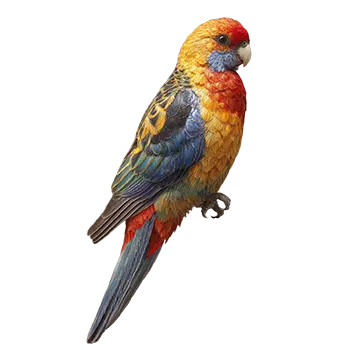
The Golden-Mantled Rosella's particular combination of warm yellow, vivid red, and blue-green cheek patches makes it an especially rewarding subject for contemporary wildlife illustrators and painters. Australian botanical and wildlife artists frequently feature rosellas in works that pair native birds with their habitat plants, creating compositions that serve both aesthetic and ecological purposes. These illustrations appear in field guides, interpretive signage at nature reserves, and gallery exhibitions dedicated to Australian fauna, reinforcing the rosella's position as an iconic representative of the continent's avian diversity.

Beyond fine art and scientific illustration, rosellas have been absorbed into the broader Australian decorative tradition. Their likeness appears on ceramics, textiles, greeting cards, and household items, often rendered in a stylized or folk-art manner that emphasizes bold color and pattern. This commercial visibility ensures that even Australians who rarely encounter rosellas in the wild are familiar with the bird's image, embedding it deeply in the national visual culture.

Indigenous Australian art traditions also engage with parrot imagery, though the representations differ fundamentally from the naturalistic European approach. In Aboriginal art, birds including rosellas may be depicted through symbolic forms, dot painting, and cross-hatching that convey ecological and spiritual meaning rather than anatomical detail. These works reflect a relationship with the species that encompasses ecological knowledge, ancestral narrative, and cultural identity, offering perspectives on the rosella that complement and enrich the naturalistic tradition.

Wildlife Film & Television

The Eastern Rosella is a staple of Australian wildlife documentary programming, appearing regularly in productions that survey the continent's bird diversity. Television series focused on Australian natural history routinely feature footage of rosellas feeding, flying, and nesting, using the species as a visually accessible entry point for audiences unfamiliar with the broader Australian parrot fauna. The Golden-Mantled form's vivid coloration translates exceptionally well to high-definition video, and cinematographers working in the New South Wales tablelands frequently capture the subspecies as part of broader landscape sequences.

International nature documentaries produced by major broadcasters have also featured Eastern Rosellas, typically within episodes dedicated to Australian wildlife or global parrot diversity. These appearances, while often brief, expose global audiences to the rosella's distinctive appearance and behaviors, contributing to the species' recognition outside Australia. Segments that depict rosellas competing for nesting hollows or foraging in mixed-species flocks provide engaging natural drama that filmmakers find both visually compelling and narratively useful.

Beyond conventional wildlife documentaries, rosellas have appeared in Australian lifestyle and travel programming. Shows that explore regional Australia, rural living, or backyard birdwatching frequently include rosella sightings as markers of place and season. The birds' willingness to visit garden feeders and birdbaths makes them accessible subjects for this style of production, and their presence lends a sense of natural authenticity to programs that celebrate Australian outdoor life.

Educational media aimed at younger audiences has embraced the rosella as a representative Australian bird. Children's programs and school resources frequently use the Eastern Rosella to introduce concepts in ecology, adaptation, and conservation, taking advantage of the bird's bright colors and active behavior to hold young viewers' attention. These educational appearances may not distinguish between Eastern Rosella subspecies, but they contribute to a general familiarity with rosella form and behavior that shapes public attitudes toward the species from an early age.

Literature & Print Media

Rosellas have occupied a place in Australian literature since the colonial period, when natural history writing and bush poetry first began documenting the sights and sounds of the Australian landscape for European audiences. Writers of the 19th century frequently referenced the flash of rosella plumage as a shorthand for the exotic beauty of the Australian bush, and the birds' calls became part of the soundscape evoked in pastoral and frontier narratives. While these literary references rarely distinguished between rosella subspecies, they collectively established the rosella as a symbol of the Australian environment in the broader English-language literary tradition.

In the 20th century, Australian children's literature embraced rosellas as characters and subjects. Picture books, early readers, and educational texts featured rosellas in stories about bush animals, backyard wildlife, and conservation themes. The rosella's bright plumage and recognizable silhouette made it a natural choice for illustration-driven formats, and generations of Australian schoolchildren have encountered the species through classroom materials that use the bird to teach concepts in biology and environmental stewardship.

Avicultural literature has provided the most detailed and sustained written treatment of the Golden-Mantled Rosella as a distinct form. Specialist magazines, breed society journals, and aviculture handbooks published in Australia, the United Kingdom, and continental Europe have devoted articles and chapters to the subspecies' husbandry, breeding, color genetics, and exhibition standards. These publications, while niche in audience, represent the most concentrated body of knowledge about the Golden-Mantled Rosella's characteristics and care, and they continue to serve as primary references for keepers worldwide.

Field guides and regional bird identification books provide another important print context for the Golden-Mantled Rosella. Guides covering the birds of New South Wales or southeastern Australia typically include distribution maps and descriptions that distinguish the Golden-Mantled form from the nominate Eastern Rosella, helping birdwatchers and naturalists appreciate the geographic variation within the species. These references, updated periodically to reflect new taxonomic and distributional data, anchor the subspecies in the formal ornithological record and make it accessible to a broad audience of nature enthusiasts.

Photography & Social Media

The rise of digital photography and social media has dramatically expanded the Golden-Mantled Rosella's visibility beyond specialist avicultural and ornithological circles. Birdwatching photography has become one of the fastest-growing nature hobbies worldwide, and Australian species, with their vivid plumage and cooperative behavior around feeders, are among the most frequently photographed and shared. Eastern Rosellas, including the Golden-Mantled form, appear regularly on platforms where wildlife photographers post images, generating engagement from audiences on every continent.

The Golden-Mantled Rosella's rich coloration presents particular rewards for photographers working with natural light. The interplay of red, yellow, and blue-green plumage against the muted tones of eucalypt bark or dry grass creates images with strong visual impact, and the subspecies' habit of feeding on the ground in open settings provides relatively accessible shooting opportunities. Photographers working in the New South Wales tablelands and adjacent regions have produced portfolios featuring the subspecies that circulate widely through online galleries, photography competitions, and social media feeds.

Avicultural social media communities have created dedicated spaces for rosella enthusiasts to share images, breeding updates, and husbandry advice. Groups and forums focused on Australian parrots, broadtails, or rosellas specifically attract members from multiple countries, fostering a global conversation about the species that transcends traditional geographic and linguistic barriers. The Golden-Mantled Rosella's appealing appearance makes it a popular subject within these communities, and photographs of well-presented aviary birds often generate substantial discussion about plumage quality, mutation forms, and breeding outcomes.

Citizen science platforms have added a data-driven dimension to the rosella's social media presence. Birdwatching applications and databases that allow users to log sightings with photographs have accumulated large datasets on Eastern Rosella distribution and abundance, including records that help track the geographic boundaries of the Golden-Mantled form. These platforms convert casual photography into ecological information, demonstrating how the species' photogenic appeal can contribute to scientific understanding when channeled through structured reporting frameworks.

Branding, Merchandise & Commercial Use

The rosella's image has been commercially leveraged in Australia for well over a century. The most prominent example remains the Rosella brand, originally established in the late 19th century as a manufacturer of tomato sauce and condiments. The brand adopted the rosella as its namesake and logo, and the association between the bird and Australian-made food products persisted through decades of commercial life. Though ownership and branding have evolved over time, the historical connection between the rosella image and Australian consumer products remains a recognizable cultural reference point.

Beyond food branding, rosella imagery appears across a wide range of Australian merchandise and commercial applications. Tourism operators, particularly those in regions where rosellas are common, incorporate the bird into promotional materials, regional branding, and visitor center displays. Wineries, bed-and-breakfast accommodations, and nature-based tourism businesses in southeastern Australia frequently use rosella motifs to signal a connection to the local landscape and wildlife, trading on the bird's aesthetic appeal and positive associations.

The Golden-Mantled Rosella specifically has featured in avicultural merchandise and specialty products aimed at bird keepers. Prints, calendars, and breed-specific items carrying the subspecies' likeness are available through avicultural society shops and online retailers. These products cater to a niche but enthusiastic market of rosella enthusiasts who value the bird not only as a living companion but as an aesthetic object worthy of display and celebration in its own right.

Philatelic and numismatic use of rosella imagery has further embedded the species in Australian commercial culture. Australia Post has issued stamps featuring Eastern Rosellas on multiple occasions, and the bird has appeared on commemorative coins and collector items that celebrate Australian wildlife. These official uses lend the rosella an institutional endorsement that reinforces its status as a nationally significant species, one whose image carries weight in both commercial and cultural contexts.

Online Communities & Digital Culture

The internet has transformed the way rosella enthusiasts connect, share knowledge, and build community. Online forums dedicated to Australian parrots and broadtail species emerged in the early days of the web and have since grown into active, well-moderated spaces where keepers exchange detailed information about breeding, nutrition, veterinary care, and aviary design. The Golden-Mantled Rosella features prominently in these discussions, with threads covering topics from subspecific identification to the management of color mutations in captive lines.

Social media groups on major platforms have supplemented and in some cases supplanted traditional forums, offering faster-paced, image-rich environments for rosella discussion. Groups with thousands of members spanning multiple countries allow keepers to post photographs, ask questions, and share experiences in near real time. The visual nature of these platforms favors the rosella, whose striking plumage generates immediate engagement and encourages participation from newer keepers who may be drawn to the species primarily by its appearance.

Video-sharing platforms have enabled rosella keepers to document and share aspects of bird behavior and care that are difficult to convey through text and photographs alone. Videos of Golden-Mantled Rosellas bathing, vocalizing, interacting with enrichment items, or displaying courtship behavior attract viewers from both within and outside the avicultural community. Educational content produced by experienced keepers and avian veterinarians provides accessible guidance on rosella husbandry, reaching audiences who might not otherwise encounter specialist avicultural publications.

The cumulative effect of this digital activity has been to broaden the Golden-Mantled Rosella's cultural footprint well beyond its traditional base of Australian and European aviculturists. Prospective keepers in regions where rosellas are less established can now access detailed, experience-based information before acquiring birds, raising the overall standard of care and awareness. Online communities also serve a conservation awareness function, providing platforms for discussion of wild population status, habitat protection, and the ethical dimensions of parrot keeping that reach audiences at scale.

Always consult a qualified professional before making any health-related decisions. This content is provided for informational reference only and should not replace professional guidance specific to your animal.