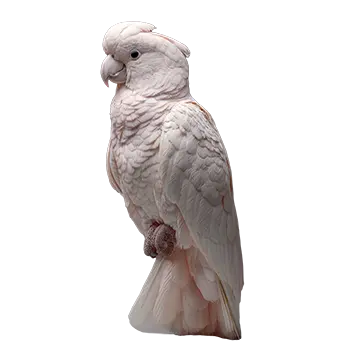

The Goffin's Cockatoo (Cacatua goffiniana) is endemic to the Tanimbar Islands, a small archipelago in the Maluku province of eastern Indonesia situated between the Banda Sea and the Arafura Sea. The species' range is remarkably compact compared to most cockatoos, centered primarily on the island of Yamdena, the largest landmass in the chain, with smaller populations on Larat and a handful of neighboring islets. This limited distribution makes the Goffin's Cockatoo one of the most geographically restricted members of the entire cockatoo family.
The Tanimbar archipelago is characterized by monsoon-influenced tropical forest, with terrain ranging from coastal mangroves and lowland rainforest to drier deciduous woodland at slightly higher elevations. Goffin's Cockatoos inhabit all of these zones but show a particular affinity for the edges of primary forest, secondary growth areas, and agricultural land where they forage on seeds, fruits, nuts, and insect larvae. Their willingness to exploit cultivated crops, especially maize and rice, has historically brought them into direct contact and occasional conflict with local farming communities.
Unlike many larger cockatoo species that depend on old-growth trees with large natural hollows for nesting, the Goffin's Cockatoo is somewhat more flexible in its cavity selection, using smaller hollows and occasionally adapting to disturbed forest environments. This ecological adaptability has helped buffer the species against some of the habitat pressures that have devastated other Indonesian parrots, though it has not rendered the bird immune to the combined effects of deforestation and trapping.
The geological and biological isolation of the Tanimbar group has fostered a distinctive local fauna, and the Goffin's Cockatoo is often regarded as one of the archipelago's most emblematic species. Its evolution in this insular setting, separated from the larger cockatoo populations of Australia and New Guinea, has produced a bird that is notably smaller and more behaviorally inventive than many of its continental relatives, traits that would later prove central to its appeal as a companion animal and its significance in cognitive research.