
Viral Videos & Social Media Stardom

The Goffin's Cockatoo's rise to public visibility owes an enormous debt to social media, where short video clips showcasing the species' intelligence and antic behavior have reached audiences numbering in the millions. Platforms such as YouTube, Instagram, and TikTok have become primary vehicles for exposing the general public to this relatively small and understated cockatoo, which might otherwise remain unfamiliar to anyone outside dedicated avicultural circles. The species' combination of mechanical ingenuity, physical comedy, and expressive body language translates exceptionally well to short-form video content.

Among the most widely circulated clips are those documenting Goffin's Cockatoos picking locks, unscrewing bolts, dismantling household objects, and devising creative escape routes from their enclosures. These videos resonate because the behaviors they capture are genuinely spontaneous rather than trained tricks, offering viewers an unscripted window into the bird's problem-solving process. The visible concentration on a Goffin's face as it works through a mechanical puzzle, followed by what can only be described as a celebratory display upon success, creates a narrative arc that audiences find irresistible.

Owner-generated content has also highlighted the species' social and emotional range. Videos of Goffin's Cockatoos dancing to music, engaging in elaborate play routines with toys and household items, or demanding attention from their human companions with theatrical vocalizations have accumulated substantial followings. Several individual birds have become recurring characters on their owners' social media accounts, building recognizable personalities that followers track over months and years.

The cumulative effect of this social media presence has been a meaningful shift in public awareness. Species that were once known primarily to breeders and experienced parrot keepers are now recognized by a much broader audience, and the Goffin's Cockatoo has benefited disproportionately from this trend. Its intelligence provides an inexhaustible supply of shareable moments, and the accessibility of the content has helped position the species as a gateway into broader public interest in avian cognition and parrot welfare.

Documentary & Science Media Coverage

The Goffin's Cockatoo's prominence in cognitive research has made it a frequent subject in science documentaries and educational programming. Television productions exploring animal intelligence, tool use, and the evolution of cognition have featured footage from the University of Veterinary Medicine Vienna's research laboratory, where captive Goffin's Cockatoos have demonstrated their problem-solving abilities under controlled experimental conditions. These segments typically pair striking visual evidence of the birds' capabilities with expert commentary from researchers, creating compelling narratives that bridge the gap between academic science and public understanding.

Broadcasters including the BBC, PBS, and National Geographic have incorporated Goffin's Cockatoo research into broader programs about animal minds, often positioning the species alongside other celebrated non-human problem solvers such as New Caledonian Crows, chimpanzees, and octopuses. The visual drama of a small white bird methodically fashioning a tool from raw material or sequentially defeating a series of mechanical locks provides the kind of concrete, visually legible evidence of intelligence that documentary filmmakers prize. These appearances have introduced the species to audiences who might never encounter it in a pet store or aviary.

Science journalism has also given the Goffin's Cockatoo significant coverage in print and digital media. Peer-reviewed studies emerging from the Vienna laboratory have been reported on by outlets ranging from Nature and Science to the New York Times and the Guardian, with headlines emphasizing the surprising sophistication of the birds' cognitive feats. Articles about Goffin's tool manufacture, delayed gratification experiments, and social learning studies have consistently generated high reader engagement, reflecting broad public fascination with animal intelligence stories.

The species' media profile in the science communication space has had practical benefits beyond public education. Increased visibility has contributed to funding support for ongoing research programs, attracted graduate students and postdoctoral researchers to the field of avian cognition, and fostered collaborations between laboratories studying different aspects of parrot intelligence. In this sense, media coverage has not merely reported on the science but has actively helped sustain and expand it.

Published Research & Academic Influence

The Goffin's Cockatoo has become one of the most intensively studied parrot species in the field of comparative cognition, generating a body of peer-reviewed literature that has reshaped understanding of avian intelligence. The research program led by Dr. Alice Auersperg at the University of Veterinary Medicine Vienna has produced dozens of publications in journals including Current Biology, Proceedings of the Royal Society B, PLOS ONE, and Animal Cognition. These papers cover a range of topics from tool manufacture and use to self-control, innovation, social learning, and combinatory object manipulation.

The species' tool-use research has been particularly influential within the academic community. The demonstration that Goffin's Cockatoos could spontaneously manufacture tools without prior training or exposure to tool-using models challenged the prevailing assumption that sophisticated tool use in birds was limited to corvids, particularly New Caledonian Crows. This finding prompted a reexamination of the cognitive prerequisites for tool use and contributed to a broader theoretical shift recognizing that complex problem-solving abilities have evolved independently in multiple avian lineages.

Beyond tool use, studies of Goffin's Cockatoo cognition have contributed to debates about the evolution of self-control, the role of play in cognitive development, and the mechanisms underlying social learning in non-human animals. Experiments demonstrating that Goffin's Cockatoos could resist an immediate food reward in favor of a preferred reward delivered after a delay placed the species' self-regulatory abilities on par with those documented in great apes, adding to evidence that executive function is more widely distributed across the animal kingdom than previously recognized.

The cumulative impact of this research extends well beyond the species itself. Goffin's Cockatoo studies are now routinely cited in review articles, textbooks, and meta-analyses addressing comparative cognition, animal intelligence, and the evolution of complex behavior. The species has become a standard reference point in academic discussions about what non-human animals can achieve cognitively, and its presence in the scientific literature continues to grow as new studies are published.

Books & Popular Science Writing

The Goffin's Cockatoo has featured prominently in a growing body of popular science writing devoted to animal intelligence and the inner lives of birds. Books exploring avian cognition frequently devote significant attention to the species, using its tool-making exploits and puzzle-solving abilities as vivid case studies that make abstract cognitive concepts accessible to general readers. The narrative appeal of a small, unassuming white parrot outperforming expectations has proven irresistible to authors seeking to communicate the richness of animal minds.

Jennifer Ackerman's widely read works on bird intelligence have helped bring the Goffin's Cockatoo to the attention of a mainstream readership, weaving the species' cognitive achievements into broader arguments about the underestimated mental capacities of birds. These accounts typically ground the science in engaging descriptions of individual birds and their behaviors, creating a personal dimension that resonates with readers who may have no prior familiarity with avian research. The result has been a significant expansion of the audience aware of the Goffin's Cockatoo and its remarkable abilities.

Avicultural publications and specialty bird-keeping magazines have also devoted extensive coverage to the species, though with a different emphasis. In these contexts, the focus tends to fall on husbandry, behavioral management, and the practical implications of living with an exceptionally intelligent companion bird. Articles in publications such as Bird Talk, Parrots magazine, and various online avicultural journals have explored topics including diet, enrichment strategies, socialization techniques, and the particular challenges posed by the Goffin's mechanical aptitude and need for constant stimulation.

The species' growing presence in published writing, spanning the range from rigorous popular science to practical pet-keeping guides, reflects its dual identity as both a subject of serious scientific inquiry and a beloved companion animal. This literary footprint has contributed to a more nuanced public understanding of the Goffin's Cockatoo, encouraging prospective owners to appreciate the depth of commitment the species requires while celebrating the extraordinary cognitive gifts that make it such a compelling animal to study and live with.

Photography & Visual Arts

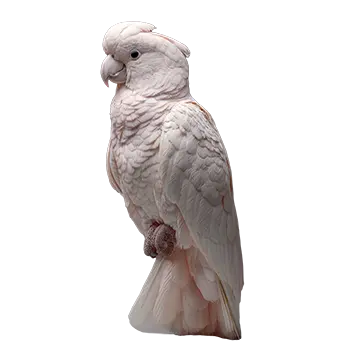
The Goffin's Cockatoo presents a distinctive challenge and opportunity for wildlife and avian photographers. Its predominantly white plumage, accented by subtle salmon-pink lores, pale yellow underwing and undertail markings, and a short recumbent crest, demands careful attention to lighting and exposure to capture the textural nuance that distinguishes the species from the flat white that a casual snapshot might produce. Accomplished bird photographers have produced striking portraits that reveal the delicate feather structure, expressive dark eyes, and animated postures that give the Goffin's its characteristic personality.

In the wild, photographic documentation of the species has been limited by the remoteness and relative inaccessibility of the Tanimbar Islands. Field photographers who have made the journey have produced images that serve important roles in conservation awareness, showing the birds in their native forest and agricultural habitats and providing visual evidence of the environmental conditions facing wild populations. These images appear in conservation reports, ornithological field guides, and educational materials produced by organizations working to protect Indonesian birdlife.

Captive Goffin's Cockatoos have proven more accessible to photographers and have become popular subjects in contexts ranging from professional avian portraiture to casual owner photography shared on social media. The species' expressiveness and willingness to interact with objects, people, and cameras makes it a cooperative and visually engaging subject. Images capturing a Goffin's mid-puzzle, crest raised in concentration, or splayed in an exuberant play posture have become iconic representations of cockatoo intelligence and personality in the avicultural community.

While the Goffin's Cockatoo has not yet become a prominent subject in fine art to the degree that more visually dramatic species have, its growing cultural profile suggests that this may change. Contemporary wildlife artists and illustrators have begun featuring the species in works that emphasize cognition and behavior over purely aesthetic appeal, reflecting a broader shift in animal art toward subjects that tell stories about intelligence, adaptation, and the complexity of animal lives.

Online Communities & Cultural Impact

The internet has been instrumental in building a global community around the Goffin's Cockatoo, connecting owners, breeders, researchers, and admirers who might otherwise have remained isolated. Dedicated forums, Facebook groups, and subreddits focused on cockatoo species or parrot keeping more broadly serve as hubs for the exchange of husbandry advice, behavioral observations, veterinary recommendations, and the endless stream of anecdotes and images that characterize life with these birds. Within these spaces, the Goffin's Cockatoo has developed a distinctive reputation as the thinking person's cockatoo, valued for its intelligence and manageable size.

These online communities have played a meaningful role in improving the standard of care for captive Goffin's Cockatoos. Experienced keepers share enrichment ideas, dietary protocols, and strategies for managing common behavioral issues such as feather destruction and excessive bonding. Newcomers to the species benefit from access to a collective knowledge base that would have been difficult to assemble before the internet era, and the open discussion of challenges as well as rewards helps set realistic expectations for prospective owners.

The cultural impact of the Goffin's Cockatoo extends beyond the avicultural community into broader conversations about animal intelligence, ethical pet keeping, and conservation. The species has become a frequently cited example in popular discussions about the cognitive abilities of birds, often invoked alongside corvids and African Grey Parrots as evidence that avian intelligence rivals that of primates in certain domains. This positioning has contributed to a gradual shift in public attitudes toward birds, challenging the dismissive connotations historically associated with terms like birdbrain.

The Goffin's Cockatoo's cultural trajectory over the past two decades illustrates how the convergence of scientific research, digital media, and community building can transform the public profile of a species. What was once a little-known island endemic, familiar mainly to Indonesian villagers and specialist ornithologists, has become a recognized symbol of avian intelligence with a dedicated global following. This transformation has been driven not by traditional media gatekeepers but by the distributed efforts of researchers sharing their findings, owners sharing their experiences, and audiences responding to the inherent appeal of a small, white bird that is far more than it first appears.

Always consult a qualified professional before making any health-related decisions. This content is provided for informational reference only and should not replace professional guidance specific to your animal.