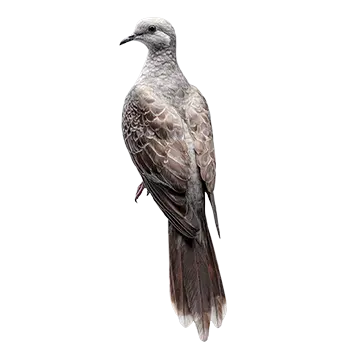

The Cape Dove (Oena capensis), widely known as the Namaqua Dove, is the sole member of the genus Oena and one of the smallest doves found anywhere on the African continent. Its natural range encompasses a vast sweep of sub-Saharan Africa, from the semi-arid Karoo and Namaqualand regions of South Africa northward through Botswana, Namibia, Zimbabwe, and East Africa into the dry savannas of the Sahel. Isolated populations also exist on Madagascar and parts of the southwestern Arabian Peninsula, likely the result of ancient dispersal events across the Mozambique Channel and the Red Sea.
The species is strongly associated with arid and semi-arid environments, a habitat preference that sets it apart from many of its columbid relatives. Cape Doves favor open grasslands, thornveld, scrubby bushland, and the edges of cultivated fields, where they forage almost exclusively on the ground for small seeds. Their slender build, elongated central tail feathers, and rapid, direct flight are all adaptations to life in dry, open country where cover is scarce and the ability to move quickly between food and water sources is essential for survival.
Water dependence is a defining feature of the Cape Dove's ecology. Unlike some desert-adapted birds that can extract sufficient moisture from their food, Cape Doves must drink regularly, and their daily movements often revolve around visits to waterholes, stock troughs, and river margins. This behavior makes them a conspicuous presence at water sources throughout their range, where flocks may gather in impressive numbers during the dry season. Their predictable appearance at such sites has made them familiar to pastoralists, farmers, and naturalists alike for centuries.
The species' long, graduated tail, unusual among doves of its size, gives it a distinctive silhouette that is immediately recognizable in the field. Males display striking sexual dimorphism, with a black face, throat, and upper breast contrasting sharply with pale underparts and a yellow-tipped bill. Females are plainer, lacking the dark facial mask and displaying a more uniformly brownish plumage. This clear difference between the sexes likely played a role in how early human observers perceived and named the bird across different cultures and languages.