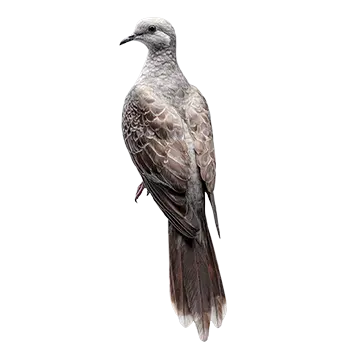

The Cape Dove has a long presence in the tradition of natural history illustration, dating to the earliest European expeditions into southern Africa. Colonial-era naturalists and artist-explorers produced some of the first detailed depictions of the species during the 18th and 19th centuries, drawn from specimens collected in the Cape Colony and surrounding regions. These early illustrations, rendered in watercolor and engraving, emphasized the bird's distinctive long tail, compact body, and the bold black facial mask of the male, features that made it a visually appealing subject for the detailed plates that accompanied published accounts of African fauna.
Among the most notable early depictions are those found in the ornithological works produced during the great era of African natural history publishing. Artists working with collectors and naturalists in South Africa captured the Cape Dove in careful profile views that adhered to the conventions of scientific illustration while also conveying something of the bird's character. The contrast between the ornate male and the subtler female was frequently highlighted, with paired illustrations showing both sexes side by side, a format that served both scientific documentation and aesthetic appeal.
As lithographic printing advanced in the 19th century, the Cape Dove appeared in several major ornithological compilations covering the birds of Africa. These plates circulated among collectors, universities, and natural history societies across Europe, establishing the species' visual identity for audiences who would never encounter it in the wild. The elegance of the male's plumage pattern, with its clean division between black and white, made it a particularly satisfying subject for the medium, and some of these lithographs remain prized by collectors of antique natural history prints.
In the modern era, the Cape Dove continues to appear in illustrated field guides, regional bird atlases, and popular natural history books covering African avifauna. Contemporary illustrators working in both traditional and digital media have depicted the species with increasing attention to behavioral context, showing Cape Doves at waterholes, in courtship displays, or in flight against arid landscapes. These modern illustrations serve not only as identification aids but as artistic interpretations that connect viewers to the bird's habitat and way of life.