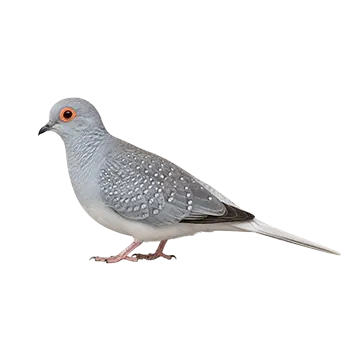

The Diamond Dove (Geopelia cuneata) derives its charming common name from the distinctive white spots scattered across the wings that sparkle like diamonds, creating beautiful patterning against the soft grey plumage. These white spots are the species' most recognizable feature, visible both when birds are at rest and particularly striking when wings are spread during flight. The name "diamond" perfectly captures the gem-like quality of these markings, and the species is universally known as the Diamond Dove throughout aviculture and ornithological literature with no significant alternate common names in use.
Taxonomically, the Diamond Dove belongs to the genus Geopelia within the family Columbidae (pigeons and doves), a large, diverse group of birds found worldwide. The family Columbidae contains hundreds of species ranging from tiny ground doves to large pigeons, all sharing characteristic features including seed-based diets, ability to drink by sucking (unlike most birds that must tilt heads to swallow), production of crop milk to feed chicks, and distinctive cooing vocalizations. The genus Geopelia contains small, terrestrial doves primarily distributed across Australia and nearby regions, with the Diamond Dove being the smallest member of this genus.
The scientific name Geopelia cuneata combines Greek and Latin elements descriptive of the species. "Geopelia" derives from Greek "geo" (earth/ground) and "peleia" (dove), referencing the species' terrestrial habits and preference for ground foraging. "Cuneata" comes from Latin "cuneus" (wedge), referring to the wedge-shaped tail that tapers to a point, distinguishing it from square or rounded tails of some relatives. The scientific nomenclature thus encapsulates both behavioral (ground-dwelling) and physical (wedge-shaped tail) characteristics.
Geographic variation within the species is minimal, with the Diamond Dove generally considered monotypic (no recognized subspecies). Individual variation exists in intensity of grey plumage and size of white wing spots, with some populations showing subtle differences, but these variations are not considered sufficient to warrant subspecies designation. The species displays remarkable consistency across its Australian range, likely reflecting relatively recent evolutionary history and gene flow across populations.
In aviculture and among bird enthusiasts, Diamond Doves are recognized as classic beginner birds and staple aviary species. They have been kept in captivity for well over a century with multiple generations of captive breeding establishing them as completely domesticated in behavioral terms. Captive-bred Diamond Doves are readily available worldwide at affordable prices, making them accessible to virtually anyone interested in aviculture. They are particularly popular in mixed aviaries where their peaceful nature allows cohabitation with finches and other small, non-aggressive species.
The species belongs to a broader group of small Australian doves sometimes called "peaceful doves" or "turtle doves," though these terms can be ambiguous. Other Geopelia species include the Peaceful Dove (Geopelia placida, formerly considered conspecific with G. striata), Bar-shouldered Dove (Geopelia humeralis), and others. The Diamond Dove is the smallest and most commonly kept in aviculture, with its distinctive spotted pattern making identification straightforward.
Historically, Diamond Doves were exported from Australia in large numbers during the 19th and early 20th centuries before export restrictions were implemented. However, established captive breeding populations worldwide eliminated dependence on wild birds, and today virtually all Diamond Doves in aviculture are captive-bred. This successful captive propagation represents one of aviculture's great achievements, ensuring availability without ongoing wild harvesting.