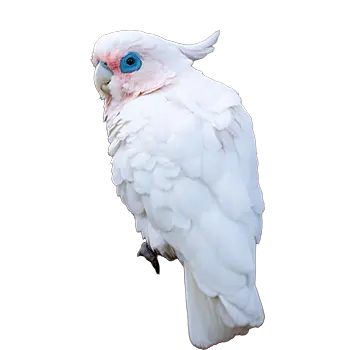

Origins & Natural Habitat

The Bare-Eyed Cockatoo (Cacatua sanguinea), also widely known as the Little Corella, is native to the arid and semi-arid regions of Australia, with a smaller population occurring in the lowlands of southern New Guinea. Its range across Australia is extensive, spanning from the interior grasslands and open woodlands of Queensland and New South Wales westward through South Australia and into Western Australia. The species thrives in environments that many other cockatoos avoid, demonstrating a marked tolerance for dry heat, sparse tree cover, and landscapes shaped by seasonal drought.

The bird's preferred habitats include open eucalyptus woodland, grassland with scattered trees, agricultural margins, and riverine corridors where water sources persist through dry seasons. Unlike the rainforest-dwelling cockatoos of the tropics, the Bare-Eyed Cockatoo has evolved alongside the open country of inland Australia, where it forages primarily on the ground for seeds, roots, tubers, and grain. Its powerful bill is well adapted for digging into hard-packed soil to extract buried food, a behavior that distinguishes it from many of its arboreal relatives.

Socially, the species is among the most gregarious of all cockatoos. Bare-Eyed Cockatoos gather in flocks that can number in the hundreds or even thousands, roosting communally in large trees near permanent water. These enormous aggregations are a striking feature of the Australian outback, and their synchronized flights at dawn and dusk create visual spectacles that have long captured the attention of both indigenous peoples and European settlers. The flock dynamics of the species are complex, with birds forming long-term pair bonds within the larger social group.

The Bare-Eyed Cockatoo's success in Australia's interior is closely tied to its adaptability. As European colonization transformed the landscape through agriculture and the creation of stock watering points, the species expanded its range and increased its numbers significantly. What was once a bird of the dry interior became increasingly common in coastal and suburban regions, a trajectory that has shaped both its ecological status and its complex relationship with human communities.

Indigenous Connections & Early Human History

Aboriginal Australians have lived alongside the Bare-Eyed Cockatoo for tens of thousands of years, and the bird occupies a recognized place in the cultural and ecological knowledge systems of many indigenous groups. In the oral traditions of peoples across central and western Australia, the Little Corella appears as a familiar presence in stories that explain the natural world, mark seasonal changes, and encode practical information about land management. The appearance of large Corella flocks at particular waterholes, for instance, served as an indicator of environmental conditions and seasonal availability of resources.

In some Aboriginal language groups, the bird's name reflects its physical characteristics or behavior. The bare bluish-grey skin around its eye, which gives the species its common English name, is a distinctive feature that lends itself to descriptive naming traditions. The cockatoo's raucous calls and playful aerial antics also feature in stories that emphasize trickery, sociability, and the importance of community. While the specific content of these traditions varies across the continent's diverse language groups, the bird's prominence in indigenous knowledge is consistent.

European awareness of the Bare-Eyed Cockatoo began with the earliest explorations of inland Australia. The species was formally described by John Gould in 1843, drawing on specimens collected during expeditions into the Australian interior. Gould, whose monumental work on Australian birds remains a foundational text in ornithology, noted the bird's abundance, its conspicuous flocking behavior, and its willingness to approach human settlements. Early colonial accounts frequently mention large flocks descending on grain crops, establishing a pattern of human-cockatoo conflict that persists to this day.

Throughout the 19th century, the Bare-Eyed Cockatoo was regarded primarily as a wild bird of the bush rather than a candidate for domestication. While some colonists kept individual birds as pets, the species did not achieve the international fame of the Sulphur-Crested Cockatoo or the Galah during this period. Its journey into the companion bird trade would come later, driven by shifts in avicultural interest and a growing appreciation for the species' remarkable personality.

Cultural Symbolism & Place in Australian Identity

In the broader tapestry of Australian cultural life, the Bare-Eyed Cockatoo is inseparable from the image of the outback itself. Flocks of white cockatoos wheeling above red earth and scattered gum trees are among the most iconic visual motifs of inland Australia, and the Little Corella contributes to this imagery alongside its larger cousin, the Sulphur-Crested Cockatoo. For many Australians, the raucous dawn chorus of a Corella flock is the quintessential sound of the bush, evoking a landscape that is simultaneously harsh and teeming with life.

The bird's reputation in rural communities is decidedly mixed. Farmers have long viewed the species with a combination of admiration and exasperation, as large flocks can strip newly sown grain fields in a matter of hours and damage infrastructure by chewing on wooden fences, irrigation lines, and even electrical cabling. This destructive capacity has made the Bare-Eyed Cockatoo a regular subject in the folklore of rural Australia, where stories of cockatoo cunning and persistence are traded with a mixture of humor and genuine frustration.

In Australian art and literature, cockatoos in general hold a special place, and the Bare-Eyed Cockatoo contributes to this tradition, particularly in works that engage with the landscape of the interior. Painters of the Australian bush have depicted Corella flocks as expressions of wildness and freedom, while writers have used the bird's noisy sociability as a metaphor for community, resilience, and the untamed spirit of the continent. The species also appears in children's literature and educational materials, where its playful nature and approachable size make it an appealing subject for young readers.

More recently, the Bare-Eyed Cockatoo has become a symbol in debates about urban wildlife management. As flocks have moved into suburban areas across southern Australia, the birds have divided public opinion between those who welcome their presence as a connection to the natural world and those who view them as noisy, destructive pests. This tension reflects broader questions about how Australians relate to their native wildlife in an era of rapid urbanization and habitat change.

Scientific Study & Avicultural Development

Scientific interest in the Bare-Eyed Cockatoo has grown steadily over the past century, driven by the species' abundance, accessibility, and increasingly complex interactions with human environments. Early ornithological work focused on taxonomy and range mapping, establishing the bird's place within the genus Cacatua and documenting its distribution across the Australian continent. Later studies turned to behavioral ecology, examining the species' flocking dynamics, foraging strategies, and nesting habits in both natural and modified landscapes.

Research into cockatoo cognition has increasingly included the Bare-Eyed Cockatoo as a study subject. Work at institutions including the Goffin Lab at the University of Veterinary Medicine Vienna, which primarily studies the closely related Goffin's Cockatoo, has helped illuminate the broader cognitive abilities of white cockatoos. Studies have demonstrated that cockatoos in this group are capable of tool use, delayed gratification, and complex problem solving, findings that have elevated the scientific profile of the entire genus and drawn attention to the Bare-Eyed Cockatoo's own intellectual capabilities.

The species' entry into the international avicultural trade occurred primarily in the mid-to-late 20th century. Australian export restrictions, enacted in 1960 and tightened in subsequent decades, limited the supply of wild-caught birds, but breeding populations established outside Australia before the bans have sustained the species in captivity. Aviculturists quickly recognized the Bare-Eyed Cockatoo's potential as a companion bird, noting its relatively manageable size, strong bonding tendencies, and capacity for speech and tricks.

Breeding programs in Europe, North America, and Asia have refined husbandry practices over several decades, improving hatch rates, nutrition protocols, and socialization techniques. The species is now well established in the companion bird market, though it remains less common than the Sulphur-Crested Cockatoo or the Umbrella Cockatoo. Avicultural societies and breed-specific organizations have contributed to a growing body of practical knowledge about the Bare-Eyed Cockatoo's care requirements, behavioral traits, and long-term health needs.

Conservation Context & Wild Populations

Unlike many parrot species that face severe population declines, the Bare-Eyed Cockatoo is classified as Least Concern by the International Union for Conservation of Nature. Its wild population in Australia is large and, in many regions, increasing. The species has benefited from agricultural development, which has provided abundant food sources in the form of spilled grain and newly sown crops, and from the construction of stock dams and irrigation infrastructure, which has created water sources in areas that were previously too arid to support large flocks year-round.

This population success, however, has created management challenges. In parts of South Australia, Western Australia, and the wheat belt of New South Wales, Bare-Eyed Cockatoo numbers have risen to levels that cause significant economic damage to agriculture. Municipal authorities in towns such as Dubbo and Port Augusta have grappled with the effects of large roosting flocks on public infrastructure, including damage to sporting fields, parks, and buildings. The birds' habit of stripping bark and foliage from ornamental trees has led to the loss of mature urban plantings in several communities.

Management responses have ranged from nonlethal deterrents such as noise devices and visual scarecrows to regulated culling programs authorized under state wildlife legislation. These measures have proven only partially effective, as the species' intelligence and adaptability allow it to habituate to most deterrent strategies over time. The ethical dimensions of cockatoo management remain a subject of public debate, with animal welfare advocates calling for greater investment in nonlethal solutions and landscape-level management strategies.

The conservation story of the Bare-Eyed Cockatoo is thus an unusual one within the parrot family. Rather than a narrative of decline and rescue, it is a story of ecological adaptability and the complex consequences that follow when a native species thrives in a landscape reshaped by human activity. Understanding this dynamic is essential context for anyone interested in the species, whether as a wild bird or a potential companion.

The Bare-Eyed Cockatoo Today

In the contemporary companion bird world, the Bare-Eyed Cockatoo has earned a devoted following among keepers who prize its affectionate nature, comedic personality, and manageable size relative to larger cockatoo species. Owners frequently describe the bird as one of the most playful and interactive cockatoos available, noting its enthusiasm for games, its willingness to learn tricks, and its capacity for speech that, while not rivaling the African Grey or the Eclectus, is nonetheless impressive for a cockatoo. The species' clownish antics and evident enjoyment of human attention have made it a favorite among experienced parrot keepers.

The challenges of Bare-Eyed Cockatoo ownership, however, are substantial and should not be underestimated. Like all cockatoos, the species is prone to forming intense bonds with a single person, which can lead to behavioral problems including excessive screaming, feather destruction, and aggression toward other household members if socialization is not carefully managed. The bird's need for daily interaction, mental stimulation, and physical exercise is significant, and prospective owners must be prepared to invest considerable time and energy in meeting these requirements over a potential lifespan of several decades.

Rescue and rehoming organizations report a steady intake of Bare-Eyed Cockatoos surrendered by owners who underestimated the species' demands. This pattern is common across the cockatoo family and underscores the importance of thorough research and realistic self-assessment before acquiring any cockatoo. Adoption from a reputable rescue remains one of the best pathways to Bare-Eyed Cockatoo ownership, offering the dual benefit of providing a home to a bird in need and connecting the new owner with experienced mentors.

The species' future as a companion bird appears secure, supported by established breeding populations, a growing body of husbandry knowledge, and an active community of dedicated keepers. As public understanding of cockatoo behavior and welfare continues to deepen, the Bare-Eyed Cockatoo is well positioned to maintain its place as one of the most rewarding, if demanding, avian companions available.

Always consult a qualified professional before making any health-related decisions. This content is provided for informational reference only and should not replace professional guidance specific to your animal.