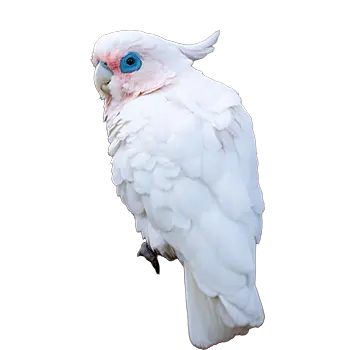

Film & Television Appearances

The Bare-Eyed Cockatoo has not achieved the individual on-screen celebrity of some larger cockatoo species, but it has contributed to the broader visual presence of white cockatoos in film and television for decades. In Australian productions especially, scenes set in the outback or bush frequently feature flocks of corellas wheeling across open skies, serving as atmospheric shorthand for the wild interior of the continent. These establishing shots rely on the species' abundance and its dramatic flocking behavior, which translates powerfully to the screen without the need for trained animal actors.

When individual cockatoos are called for in scripted productions, animal trainers have occasionally selected Bare-Eyed Cockatoos for their cooperative temperament and compact size. The species' willingness to perform on cue, combined with its expressive facial features and lively body language, makes it a practical choice for scenes requiring a parrot that interacts with human actors. In many cases, however, casual viewers may not distinguish the Bare-Eyed Cockatoo from other white cockatoo species on screen, and credits rarely specify the exact species used.

Australian nature documentaries have given the Bare-Eyed Cockatoo more focused attention. Programs exploring the wildlife of the outback have devoted segments to the spectacle of mass Corella flocks, documenting their feeding behavior, aerial acrobatics, and sometimes contentious interactions with human communities. These documentary treatments have helped audiences understand the species not just as a pretty bird but as an ecologically significant animal whose relationship with the Australian landscape is complex and evolving.

Internationally, the Bare-Eyed Cockatoo appears less frequently in mainstream media than the Sulphur-Crested Cockatoo or the Moluccan Cockatoo, both of which have more dramatic crests and larger physical profiles. Nevertheless, the species benefits from the general public fascination with cockatoos as a group, and any viral footage of cockatoo behavior tends to increase interest in all members of the family, including the more modestly sized Bare-Eyed variety.

Social Media & Online Stardom

The rise of video-sharing platforms and social media has been transformative for the Bare-Eyed Cockatoo's public profile. The species' natural clownishness, its love of physical play, and its tendency to vocalize in response to music or conversation make it an ideal subject for short-form video content. Clips of Bare-Eyed Cockatoos dancing, talking, playing with household objects, or engaging in elaborate attention-seeking behaviors routinely accumulate hundreds of thousands of views across platforms, introducing the species to audiences who may never have encountered one in person.

Several individual Bare-Eyed Cockatoos have developed substantial online followings, with dedicated social media accounts chronicling their daily lives and personalities. These accounts often showcase the bird's affectionate nature, its capacity for mimicry, and the humorous dynamics of cockatoo-human cohabitation. The content resonates particularly with existing parrot enthusiasts, but it also reaches a broader audience drawn to animal content in general, creating new awareness of the species among people who might not otherwise consider a parrot as a companion.

The social media presence of Bare-Eyed Cockatoos has also served an educational function, albeit an informal one. Experienced owners who share content online frequently include information about the realities of cockatoo care alongside the entertaining footage. Comments sections and community posts become forums for discussing dietary needs, behavioral challenges, veterinary concerns, and the long-term commitment involved in cockatoo ownership. This peer-to-peer information sharing has become an important supplement to formal avicultural resources.

There is a cautionary dimension to the species' online popularity, however. Viral videos that emphasize the bird's charm and humor can create an incomplete picture of what ownership entails, potentially encouraging impulsive acquisitions by viewers who are unprepared for the species' demands. Responsible content creators within the cockatoo community have increasingly made an effort to balance entertaining content with candid discussions of the challenges, helping to temper unrealistic expectations before they lead to rehoming situations.

Literature, Art & Photography

In Australian literature, the Bare-Eyed Cockatoo appears as part of the broader cast of native wildlife that populates bush narratives, pastoral poetry, and ecological writing. Authors describing the interior landscape frequently invoke flocks of white cockatoos as markers of place and season, and while these references do not always specify the Bare-Eyed Cockatoo by name, the species' dominance in many inland regions means it is often the bird being described. In children's literature, cockatoos feature as spirited characters whose noisy sociability and mischievous tendencies provide rich material for storytelling.

Visual artists have long been drawn to the cockatoo as a subject, and the Bare-Eyed Cockatoo, with its clean white plumage, pale blue periorbital skin, and subtle pink lores, offers a study in understated elegance that contrasts with the showier crests of its relatives. Australian painters working in both traditional and contemporary styles have depicted corellas in landscapes, still-life compositions, and abstract works that use the bird's form as a starting point for explorations of color, movement, and Australian identity.

Wildlife photography has provided some of the most arresting images of the Bare-Eyed Cockatoo, particularly shots capturing the scale and energy of mass flocks. Photographs of thousands of corellas descending on a single tree or lifting off from a grain field in a synchronized white cloud have become iconic images in Australian nature photography. These images circulate widely in print and online, reinforcing the species' association with the vast, open landscapes of the interior.

In the companion bird community, photography and videography of individual Bare-Eyed Cockatoos serve a more intimate purpose. Owners share portraits and candid shots that capture the bird's expressiveness, its capacity for affection, and the small daily moments that define life with a cockatoo. These images collectively build a visual archive of the species' domestic life, complementing the wild-bird imagery that dominates professional photography and contributing to a richer, more complete public understanding of what the Bare-Eyed Cockatoo is and what it means to the people who know it best.

Educational Media & Documentaries

The Bare-Eyed Cockatoo has featured in a number of educational programs and nature documentaries produced for both Australian and international audiences. Australian broadcasting networks have included the species in programs about outback ecology, urban wildlife management, and the behavioral science of parrots. These productions typically present the Bare-Eyed Cockatoo within the context of its natural environment, using footage of wild flocks to illustrate broader themes about adaptation, social behavior, and the effects of habitat modification on native species.

International nature documentary series have occasionally spotlighted the species as part of broader surveys of Australian fauna. In these contexts, the Bare-Eyed Cockatoo is often presented alongside other cockatoo species, with narration drawing attention to the diversity within the family and the different ecological strategies its members employ. The species' ground-foraging habits and its tolerance of arid conditions make it a useful case study in avian adaptability, and documentary filmmakers have used these traits to tell stories about resilience and ecological opportunism.

Zoos and wildlife parks that house Bare-Eyed Cockatoos have produced their own educational content, including keeper talks, behind-the-scenes videos, and interactive exhibits that allow visitors to observe the species up close. These institutional efforts are valuable for public education, as they provide structured, accurate information in a format that is accessible to families and school groups. Some facilities have featured Bare-Eyed Cockatoos in free-flight demonstrations, where the birds' agility and responsiveness to training are showcased in real time.

Online educational platforms and avian welfare organizations have also contributed to the body of media about the Bare-Eyed Cockatoo. Video series on parrot care, species profiles hosted on ornithological websites, and webinars organized by avicultural societies all serve to disseminate practical knowledge about the species. As the demand for reliable, accessible information about companion parrots grows, the Bare-Eyed Cockatoo is increasingly well served by a diverse ecosystem of educational content.

Community Culture & the Companion Bird World

Within the organized companion bird community, the Bare-Eyed Cockatoo occupies a distinctive niche. It is widely regarded as one of the more approachable cockatoo species for experienced parrot keepers who want the cockatoo bonding experience in a slightly smaller, somewhat less intense package than a Moluccan or an Umbrella Cockatoo. Bird clubs, online forums, and species-specific social media groups provide spaces where Bare-Eyed Cockatoo owners exchange husbandry tips, celebrate milestones, and support one another through the inevitable challenges of living with a cockatoo.

Avian expos and bird fairs regularly feature Bare-Eyed Cockatoos, both as birds available for sale or adoption and as demonstration animals in educational presentations. Their willingness to engage with strangers, their eye-catching playfulness, and their ability to perform simple tricks make them crowd favorites at these events. For many attendees, an encounter with a Bare-Eyed Cockatoo at an expo is the first step toward deeper involvement with the species and the companion bird hobby more broadly.

Rescue organizations play an important role in the Bare-Eyed Cockatoo's community culture. Because cockatoos of all species are frequently surrendered by overwhelmed owners, parrot rescues across North America, Europe, and Australia regularly have Bare-Eyed Cockatoos available for adoption. These organizations serve not only as rehoming services but as advocacy platforms, using the stories of individual birds to educate the public about the realities of cockatoo ownership and the importance of lifelong commitment.

The species' place in the broader cultural conversation about parrots as companion animals continues to evolve. As awareness of avian welfare issues grows and as more keepers share their experiences publicly, the Bare-Eyed Cockatoo benefits from an increasingly informed and engaged community. The bird's personality — affectionate, mischievous, demanding, and endlessly entertaining — ensures that those who know it well become its most effective ambassadors, shaping public perception one interaction at a time.

Always consult a qualified professional before making any health-related decisions. This content is provided for informational reference only and should not replace professional guidance specific to your animal.