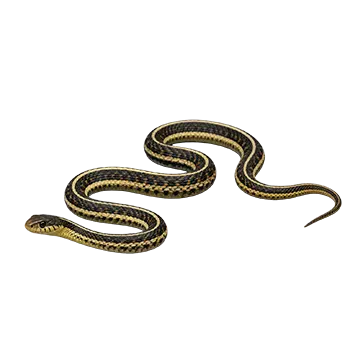

Enrichment in reptile husbandry refers to the deliberate provision of stimuli, challenges, and environmental complexity that encourage the expression of natural behaviors. For the Eastern Garter Snake, enrichment is not a luxury or an optional upgrade to basic care — it is a fundamental component of responsible husbandry that directly impacts physical health, psychological wellbeing, and longevity. Wild Thamnophis sirtalis sirtalis occupies a dynamic, complex environment where the animal navigates varied terrain, encounters novel scent trails daily, forages across diverse microhabitats, and responds to fluctuating environmental conditions. A sterile enclosure with a water dish and a single hide, while meeting the animal's survival requirements, deprives the snake of the stimulation it is behaviorally adapted to process.
The concept of enrichment for snakes has historically lagged behind enrichment programs developed for mammals, birds, and even some lizard species. This gap stems partly from the widespread misconception that snakes are simple organisms driven entirely by basic feeding and thermoregulatory impulses, incapable of boredom, curiosity, or behavioral complexity. Research published over the past two decades has thoroughly dismantled this view. Studies on spatial learning, exploratory motivation, and behavioral indicators of stress in captive colubrids — including Thamnophis species — demonstrate that snakes actively seek novelty, form cognitive maps of their environments, and display measurable stress responses when confined in barren, unchanging conditions.
The Eastern Garter Snake is an especially strong candidate for enrichment investment because of its high activity level, diurnal habits, and investigative temperament. Unlike many popular pet snake species that spend the majority of their time concealed in hides and emerge primarily for nocturnal activity, garter snakes are visible and active throughout the day. They patrol their enclosures, investigate environmental changes, tongue-flick novel objects extensively, and display a clear behavioral distinction between familiar and unfamiliar elements in their habitat. A garter snake that has stopped exploring, remains in a single hide for extended periods, or displays repetitive pacing along the enclosure walls is likely understimulated and would benefit from enrichment intervention.
The enrichment categories most applicable to Eastern Garter Snakes include structural complexity, foraging challenges, sensory stimulation, and environmental variation. Each category engages a different set of natural behaviors, and the most effective enrichment programs incorporate elements from multiple categories simultaneously. A single cork bark tube is structural enrichment; placing that tube in a new location each week adds environmental variation; hiding a prey item inside it introduces foraging challenge. Layering enrichment types in this way maximizes the behavioral response without requiring elaborate equipment or excessive time investment from the keeper.