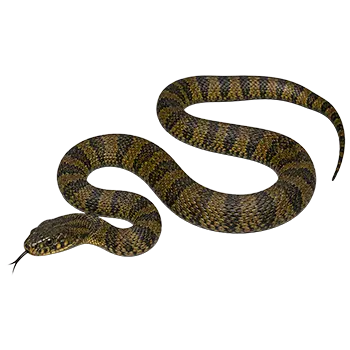

Snakes do not play, and any honest discussion of enrichment for the Diamond-Backed Water Snake has to begin there. There is no toy in the conventional sense that this animal will engage with for amusement. What the research on reptile welfare does support is that captive snakes given structurally complex, variable environments show more natural behavior, more exploration, better body condition, and fewer stereotypic patterns such as persistent rubbing or endless perimeter patrolling than snakes kept in bare enclosures. Enrichment here means environmental complexity that gives the animal something real to do, not novelty objects to bat around.
Nerodia rhombifer is an unusually strong candidate for this approach because it is behaviorally busier than most commonly kept snakes. It is active by day as well as at dusk, it swims, it climbs, it forages actively rather than sitting in ambush for weeks, and in the wild it moves through a habitat that changes with water level, season, and prey availability. A ball python may spend ninety percent of its life in one hide without any welfare cost. A Diamond-Backed Water Snake in that same static setup is being asked to switch off a substantial portion of its behavioral repertoire, and keepers commonly see the result as glass surfing, restless nocturnal patrolling, or refusal to settle.
The four levers worth pulling are aquatic access, vertical structure, foraging challenge, and periodic change. Each maps to something the animal does in the wild: swimming and hunting in shallow water, hauling out to bask above the surface, searching for prey among roots and debris, and adapting to a habitat that never looks quite the same two months running. Enrichment products for this species are therefore mostly structural furnishings and habitat components rather than anything sold as a reptile toy.
Assessment matters as much as provision. An enrichment change is working when the keeper sees increased use of previously ignored zones, more daytime activity that is exploratory rather than agitated, confident feeding, and a well-muscled animal that moves smoothly. It is failing when the snake retreats to one hide and stops emerging, refuses meals, or shows persistent frantic movement along a wall. For a defensive species like this one, a slower rollout is the correct instinct: add complexity in stages, watch for a week, and keep what earns its place.