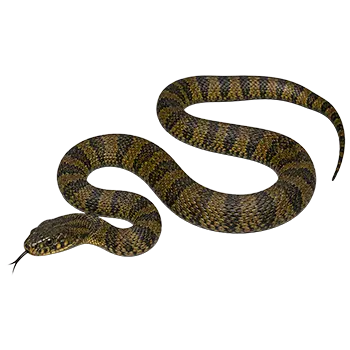

Enclosure Size and Footprint

Floor space is the governing measurement for a Diamond-Backed Water Snake, and the practical minimum for a single adult is an enclosure measuring forty-eight inches long by twenty-four inches deep by twenty-four inches tall. That footprint allows a genuine thermal gradient, a substantial water feature, and dry land on both the warm and cool ends simultaneously, which a smaller cage simply cannot deliver once a water basin occupies part of the floor. Keepers who try to house an adult in a thirty-six inch enclosure invariably find that the water bowl consumes the warm end and the gradient collapses.

Sexual dimorphism in Nerodia rhombifer is pronounced enough to affect enclosure planning. Females routinely reach forty to forty-eight inches and occasionally exceed sixty, while males are noticeably smaller and more slender, commonly staying in the low thirties. A keeper housing a large female should treat the forty-eight by twenty-four footprint as a starting point rather than a target, and a seventy-two inch enclosure is genuinely appreciated by a full-grown female. For a male, the standard four-foot enclosure is comfortably generous for life.

Neonates and small juveniles are the exception to the bigger-is-better principle. A newborn Diamond-Backed Water Snake at nine inches placed directly into a four-foot enclosure often becomes stressed, hides constantly, and feeds poorly, because the volume of open space reads as exposure. Start neonates in a small tub or enclosure in the range of a standard ten to twenty gallon footprint, with dense cover and a shallow water dish, and step up in stages as the animal grows. Two or three enclosure upgrades over the first eighteen months is a normal and healthy progression.

Height deserves more attention than many keepers give it, because this species is a habitual basker that climbs willingly. In the wild, Diamond-Backed Water Snakes are frequently observed draped on branches, root tangles, and brush overhanging water, from which they drop into the river when disturbed. Eighteen inches of interior height is workable, twenty-four is better, and any height above the substrate should be furnished with secure branches rather than left as empty air. Cohabitation should be avoided entirely; this is a food-motivated species with a strong feeding response, and housing two together invites both competition and injury.

Enclosure Types and Construction Materials

Sealed PVC enclosures are the strongest match for this species, and the reason is moisture. A Diamond-Backed Water Snake enclosure runs damper than most snake setups by design, with a large open water surface and a substrate that stays humid. Wooden and melamine cages absorb that moisture, swell at the seams, delaminate at the edges, and eventually harbor bacteria and mold in the compromised material. PVC panel enclosures are impervious, hold heat efficiently, resist the constant wiping and disinfecting this species demands, and last decades in a wet installation.

Glass aquariums and glass-fronted terrariums are a viable second choice with caveats. Glass is entirely waterproof and easy to sanitize, and the visual clarity suits an active diurnal species that many keepers genuinely enjoy watching. The drawbacks are heat retention and security. Glass sheds heat quickly through its walls, which raises the energy cost of maintaining a warm end, and screen tops shed humidity fast enough that some keepers must partially cover them. Screen tops must be secured with proper clips or latches, because a determined Nerodia is a capable and persistent escape artist that will test every seam.

Front-opening designs are strongly preferred over top-opening for the Diamond-Backed Water Snake, and this is a welfare consideration rather than a convenience one. A snake whose natural anti-predator response is to flee into water reacts to a hand descending from above as an aerial threat, and top-access enclosures produce far more defensive striking and musking during routine maintenance. Approaching from the side at the animal own level measurably reduces stress over months of daily interaction, and keepers report calmer animals as a direct result.

Whatever the material, escape-proofing is non-negotiable. This species is slender, strong, and highly motivated, and it will exploit a gap that looks impossibly small. Sliding glass doors need functioning locks, hinged doors need positive latches, and every cable pass-through, drain fitting, and ventilation cutout needs to be sealed or screened. Ventilation itself should be generous and cross-flowing, positioned low on one side and high on the other, because a damp enclosure with poor air exchange becomes a respiratory infection risk in a matter of weeks. The goal is humid air that moves, not humid air that sits.

Substrate Selection

The substrate for a Diamond-Backed Water Snake has to accomplish something slightly contradictory: tolerate constant moisture without breaking down, hold enough humidity to support clean sheds, and still dry at the surface so the animal is not lying permanently in wet bedding. Cypress mulch is the long-standing keeper favorite because it does all three. It resists mold well, holds moisture in its lower layers while the surface dries, and can be spot-cleaned easily. A depth of two to three inches gives the snake something to push into and buffers humidity between misting or water changes.

Coconut husk chips and coir-based bedding are the main alternative and perform comparably. Husk chips drain and dry a little faster than cypress, which suits keepers whose enclosures run damp, while fine coir holds more water and suits drier rooms. Either can be blended with cypress to tune the moisture behavior of the substrate to a specific setup. Sphagnum moss layered in the cool-end hide or worked into a corner creates a localized damp pocket that is particularly valuable in the days before a shed.

Paper-based substrates deserve serious consideration and should not be dismissed as a beginner compromise. Newspaper, unprinted butcher paper, and reptile-grade paper towels are the correct choice during quarantine, during treatment for mites or internal parasites, for neonates whose feeding response makes substrate ingestion likely, and for any animal under veterinary observation where stool must be inspected. Paper makes contamination immediately visible and costs almost nothing to replace daily. The tradeoff is that it holds no humidity and offers no burrowing opportunity, so it is a management tool rather than a permanent housing solution.

Several substrates should be avoided outright. Cedar shavings release aromatic oils that are directly toxic to reptiles, and pine carries similar concerns. Sand and calcium sand are wrong for a woodland-and-wetland species and pose impaction risk. Gravel and aquarium stone in the land area trap waste and are impossible to sanitize properly. Loose substrates that break down into fine dust when wet, including some low-grade bark products, foul the water feature within days and clog filtration. A useful test for any candidate substrate is simple: soak a handful, leave it three days, and see whether it smells sour or holds together.

Water Features and Aquatic Design

The water feature is the defining element of a Diamond-Backed Water Snake enclosure and the single component most keepers get wrong. This is a semi-aquatic species that forages, thermoregulates, and escapes into water, and a small drinking bowl does not meet its behavioral needs. The target is a basin large enough for the snake to submerge fully and coil comfortably, which in practice means something roughly one third to one half the length of the animal in its longest dimension. For an adult female, that often means a shallow storage tub, a mortar mixing tray, or a purpose-built water box rather than any commercially sold reptile dish.

Depth should be modest and access should be effortless. Four to six inches of water is ample for an adult, and while these snakes are genuinely capable swimmers, a basin with steep smooth walls can exhaust or trap an animal that cannot find a climbing point. Build in a ramp, a stack of flat river stone, a partially submerged cork slab, or a section of egg-crate to give the snake a reliable exit at more than one point. Stability matters equally, because a large heavy-bodied snake entering a lightweight basin will flip it and flood the enclosure, so the container should either be weighted or recessed into the substrate.

Water temperature is a legitimate husbandry parameter for this species rather than an afterthought. Water that sits well below ambient becomes a heat sink that draws body temperature down every time the snake soaks, which over weeks suppresses digestion and immune function. Aim for water in the low to mid seventies Fahrenheit, achieved most safely by positioning the basin toward the cool-to-neutral zone and letting room and enclosure air temperature govern it. Submersible aquarium heaters should be used only with a guard and an external thermostat if used at all, since an unprotected heater is a burn and electrocution hazard with a snake that wraps around objects.

Water hygiene is where the real labor of this species lives. Diamond-Backed Water Snakes defecate in water routinely, and a fouled basin turns into a bacterial culture very quickly in a warm enclosure. Small basins should be dumped, scrubbed, and refilled every one to three days, and any basin should be fully sanitized weekly. Keepers running larger water volumes often add a sponge filter or small canister filter to extend the interval, which works well but never eliminates the need for physical cleaning. Dechlorinated or aged water is the sensible default, particularly in municipalities that use chloramine, and a spare identical basin lets a keeper swap in a clean one in seconds rather than working around a wet snake.

Heating and Thermal Gradient

A Diamond-Backed Water Snake needs a working thermal gradient far more than it needs any single perfect temperature. The warm end should offer a basking surface in the range of eighty-eight to ninety degrees Fahrenheit, ambient warm-side air in the low to mid eighties, and a cool end settling around seventy-five to seventy-eight. A night drop into the low seventies is natural and beneficial, mirroring the diel cycle of the river bottomlands this species inhabits. What matters is that the snake can move between meaningfully different temperatures without leaving cover.

Under-tank heating is a poor primary heat source for this species and works better as a supplement or not at all. A heat mat warms a narrow patch of floor, which in a moist enclosure with several inches of substrate produces very little useful gradient and risks scorching the substrate above it. Radiant heat panels mounted to the ceiling are the strongest choice for PVC enclosures, producing broad gentle warmth that mimics overhead sun and does not create a hot spot the snake can press against. Ceramic heat emitters are the reliable alternative, particularly in glass enclosures that lose heat quickly, and they produce no light so they can run overnight if a room is cold.

A basking bulb over a flat stone or a thick branch is a genuinely worthwhile addition because it lets the snake do what it does in the wild: haul out of water and warm itself under a directional heat source. A well-designed enclosure places this basking spot above or adjacent to the water feature so the animal can move from a swim directly to a warming perch. Every heat source without exception must run through a thermostat, and every heat source that a snake could contact directly must be guarded. Nerodia will climb to a heat source and wrap it, and unguarded ceramic emitters cause severe thermal burns.

Measurement discipline turns a set of heating equipment into an actual gradient. Surface temperatures should be checked with an infrared temperature gun at the basking site, the mid-enclosure, and the cool end, while air temperature at each end is better tracked with probe thermometers positioned at snake height rather than stuck to the upper wall. Thermostat probes should be secured where they read the surface the animal actually uses, not floating in air. Humidity for this species sits comfortably in the fifty to sixty percent range, rising toward seventy during shed cycles, and a large open water surface plus a moisture-retaining substrate usually delivers that without misting. Persistent readings above seventy-five percent with stagnant air are a warning sign rather than a success.

Hides, Perches, and Interior Furnishing

Two hides is the baseline requirement, one on the warm end and one on the cool end, and both should be tight enough that the snake body contacts the walls when coiled inside. This is the most consistently underrated welfare factor in snake keeping. A Diamond-Backed Water Snake given only a spacious open cave will often ignore it and press into a corner behind the water basin instead, because the security signal it is seeking is physical contact rather than shelter. Matching hides at both ends means the animal never has to trade thermoregulation against feeling safe.

A third hide positioned partly in the water, or immediately adjacent to it, suits this species particularly well. Cork rounds, half logs, and inverted opaque containers with a cut entrance all work, and cork bark is especially good because it tolerates constant wetting without degrading. Opaque materials are meaningfully better than the clear or tinted plastic caves sold in some pet stores, since a hide that admits light does not fully deliver the sense of enclosure the animal is after. Whatever is used must be stable enough that it cannot shift and pin a snake underneath it.

Branches and elevated perches convert unused vertical volume into usable habitat. Thick cork branches, manzanita, grapevine, and well-cured hardwood all serve, and the placement that matters most is a horizontal limb suspended over or beside the water so the animal can rest above the surface exactly as it does over a river channel. Anchor every branch at both ends; a limb that rolls under a forty-inch snake can cause injury and will certainly discourage the animal from using it again. Live or artificial plants layered along the branches create the visual break that makes an elevated perch feel safe enough to actually use.

Sightline management ties the interior together. An enclosure in a high-traffic room with clear glass on the front and open space inside puts a defensive species in a permanent state of alert. Backing or siding the enclosure with an opaque background, clustering foliage against the front glass at a few points, and leaving one flank fully screened gives the snake places to be unseen while still permitting observation. Everything placed inside should be sanitizable, since it all lives in a damp environment; porous decorations that cannot be scrubbed or replaced cheaply become long-term bacterial reservoirs.

Cleaning, Maintenance, and Enclosure Hygiene

The maintenance load for a Diamond-Backed Water Snake is higher than for a comparable dry-habitat snake, and a keeper should plan for that honestly before acquiring one. The daily routine is short: check and refresh water, remove any visible waste or shed skin, confirm temperatures at both ends, and visually inspect the animal. Because this species defecates in water so consistently, the water check is the one task that genuinely cannot be skipped, and a fouled basin left overnight in a warm enclosure produces a bacterial load that no weekly deep clean fully undoes.

Weekly maintenance means a full water basin sanitation, spot removal and replacement of any soiled substrate, wiping down interior surfaces at the waterline where biofilm accumulates, and cleaning the inside of the glass or door panel. Full substrate replacement runs on a four to eight week cycle depending on enclosure size, water volume, and how diligent the spot-cleaning has been, with loose natural substrates needing it more often than paper, which is simply replaced as it soils. Branches, hides, and stones should come out for scrubbing on roughly the same schedule as the substrate change.

Disinfectant choice matters in a wet enclosure. Reptile-safe veterinary disinfectants formulated for animal housing are the standard, applied to a physically cleaned surface, given the contact time printed on the label, and then rinsed thoroughly and allowed to dry before the animal returns. Dilute bleach solution is effective and inexpensive but demands complete rinsing and full airing out, since residual chlorine fumes in an enclosed space are a genuine respiratory hazard. Physical cleaning always precedes disinfection, because organic debris inactivates most disinfectants before they can work.

The hygiene issues specific to this species are worth naming directly. Persistently damp substrate against the ventral scales causes scale rot, which appears as discolored, blistered, or lifting belly scales and progresses to serious infection if ignored, so the fix is always drier surface bedding and better airflow rather than treatment alone. Stagnant humid air with poor ventilation drives respiratory infection, signaled by open-mouth breathing, bubbling at the nostrils, or audible clicking. Salmonella is present in healthy reptiles as normal gut flora, so hand washing after every contact with the animal, its water, or its furnishings is a baseline household practice, and enclosure equipment should never be cleaned in a kitchen sink or anywhere food is prepared.

Always consult a qualified professional before making any health-related decisions. This content is provided for informational reference only and should not replace professional guidance specific to your animal.