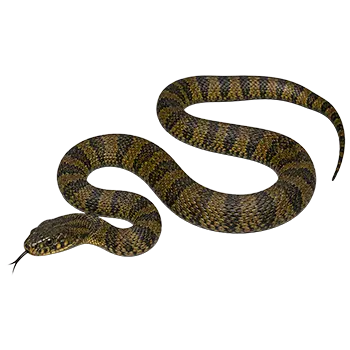

A thermostat is the one piece of technology that is genuinely mandatory for a Diamond-Backed Water Snake, and it is not a device to economize on. An unregulated heat source is not merely imprecise; it is a burn hazard and a fire hazard, and reptile thermal burns are severe, slow-healing, and frequently fatal in the medium term through secondary infection. Every heat-producing device in the enclosure must be controlled, without exception, and the thermostat should be sized with headroom above the wattage it is actually driving.
Thermostat class should be matched to the heat source rather than chosen by price. On/off thermostats cut power entirely at the setpoint and restore it when temperature drops, which produces a sawtooth pattern of overshoot and undershoot; they are acceptable for a heat mat under a small quarantine tub and little else. Pulse proportional units deliver rapid power pulses that hold a much tighter band and are the correct choice for ceramic heat emitters, heat cable, and radiant heat panels, though they must never drive a light-producing element because the pulsing causes flicker and shortens bulb life dramatically. Dimming thermostats vary voltage smoothly and are the right controller for basking bulbs and other light-emitting sources.
For most Diamond-Backed Water Snake setups, the practical configuration is a pulse proportional thermostat governing a radiant heat panel or ceramic emitter as the primary heat source, with a second dimming controller on a basking bulb if one is used. Running two heat sources from a single thermostat channel is a common mistake that gives the keeper control over neither, so multi-zone units or separate controllers are worth the additional cost. A high-temperature safety cutoff, either built into the unit or added as a separate backup thermostat wired in series, converts a thermostat failure from a fatal event into an inconvenience.
Probe placement determines whether a correctly chosen thermostat actually works. The probe must sit where it reads the surface the animal uses, secured with reptile-safe tape or a mount so it cannot be displaced, and it should never dangle in open air where it reads a temperature no animal experiences. In this species enclosure there is an additional hazard worth stating plainly: a probe that falls into the water basin will read water temperature and drive the heat source to maximum indefinitely. Route and anchor every probe cable so that a forty-inch snake pushing through the enclosure cannot drag it into the water, and verify probe position at every cleaning.