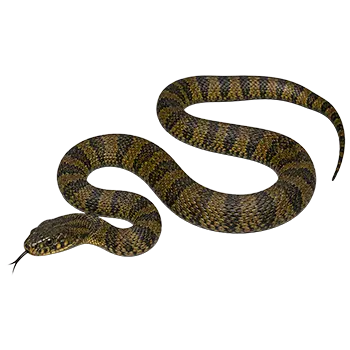

The Diamond-Backed Water Snake is a piscivore first and a generalist second, and that single fact reshapes nearly every assumption a keeper might carry over from boas, pythons, or ratsnakes. In the river systems, oxbows, sloughs, and flooded bottomlands of the central United States, Nerodia rhombifer earns most of its calories from fish, favoring slow, injured, or crowded individuals it can pin against the substrate or the bank rather than pursuing fast open-water swimmers. Amphibians, tadpoles, crayfish, and the occasional carrion item round out the wild diet. The nutritional consequence is a species adapted to frequent, moderate meals of lean aquatic protein rather than infrequent, enormous meals of warm-blooded prey.
Metabolically, this snake runs hot compared with a constrictor of similar mass. A fish meal is digested and cleared far faster than a rodent of equivalent weight because fish carry less fat, thinner skeletal mineral density, and no fur to slow passage through the gut. A juvenile Diamond-Backed Water Snake fed only every ten days will grow slowly and may become chronically underweight, while the same interval is entirely appropriate for a young ball python. Keepers accustomed to constrictor schedules routinely underfeed young Nerodia and then misread the resulting poor growth as a genetic or temperament problem rather than a caloric one.
The macronutrient profile a keeper should target is high complete protein, moderate fat, and reliable whole-body mineral content. Whole fish and whole rodents both satisfy this. Fillets, cut portions, and boneless meat do not, because they strip out the skeleton that supplies calcium and phosphorus in usable ratio and the viscera that supply fat-soluble vitamins and trace minerals. A Diamond-Backed Water Snake maintained on fillet strips will look acceptable for months and then decline rapidly with metabolic bone disease, a preventable outcome that whole-prey feeding makes almost impossible. The rule is simple and worth repeating: feed whole animals, not portions of animals.
Hydration deserves specific mention for a species that spends much of its life in or beside water. Nerodia rhombifer drinks readily, soaks routinely, and often defecates in its water source, which means a captive individual can become mildly dehydrated not because water is absent but because the water offered is fouled and refused. Digestion of a whole-prey meal draws meaningfully on body water reserves, and a dehydrated snake digests inefficiently, passes dense urates, and is more prone to regurgitation. Clean, frequently refreshed water is not merely an enclosure feature for this species; it is an active component of its nutrition.