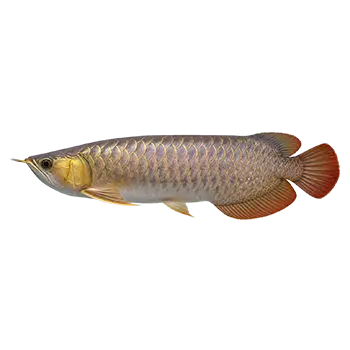

Natural Behavior & Drive

Arowanas are apex predators with keen eyesight, fast reflexes, and a strong prey drive that evolved over millions of years in tropical river systems. In the wild, they spend their days patrolling the surface, scanning for movement above and below the waterline, and striking at insects, small fish, and crustaceans with explosive speed. This active hunting lifestyle means captive Arowanas need more than food and clean water — they need reasons to move, investigate, and react.

Boredom in Arowanas is a real and underappreciated problem. A fish with nothing to engage its natural instincts may become lethargic, develop repetitive swimming patterns, or display stress behaviors like glass surfing — constantly swimming back and forth against the tank walls. These behaviors are not just cosmetically unappealing; they indicate genuine psychological stress that can suppress immune function and shorten the fish's lifespan.

Enrichment for Arowanas does not look like enrichment for mammals. You are not going to hand a puzzle box to a fish. Instead, effective enrichment taps into the Arowana's sensory world — visual stimuli, movement patterns, feeding challenges, and environmental changes that engage the fish's attention and reward investigation. The goal is to make the tank environment dynamic rather than static.

Understanding your specific Arowana's personality is the starting point for any enrichment plan. Some individuals are bold and responsive, eagerly investigating anything new in their tank. Others are cautious and easily startled. Introduce enrichment gradually, observe how the fish responds, and adjust based on what provokes healthy curiosity rather than fear.

Floating & Surface Enrichment

Because Arowanas are surface-oriented fish, enrichment that operates at or near the waterline is the most effective category. Floating objects that move gently with the current catch the Arowana's attention and encourage investigation. Items like floating logs designed for aquarium use, leaf litter that sits on the surface, or buoyant decorations can transform a static water surface into a landscape worth patrolling.

Floating plants — or high-quality artificial equivalents — create dappled light patterns and partial cover that mimic the Arowana's natural habitat. The interplay of shadow and light across the water surface stimulates the fish visually and can reduce the stress associated with a fully exposed, uniformly lit tank. If live floating plants are impractical due to the Arowana's tendency to disturb them, silk or plastic floating plant replicas anchored lightly at the edges of the tank are a workable alternative.

Ping pong balls are a surprisingly effective and inexpensive enrichment tool that many Arowana keepers use. Dropped onto the water surface, they bob and drift unpredictably, triggering the fish's predatory tracking instinct. Some Arowanas will nudge them with their snout, while others simply follow them with their eyes. Remove them after a session to keep the novelty factor intact — permanent additions lose their enrichment value quickly.

Whatever you place on the surface, ensure it is aquarium-safe and free of paints, coatings, or adhesives that could leach into the water. Even items marketed for aquarium use should be rinsed thoroughly before introduction. The Arowana will mouth-test almost anything new in its environment, so material safety is non-negotiable.

Target Training & Interaction

Arowanas are among the most intelligent freshwater fish commonly kept in captivity, and they are remarkably trainable. Target training — teaching the fish to follow or strike at a visual target in exchange for a food reward — is one of the most effective forms of enrichment available. It engages the fish mentally, strengthens the bond between keeper and fish, and provides structured physical activity.

The basic setup is simple. Use a small, brightly colored object attached to a stick or rod — a red or orange bead works well — and hold it just above or at the water's surface. When the Arowana approaches or touches the target, immediately reward it with a small food item. Over repeated sessions, the fish learns to associate the target with food and will actively follow it across the tank.

Once the Arowana reliably follows the target, you can use it to guide the fish through simple exercises: swimming to specific areas of the tank, turning, or even jumping slightly to reach the target above the waterline. These sessions should be short — five to ten minutes is sufficient — and conducted at consistent times to build routine. Overlong sessions can fatigue or frustrate the fish.

Hand feeding, while not strictly target training, serves a similar enrichment function. Arowanas that accept food directly from their keeper's fingers or from feeding tongs develop a level of interactive engagement that passive tank observation cannot provide. Always use feeding tongs rather than bare fingers for safety — an Arowana's strike is powerful enough to startle you into dropping food or pulling away suddenly, which can frighten the fish.

Environmental Variety

One of the simplest and most overlooked enrichment strategies is periodically changing the tank environment. Rearranging driftwood, repositioning decorations, or adding a new piece of aquarium-safe decor forces the Arowana to re-explore and re-map its territory. This process engages spatial awareness and investigative behavior that stagnant environments cannot stimulate.

Changes do not need to be dramatic. Moving a single piece of driftwood from the left side to the right side of the tank is enough to provoke renewed interest. Adding a new background — even a printed image taped to the outside of the tank — changes the visual field the Arowana perceives and can alter swimming patterns. Rotate backgrounds every few weeks to maintain the novelty effect.

Mirror exposure is a controversial but widely practiced enrichment technique. Placing a mirror against the outside of the tank causes the Arowana to perceive a rival fish, triggering display behavior — flared gill covers, heightened coloration, and assertive posturing. Used in brief, supervised sessions of five to ten minutes, this can be a powerful stimulant. However, prolonged or unsupervised mirror exposure can cause chronic stress, so it should be treated as an occasional tool rather than a permanent fixture.

Seasonal lighting adjustments offer another layer of environmental variety. Gradually shifting the photoperiod or color temperature of your lighting throughout the year mimics the subtle seasonal changes an Arowana would experience in the wild. These adjustments are minor — an hour's difference in photoperiod or a slight shift in Kelvin temperature — but they add a layer of environmental dynamism that a fixed, unchanging setup lacks.

Feeding Enrichment

Transforming mealtime from a routine pellet drop into an engaging challenge is one of the most impactful enrichment strategies for Arowanas. In the wild, every meal requires effort — tracking prey, timing a strike, and capturing a moving target. Captive feeding should replicate at least some of that effort to keep the fish's predatory instincts sharp and its body active.

Varying the location where food is introduced is the simplest feeding enrichment technique. Instead of always dropping food at the same corner of the tank, alternate between different positions along the surface. This forces the Arowana to patrol and search rather than simply waiting at a conditioned spot. The fish expends more energy, covers more of its tank, and stays mentally engaged.

Live food offerings, when safe and appropriately sourced, provide the ultimate feeding enrichment. The unpredictable movement of a live cricket on the water surface or a small feeder shrimp swimming through the water column activates the full hunting sequence — detection, tracking, approach, and strike. Even Arowanas that eat pellets willingly show visibly heightened alertness and activity during live feeding sessions.

Feeding puzzles designed for large fish are a newer category of enrichment product. These devices hold food inside a floating or submerged container that requires the fish to push, bump, or manipulate it to release the reward. Not all Arowanas will engage with these devices, and patience during the learning phase is essential. Start with simple, loosely secured food that falls free with minimal effort, then increase the challenge as the fish learns the mechanism.

DIY & Budget Options

Effective Arowana enrichment does not require expensive specialty products. Many of the most successful enrichment tools can be assembled from common household items and basic aquarium supplies. The key requirement is that all materials must be aquarium-safe — free of toxic coatings, sharp edges, and degradable components that could contaminate the water.

Leaf litter is a free and highly effective enrichment material. Dried Indian almond leaves, oak leaves, or similar tannin-producing foliage can be floated on the surface or allowed to sink. They release mild tannins that tint the water a natural amber color, reduce stress in many tropical fish species, and create a textured surface environment that the Arowana will investigate. Replace leaves as they decompose to maintain water quality.

DIY target trainers can be made from a thin dowel rod and a non-toxic bead or bottle cap. Secure the target to the rod with aquarium-safe silicone or stainless steel wire, and you have a functional training tool for a fraction of the cost of commercial alternatives. The training technique is identical regardless of whether the tool cost two dollars or twenty.

Rotating enrichment items on a weekly schedule maximizes their impact without requiring a large inventory. Keep three or four different enrichment options and cycle one in while removing another. Familiarity kills enrichment value — an object that was exciting on day one becomes invisible furniture by day seven. The rotation does not need to be elaborate; simply swapping which items are in the tank each week is enough to maintain the novelty that drives engagement.

Always consult a qualified professional before making any health-related decisions. This content is provided for informational reference only and should not replace professional guidance specific to your animal.