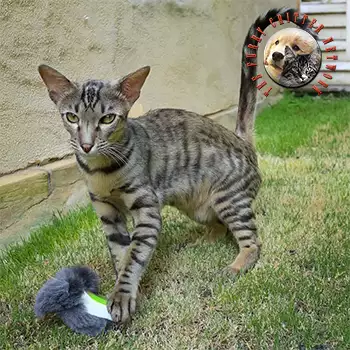

Play Style & Drive

Oriental Shorthairs approach play with an intensity that borders on obsessive. These are cats that will fetch, stalk, pounce, and chase with the focus of a predator and the endurance of an athlete. Their play drive remains high well into adulthood — do not expect your Oriental to mellow out after kittenhood the way some breeds do. Understanding this persistent energy level is the first step toward choosing toys that will actually hold their attention.

The breed's intelligence adds another dimension to play. Orientals quickly figure out simple toys and lose interest once the novelty fades. A toy that challenges a typical cat for weeks may bore an Oriental within days. This means you need to think in terms of rotation and complexity rather than simply buying more of the same type. The goal is to engage both their physical athleticism and their problem-solving mind simultaneously.

Social play is particularly important for this breed. Orientals want to play with you, not just near you. Solitary toys that require no human involvement — a ball in a track, a stationary dangling object — serve a purpose when you are unavailable, but they should not be the primary source of enrichment. Interactive play sessions, ideally fifteen to twenty minutes twice a day at minimum, are essential for this breed's emotional and physical well-being.

Pay attention to your individual cat's prey preferences. Some Orientals are bird-focused, responding most enthusiastically to feathered toys that flutter and dart through the air. Others are ground-prey hunters, preferring toys that scurry along the floor. A few are fish-oriented, captivated by anything moving beneath a surface. Identifying your cat's primary prey drive helps you select toys that trigger the most satisfying play response.

Interactive & Puzzle Toys

Puzzle feeders are among the most valuable enrichment tools for Oriental Shorthairs. These devices require the cat to manipulate levers, slide compartments, or navigate obstacles to access treats or kibble, turning mealtime into a cognitive workout. Start with beginner-level puzzles and progress to more complex designs as your cat masters each stage. An Oriental that solves a puzzle too quickly is not being stubborn — the puzzle is simply too easy.

Treat-dispensing balls and wobble toys add a physical component to food puzzles. The cat must bat, roll, or knock the toy to release small portions of food, combining exercise with mental stimulation. These are particularly useful for Orientals that tend to eat too quickly or for providing activity during the owner's absence. Adjustable difficulty settings allow you to increase the challenge as the cat becomes more proficient.

Multi-step puzzle boxes with sliding doors, rotating discs, and hidden compartments represent the upper tier of feline cognitive enrichment. These products are designed for cats that have already mastered simpler puzzles and need more complex problem-solving challenges. Oriental Shorthairs are prime candidates for these advanced toys. Some owners report their cats learning to solve new configurations within a single session, which speaks to the breed's exceptional learning speed.

DIY puzzle options are easy to create at home. A muffin tin with tennis balls placed over treats in each cup becomes an instant puzzle feeder. Paper bags with treats hidden inside, cardboard boxes with holes cut at various angles, and toilet paper rolls folded into treat parcels all provide low-cost enrichment. The advantage of homemade puzzles is that you can constantly create new configurations, keeping the novelty factor high without recurring expense.

Wand Toys & Aerial Play

Wand toys — also called fishing-rod toys or teaser toys — are the single most effective interactive play tool for Oriental Shorthairs. These toys consist of a flexible rod with a string and an attachment at the end, allowing the handler to simulate the erratic movement of prey. Feathered attachments mimic birds, while fur or fabric lures mimic ground prey. The key to engaging an Oriental is unpredictable motion: pause, dart, flutter, drag, and occasionally let the cat catch the prize.

Quality matters significantly with wand toys. Cheap versions with brittle rods snap easily, and poorly attached lures come apart after a few sessions, creating choking hazards. Look for wands with fiberglass or flexible composite rods, securely attached strings, and interchangeable lure ends. The ability to swap attachments extends the toy's lifespan and lets you vary the play experience without buying entirely new wands.

Aerial play — dangling and swooping the lure through the air — particularly excites Orientals, who are exceptional jumpers. These cats can leap to impressive heights and will launch themselves off furniture to snag a fluttering target. Ensure you have adequate vertical clearance and remove fragile objects from the play area before initiating an aerial session. A broken lamp is a rite of passage for many Oriental owners, but it is avoidable with a little foresight.

Always end wand play sessions with a successful catch followed by a small treat. This simulates the natural hunt-catch-eat sequence and provides psychological closure for the cat. Abruptly stopping play without a resolution can leave an Oriental frustrated and overstimulated. Store wand toys out of reach when not in use — unsupervised play with strings and feathers poses an ingestion and entanglement risk.

Chew Toys & Durability

While cats are not typically thought of as heavy chewers, Oriental Shorthairs can be surprisingly mouthy. Some individuals develop a strong chewing habit, particularly during adolescence, that extends to furniture corners, cables, plastic bags, and anything else within reach. Providing appropriate chew outlets redirects this behavior toward safe targets.

Silvervine sticks and dried matatabi fruit are natural chew options that most cats find irresistible. Silvervine produces a euphoric response similar to catnip but is effective in a higher percentage of cats — roughly eighty percent respond to silvervine compared to about sixty percent for catnip. The sticks are durable enough for extended chewing sessions and also serve as dental aids, helping to scrape plaque from the teeth.

Dental chew toys designed specifically for cats come in various materials, from rubber to compressed plant fibers. Look for products that are firm enough to provide resistance but not so hard that they risk cracking teeth. Netting-covered toys with catnip inside encourage chewing behavior while the mesh texture works against the tooth surface. Replace these toys once the outer material shows significant wear or begins to unravel.

For Orientals that chew out of boredom or anxiety rather than instinct, increasing overall enrichment is more effective than simply providing more chew toys. A bored Oriental will find something to destroy regardless of how many sanctioned chewing options are available. Address the root cause — insufficient play, social isolation, or environmental monotony — and the destructive chewing typically diminishes. If chewing persists despite adequate enrichment, consult your veterinarian to rule out dental discomfort or nutritional deficiencies.

Automated & Solo Toys

Automated toys fill the gap when you cannot be actively present for play. Robotic mice, laser-dot devices on timers, and motorized balls that move randomly across the floor provide stimulation during work hours or other periods of owner absence. For a breed as active as the Oriental Shorthair, having reliable solo entertainment options is not optional — it is a necessity for preventing boredom-driven behavior problems.

Robotic toys vary widely in quality and durability. Better models feature unpredictable movement patterns, quiet motors, and rechargeable batteries. Cheap robotic mice that move in a straight line until they hit a wall and stop will not engage an Oriental for more than five minutes. Look for models with randomized directional changes, variable speeds, and obstacle detection that keeps the toy moving realistically around furniture and room features.

Automatic laser toys project a dot that moves in randomized patterns across floors and walls on a timer. These can provide excellent aerobic exercise, but they should be supplemented with a physical toy afterward — chasing a laser without ever catching tangible prey can cause frustration in highly driven cats. Some models now include a treat dispenser that drops a reward at the end of the laser session, partially addressing this concern.

Track toys with enclosed balls, spring-mounted bobblers, and motion-activated feather poppers are lower-tech options that require no batteries or charging. While they lack the sophistication of robotic alternatives, their simplicity means fewer breakdowns and no dead-battery disappointments. An Oriental will revisit a track toy in passing throughout the day, batting the ball for a few seconds between naps. These toys work best as one component within a larger enrichment strategy rather than as a standalone solution.

DIY & Budget Options

Some of the most engaging toys for Oriental Shorthairs cost nothing at all. A crumpled ball of paper tossed across a hardwood floor triggers an immediate fetch response in many Orientals. A cardboard box with a few holes cut into the sides becomes a hiding, ambush, and exploration station that can entertain a cat for days. Ping pong balls in an empty bathtub create a chaotic, unpredictable play environment that Orientals find endlessly amusing.

Paper bags — never plastic — make excellent crinkle toys that stimulate both auditory and tactile interest. Toss a treat inside to combine foraging with play. A large paper bag laid on its side becomes a tunnel, and cutting a hole in the bottom creates a two-entrance hideout. Replace bags as they become shredded, which for an Oriental typically means every day or two.

Fabric strips tied to a stick create an instant wand toy. Old shoelaces dragged across the floor become irresistible prey. A sock filled with dried catnip and tied shut is a simple but effective kicker toy that satisfies the bunny-kick instinct many cats exhibit during play. The key with DIY toys is supervision — homemade items may not be as structurally sound as commercial products, and small pieces can become choking hazards if the toy comes apart.

Rotation is the most cost-effective enrichment strategy regardless of budget. Rather than leaving all toys out permanently, maintain an active set of four to five toys and store the rest. Swap them out every few days, and previously ignored toys regain novelty. This works because cats are neophilic — they are attracted to new things, and a toy that has been absent for a week reads as new. Oriental Shorthairs are especially responsive to rotation because of their high curiosity and quick habituation to familiar objects.

Always consult a qualified professional before making any health-related decisions. This content is provided for informational reference only and should not replace professional guidance specific to your animal.