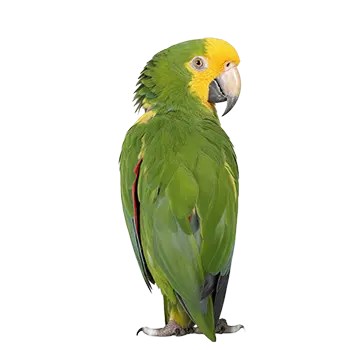

The Yellow-Crowned Amazon is a medium-large parrot that requires significantly more living space than its body length alone would suggest. These birds are active, athletic, and behaviorally complex, and an undersized cage is one of the most common contributors to the feather-destructive behavior, aggression, and chronic stress that plague captive Amazons. Housing decisions made at the outset of ownership shape the bird's quality of life for decades, making this one of the most consequential product purchases an owner will make.
The fundamental principle guiding enclosure selection is that a cage serves as the bird's home base rather than its entire world. Even the most generous indoor cage cannot replicate the freedom of movement that a wild Yellow-Crowned Amazon experiences daily, so the cage should be understood as a secure sleeping and resting space supplemented by extensive supervised out-of-cage time. With that framework in mind, the cage itself still needs to be large enough for the bird to fully extend and flap its wings without contacting the bars, move between multiple perching stations, and access food, water, and enrichment items without crowding.
Material quality directly affects both longevity and safety. Cages constructed from wrought iron with a powder-coated finish are the industry standard for Amazon parrots. The powder coating must be non-toxic and lead-free, as Amazons routinely chew on cage bars and will ingest any coating material that flakes off. Stainless steel cages eliminate the coating concern entirely and offer superior corrosion resistance, though they come at a significantly higher price point. Brass, zinc-coated, and decorative cages marketed for smaller birds should never be used for Amazons, as these materials pose direct toxicity risks through zinc or heavy metal ingestion.
Durability is a practical concern with a species this strong-beaked. Yellow-Crowned Amazons are powerful chewers capable of bending thin wire, breaking poorly welded joints, and defeating flimsy latch mechanisms. Cage construction should feature welded rather than clipped bar joints, reinforced door frames, and lock mechanisms that resist manipulation by an intelligent, dexterous bird. Owners who have experienced an Amazon escaping a cage designed for a smaller species quickly learn that structural integrity is not an area where cost savings are advisable.