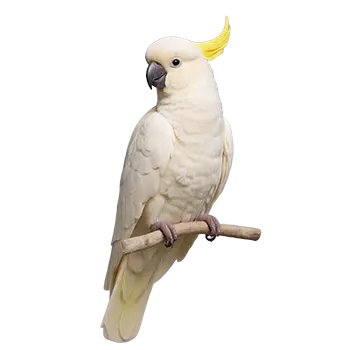

The Sulphur-Crested Cockatoo presents a unique set of ownership challenges that make technology and monitoring tools more valuable for this species than for nearly any other companion bird. These are large, powerful, emotionally intense animals with a capacity for self-harm, environmental destruction, and sudden health crises that can escalate rapidly when the owner is absent or unaware. The species' intelligence means it will test every boundary of its environment continuously, and a monitoring infrastructure that provides real-time awareness of the bird's behavior, activity levels, and environmental conditions gives the owner a critical layer of oversight that supplements direct supervision.
Behavioral monitoring is particularly relevant for Sulphur-Crested Cockatoos because many of the early warning signs of psychological distress are subtle and time-dependent. A bird that begins feather-destructive behavior may only pluck when alone and stop when it hears the owner approaching, masking the problem until significant feather damage has already occurred. Changes in vocalization patterns, such as an increase in contact calling or a shift from normal calls to repetitive monotone screaming, can indicate stress, illness, or environmental discomfort that the owner might miss if they are only present for portions of the day. Video and audio monitoring allows owners to observe the bird's behavior during their absence and identify emerging problems before they become entrenched.
Environmental monitoring addresses the Sulphur-Crested Cockatoo's sensitivity to air quality, temperature fluctuations, and humidity levels. The species' prolific powder-down production creates a persistent air quality challenge that affects both the bird and its human housemates, and real-time particulate monitoring can inform decisions about air purifier operation and ventilation. Temperature extremes, whether from a failed heating system in winter or an air conditioning outage in summer, can stress or endanger a bird accustomed to stable indoor conditions. Automated alerts from environmental sensors provide an early warning system that is especially valuable when the owner is away from home.
The long lifespan of a Sulphur-Crested Cockatoo, which commonly reaches fifty to seventy years in captivity, means that technology investments amortize over an extraordinarily long period. A monitoring system installed when the bird is young may serve the owner-bird relationship for decades, evolving and upgrading as technology improves. Viewing these tools as long-term infrastructure rather than novelty gadgets shifts the cost-benefit analysis significantly in favor of investment.