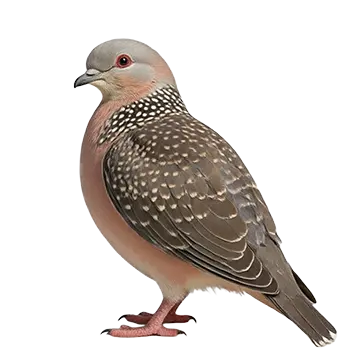

Understanding Dove Enrichment

Enrichment for Spotted Doves requires a fundamentally different approach than enrichment for parrots, and this distinction is the single most important concept for dove owners to internalize before purchasing toys. Parrots are manipulative foragers with powerful beaks, dexterous tongues, and zygodactyl feet that function almost like hands. Their enrichment centers on destruction, puzzle-solving, and object manipulation. Doves have none of these attributes. Their beaks are slender and lack the crushing power of a hookbill, their feet are designed for walking and perching rather than grasping, and their cognitive engagement with objects is fundamentally observational and tactile rather than destructive.

This does not mean Spotted Doves do not need enrichment. In the wild, these birds spend the majority of their waking hours engaged in ground foraging, walking through varied terrain, scanning for and selecting seeds, and navigating a constantly changing environment. Captivity eliminates nearly all of this behavioral complexity, replacing it with a static food dish and an unchanging environment. Without enrichment that stimulates the dove's natural behavioral repertoire, captive birds can develop apathy, excessive sleeping, stress-related feather issues, and repetitive behaviors that indicate psychological distress.

Effective dove enrichment targets three behavioral systems: foraging, environmental exploration, and social interaction. Foraging enrichment makes the bird work for its food in ways that approximate the time and effort of wild feeding. Environmental enrichment changes the sensory landscape of the enclosure through novel objects, sounds, textures, and visual stimuli. Social enrichment provides interaction with cage mates, human companions, or even visual contact with other birds. The most successful enrichment programs incorporate all three systems into a rotating schedule that keeps the environment fresh without overwhelming a species that is inherently cautious about novelty.

Owners transitioning from parrot keeping often find dove enrichment frustratingly subtle. A parrot attacking a wooden block produces immediate, visible engagement. A dove investigating a new patch of foraging substrate may appear to be doing nothing more than walking and pecking, but this understated behavior represents genuine cognitive engagement with the environment. Learning to recognize and appreciate dove-appropriate enrichment responses is part of the adjustment to keeping a columbid species.

Foraging Toys and Activities

Foraging enrichment is the most impactful category of enrichment for Spotted Doves because it directly engages the behavior they are most strongly motivated to perform. The simplest and most effective foraging enrichment is scattering seed across a textured substrate rather than offering it in a dish. A shallow tray filled with clean sand, dried leaves, shredded paper, or a mix of natural substrates, with seed scattered through and beneath the material, transforms passive eating into an active foraging session that can occupy the bird for extended periods.

Commercial foraging mats and trays designed for birds or small animals work well for doves. Products made from natural seagrass, woven palm leaf, or sisal, with seeds tucked into folds and crevices, provide both a foraging challenge and textural interest. Unlike parrot foraging toys that require manipulation to extract food, dove foraging products should rely on the bird's natural pecking and scratching behavior. If the bird cannot access the food by pecking and walking through the substrate, the product is too complex for a dove and will simply be ignored or cause frustration.

Sprouting trays offer a living foraging experience that closely mimics wild grazing. A shallow container planted with bird-safe seeds such as wheat grass, millet, or clover provides a renewable foraging surface that the dove can pick through as the sprouts grow. These trays require regular replanting but provide exceptional enrichment value because the foraging surface changes daily as plants grow, are eaten back, and regrow. Placing the sprouting tray on the enclosure floor aligns with the Spotted Dove's ground-feeding instinct and creates a naturalistic feeding experience.

Foraging complexity can be increased gradually by layering substrates, varying the seed types scattered in the foraging area, and changing the location of foraging stations within the enclosure. Placing small dishes or patches of seed in different positions each day encourages the dove to explore its space rather than returning to the same feeding spot by habit. This rotational approach is low-cost and requires no special equipment, relying instead on the owner's willingness to vary the routine.

Mirrors and Social Enrichment

Mirrors occupy a unique and somewhat controversial position in avian enrichment. For Spotted Doves, particularly single birds kept without a companion, a mirror can provide meaningful social stimulation by creating the visual impression of another dove. Spotted Doves are social birds that live in pairs or loose flocks in the wild, and a solitary bird may derive comfort and behavioral stimulation from the presence of its reflection. The mirror companion elicits soft cooing, courtship postures, and relaxed proximity behavior that indicate positive social engagement.

However, mirror use should be monitored for signs that the reflection is causing distress rather than comfort. Some birds become agitated or aggressive toward their reflection, repeatedly pecking at or charging the mirror. Others may become so attached to the mirror companion that they refuse to interact with their human caretakers or show signs of frustration when the reflection does not reciprocate in expected ways. If the bird's behavior around the mirror shifts from relaxed social interaction to obsessive or agitated responses, the mirror should be removed or relocated to reduce its prominence.

Bird-safe mirrors designed for cage mounting are preferable to household mirrors, which may have sharp edges, breakable glass, or toxic backing materials. Acrylic mirrors marketed for bird use are shatter-resistant and mount securely to cage bars or walls. Positioning the mirror near a favorite perch at the bird's eye level, rather than on the floor or at an awkward angle, produces the most natural social response, as the dove perceives the reflection as a nearby roosting companion rather than a threat approaching from an unusual direction.

For owners who keep a single Spotted Dove, the most effective social enrichment remains the eventual addition of a second dove. A mirror is a useful interim measure but does not replace the behavioral complexity of a live companion. Two compatible doves engage in mutual preening, coordinated cooing, shared foraging, and side-by-side roosting that a mirror image cannot provide. If a second bird is planned, the mirror can be gradually removed as the new companion is introduced.

Natural Materials and Textures

Introducing natural materials into the Spotted Dove's environment provides sensory variety and encourages exploratory behavior. Small bundles of dried grasses, clean straw, or untreated willow twigs placed on the enclosure floor or attached loosely to the cage sides give the bird materials to peck through, stand on, and rearrange. Spotted Doves are naturally drawn to these materials because they resemble the ground cover and nesting substrate the species encounters in wild habitats. The textures and scents of natural plant materials stimulate investigation in ways that plastic and metal objects rarely achieve.

Cork bark pieces and natural fiber mats provide additional textural variety. Flat pieces of cork bark placed on the cage floor or leaned against the enclosure wall create a surface the bird can walk on, peck at, and explore. The uneven texture and slight softness of cork is appealing to ground-dwelling birds and provides foot exercise that smooth surfaces cannot. Seagrass mats, coconut fiber panels, and woven palm leaves offer similar benefits and can be rotated through the enclosure on a weekly basis to maintain novelty.

Pine cones cleaned and dried to remove sap make excellent natural enrichment objects for doves. Their complex surface provides visual interest and tactile stimulation, and small seeds or grit can be pressed into the scales to create a foraging challenge. Pine cones should be collected from areas free of pesticide application, baked at a low temperature to kill any insects or mold, and cooled completely before offering to the bird. Their natural appearance and scent add an element of environmental complexity that manufactured toys cannot replicate.

Sand and fine gravel baths deserve mention as both enrichment and hygiene tools. Many Spotted Doves enjoy dust bathing in fine, clean sand, a behavior that helps maintain feather condition by absorbing excess oil and dislodging parasites. A shallow dish of clean play sand or chinchilla dust placed on the enclosure floor allows the bird to engage in this behavior. The sand should be changed frequently to prevent bacterial buildup, and the dish should be offered for specific periods rather than left permanently, as prolonged access leads to excessive dust in the air that can irritate both avian and human respiratory systems.

Swings, Ladders, and Hanging Objects

Swings and ladders are staple items in the parrot toy market but have limited appeal and utility for Spotted Doves. Doves lack the foot dexterity to grip a swinging perch confidently, and the instability of a swing can cause stress rather than enjoyment for a bird that naturally seeks stable, solid perching surfaces. Some individual doves may learn to tolerate or even enjoy a gently moving swing, but this is the exception rather than the rule, and forcing the issue by providing only swing-type perches is counterproductive.

Ladders present similar challenges. Parrot ladders are designed for birds that climb using their beak and feet in alternating fashion, a locomotion style entirely foreign to doves. A Spotted Dove placed in an enclosure with a rope or wooden ladder will either ignore it completely or attempt to fly over it rather than climb. Flat ramps with a gentle incline, however, can serve as walkways that doves will use to move between levels within an enclosure, as walking up a slight slope is within their natural behavioral range while climbing is not.

Hanging objects that move and catch light can provide visual stimulation without requiring physical interaction. Small stainless steel bells, reflective discs, or strands of natural fiber hung where air currents cause gentle movement create a dynamic visual element in the enclosure. The movement and occasional sound can attract the dove's attention and elicit investigative behavior, particularly head-tilting and focused observation. These items should be lightweight and positioned where they do not obstruct flight paths or startle the bird by swinging into perching areas.

The key principle with suspended enrichment items is restraint. One or two hanging objects in a flight cage provide visual interest without cluttering the flight space. Unlike parrots, which may interact with a dozen toys scattered throughout their cage, Spotted Doves interact with enrichment objects briefly and from a distance. A single bell or a small cluster of wooden beads suspended near a perch provides adequate stimulation. Filling the enclosure with hanging items reduces the flight space the bird depends on and creates an environment that feels cluttered and confining rather than enriched.

Outdoor Enrichment and Supervised Exploration

Supervised time outside the enclosure provides enrichment opportunities that no toy or in-cage activity can fully replicate. For indoor Spotted Doves, supervised flight time in a bird-safe room offers exercise and environmental stimulation that transforms the bird's daily experience. Before allowing free flight, the room must be secured by closing windows and doors, covering mirrors and windows with curtains to prevent collision injuries, removing ceiling fans, blocking access behind furniture where the bird could become trapped, and ensuring no other pets are present.

Outdoor supervised time in a secure enclosure, such as a portable flight cage or a fully enclosed patio, exposes the dove to natural sunlight, fresh air, ambient sounds, and visual complexity that indoor environments cannot replicate. Natural sunlight is particularly valuable because it enables vitamin D3 synthesis through the preen gland, a physiological process that does not occur through window glass, which filters out the necessary ultraviolet wavelengths. Even brief daily periods of outdoor exposure provide measurable health benefits that complement the enrichment value.

Water features provide exceptional enrichment for Spotted Doves, who are enthusiastic bathers. A shallow dish of lukewarm water placed in the supervised exploration area invites bathing behavior that is both physically beneficial for feather maintenance and visibly enjoyable for the bird. Some owners use small, shallow fountain features that create gentle water movement, which attracts the dove's attention and encourages more vigorous bathing. The water should be no more than one to two inches deep to prevent any risk of drowning, and the bathing area should be positioned where splashing does not create hazards on nearby surfaces.

Garden exposure, when available and safe, provides the richest outdoor enrichment. A dove placed in a secure outdoor enclosure positioned on grass or near garden plants can observe insects, feel wind and sun, hear wild birds, and interact with a sensory environment vastly more complex than any indoor setting. This type of enrichment should be closely supervised and limited to periods of favorable weather, with shade available at all times and the enclosure secured against predators, including domestic cats and birds of prey that may be attracted by the dove's presence and calls.

Rotation and Safety Considerations

Enrichment rotation is essential for maintaining the stimulating value of toys and activities. Spotted Doves, like all birds, habituate to static environments over time, and objects that initially provoked curiosity become invisible fixtures after days or weeks of constant exposure. Rotating enrichment items on a weekly cycle, removing some objects and introducing previously stored alternatives, maintains a sense of novelty without requiring a constantly expanding inventory of toys. A collection of ten to fifteen enrichment items, with three to five in active use at any time, provides enough variety for a sustainable rotation schedule.

Introducing new objects should be done gradually and with sensitivity to the dove's cautious temperament. Spotted Doves are neophobic by nature, meaning they are instinctively wary of unfamiliar objects. A new toy or foraging item placed directly on the bird's favorite perch or near its food dish is likely to provoke avoidance rather than investigation. Instead, new items should be introduced at the periphery of the enclosure or in the least-used area, allowing the bird to observe from a distance and approach at its own pace. Most doves will begin investigating a new object within twenty-four to forty-eight hours if it is placed non-threateningly.

Safety evaluation of enrichment items must account for the specific risks that dove anatomy and behavior present. Doves lack the beak strength to destroy most materials, so the choking hazards associated with parrot toys are less relevant. However, doves are vulnerable to entanglement in loose threads, fibers, and thin chains. Any textile or string-based enrichment should be inspected for loose threads that could wrap around toes or legs, and items showing wear should be replaced immediately. Small bells should be checked to ensure the clapper cannot be dislodged and swallowed.

Chemical safety applies to all enrichment materials. Toys and natural materials should be free of paints, dyes, adhesives, and chemical treatments. Commercially produced bird toys from reputable manufacturers are generally safe, but imported items of unknown origin should be treated with suspicion and washed thoroughly before use. Natural materials collected from outdoor sources must come from areas free of pesticide, herbicide, and fertilizer application, and should be cleaned and dried before introduction to the enclosure. When in doubt about the safety of any material, the conservative choice is to exclude it and select a known-safe alternative.

Always consult a qualified professional before making any health-related decisions. This content is provided for informational reference only and should not replace professional guidance specific to your animal.