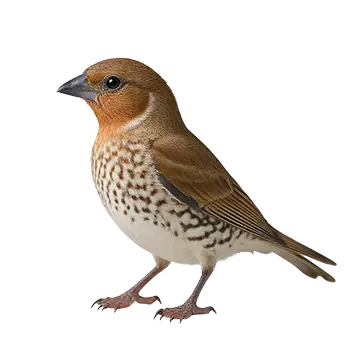

Understanding Enrichment Needs

Enrichment for Spice Finches looks fundamentally different from enrichment for parrots and other hookbills. Parrots are manipulative foragers that use their feet and beaks to disassemble, chew, and puzzle-solve their way through toys and food challenges. Finches, by contrast, are primarily ground-level and grass-canopy foragers whose wild behavioral repertoire centers on seed searching, social interaction, bathing, nest building, and sustained flight through open spaces. Effective enrichment for Spice Finches engages these natural behavioral patterns rather than attempting to impose parrot-style play behaviors on a species that is not wired for them.

The most common mistake in finch enrichment is purchasing toys designed for budgies, cockatiels, or small parrots and expecting Spice Finches to interact with them in the same way. Finches rarely manipulate objects with their feet, almost never chew on hard materials for recreation, and have little interest in bells, mirrors, or plastic beads that captivate hookbills. A cage filled with parrot toys may look well-furnished to the owner but offers almost nothing meaningful to a finch. Understanding what Spice Finches actually do with their time is the necessary starting point for selecting enrichment that the birds will genuinely use.

Social interaction is the single most powerful form of enrichment for this species. Spice Finches are obligate flock birds that engage in near-constant social behaviors including allopreening, contact calling, communal roosting, and synchronized foraging. A solitary Spice Finch, regardless of how many toys are in its cage, is a deprived bird. The presence of conspecifics provides stimulation that no product can replace. This social foundation means that enrichment products should be evaluated not only by how individual birds interact with them but by how they facilitate or enhance group social dynamics.

Beyond social needs, the primary enrichment categories relevant to Spice Finches are foraging complexity, environmental variety, bathing opportunities, nesting materials, and spatial novelty. Products and arrangements that address these categories provide genuine behavioral enrichment rather than mere cage decoration. The most successful Spice Finch keepers think of enrichment as an ongoing program of environmental management rather than a one-time purchase of accessories.

Foraging Enrichment

Foraging is the dominant waking activity for wild Spice Finches, which spend hours each day moving through grass seed heads, rice paddies, and weedy margins searching for ripe seeds. In captivity, a standard open seed dish eliminates all foraging effort, reducing the most time-consuming natural behavior to a few seconds of eating from a stationary bowl. Restoring foraging complexity is the most impactful enrichment strategy available for this species, and it can be achieved through simple, inexpensive means that dramatically increase the time birds spend engaged in purposeful activity.

Scattering seed directly onto the cage floor or into a shallow tray filled with clean, dry substrate is the simplest foraging enrichment technique. A layer of sterile coco fiber, clean dried grass, or crinkled paper strips over the cage floor transforms feeding from a passive bowl visit into an active search that occupies the birds for extended periods. The seeds become partially hidden, requiring the finches to scratch, sort, and sift through the substrate material to locate them. This single change can increase active foraging time from minutes to hours per day.

Millet sprays hung at various points within the cage provide a naturalistic foraging challenge that Spice Finches take to immediately. Unlike processed seed in a dish, a millet spray requires the bird to cling to the swaying spray, strip individual seeds from the stem, and husk them while maintaining balance on an unstable surface. This multidimensional challenge engages motor skills, balance, and feeding behavior simultaneously. Sprays can be positioned at different heights and angles to vary the difficulty and encourage exploration of different cage areas. Replacing consumed sprays with fresh ones in new locations maintains novelty.

Foraging wheels, clip-mounted seed holders, and hanging seed dispensers designed for finches add additional complexity to the foraging landscape. These products require birds to adopt specific body positions, reach into openings, or work against gravity to access seeds, all of which extend feeding time and provide physical exercise. When selecting foraging devices, choose products sized for small finches rather than larger parrot-scale foraging toys, which may be too heavy, too large, or have openings too wide to present any challenge to a bird as small as a Spice Finch.

Swings, Perch Toys, and Motion Enrichment

Swings are among the few conventional toy types that Spice Finches genuinely enjoy and use consistently. A simple wooden or rope swing provides an unstable perching surface that engages the bird's balance and proprioception, offering a qualitatively different perching experience from fixed branches. Many Spice Finches will spend extended periods on a swing, gently rocking and preening, particularly in the quiet midday period when the flock's activity level naturally decreases. Swings sized for finches are small, lightweight, and should be hung where they can move freely without striking cage walls or other fixtures.

Rope perches made from untreated cotton or sisal offer a flexible perching surface that Spice Finches often prefer for communal roosting. A rope perch bowed across the upper portion of the cage provides a gentle curve that the birds can space themselves along, maintaining their preferred inter-individual distance while remaining within the social comfort zone of the flock. The texture of rope also provides varied foot exercise, as the birds grip differently depending on where along the curve they perch and how much the rope flexes under their weight.

Bouncing and swaying branch arrangements add dynamic motion to the cage environment. Thin, flexible branches mounted at one end and left free at the other create springy perches that move when birds land on them, mimicking the experience of landing on grass stems and thin branches in the wild. This motion component is enriching because it requires constant minor postural adjustments, keeping the birds physically engaged in ways that rigid perches do not. Natural branches from bird-safe trees such as willow, birch, or fruit wood are ideal for this purpose because they provide both the appropriate flexibility and interesting bark textures for foot stimulation.

Mirrors and bells, the staple toys of parakeet keeping, should be used with caution or avoided entirely for Spice Finches. Mirrors can cause behavioral confusion in social finch species, as some individuals may direct social behaviors toward their reflection rather than toward live flockmates, which disrupts normal social dynamics. Bells produce sounds that can startle finches, which are more sound-reactive than many hookbills, potentially triggering panic flights in the confined space of a cage. If either item is introduced, it should be monitored closely for adverse behavioral reactions and removed if the birds show signs of stress.

Natural and DIY Enrichment

Some of the most effective enrichment for Spice Finches costs nothing and comes directly from the natural environment. Fresh branches from bird-safe trees and shrubs provide perching surfaces, bark to explore, and in some cases edible buds or flowers. Willow branches are particularly valuable because their thin, flexible stems mimic the grass and reed perches Spice Finches use in the wild, and willows are confirmed safe for avian use. Apple, pear, birch, and hawthorn branches are also excellent choices. All wild-collected branches should be washed thoroughly and inspected for insects before being placed in the enclosure, and they should be sourced from areas free of pesticide application.

Bundles of clean, dried grass stems placed in the cage provide both foraging substrates and nesting material that Spice Finches will pick through, rearrange, and carry to preferred nesting sites. This dual-purpose enrichment taps into two strong behavioral drives simultaneously. Common orchard grass, timothy hay, and dried meadow grass are all suitable materials. Offering grass in loose bundles rather than tightly packed clumps allows the birds to pull individual stems free, which provides manipulative engagement that finches are naturally equipped to perform even though they lack the foot dexterity of parrots.

Shallow dishes of lukewarm water placed on the cage floor or attached at perch height serve as bathing stations that provide some of the most enthusiastically received enrichment available. Spice Finches are vigorous bathers that splash, flutter, and dip repeatedly when given the opportunity. Bathing is not merely hygienic but serves as a genuinely enjoyable activity that birds will return to multiple times per day if water is available. The bathing dish itself becomes a social gathering point where flock dynamics play out as birds take turns and splash together.

Rotating natural enrichment items on a weekly basis maintains novelty without requiring continuous purchases. A branch arrangement that has been in the cage for a week becomes familiar furniture; replacing it with a different set of branches from another tree species refreshes the environment. Similarly, alternating between different foraging substrates, varying the placement of millet sprays, and periodically rearranging the interior layout of the cage prevents the stagnation that occurs when every element of the environment remains static for extended periods. This rotation principle is the foundation of a sustainable, effective enrichment program.

Nesting Materials as Enrichment

Nest building is a powerful behavioral drive in Spice Finches that provides enrichment value independent of actual breeding. Even non-breeding birds and same-sex pairs will collect, carry, and arrange nesting material when it is available, spending substantial time selecting preferred fibers, transporting them to a chosen site, and weaving them into a structure. Providing appropriate nesting materials channels this instinct into a constructive activity that occupies time and satisfies a deep behavioral need.

Coconut fiber, dried grass strands, and soft sisal strips are the most commonly accepted nesting materials for Spice Finches. These should be offered in a small basket or clip holder within the cage rather than scattered loose, allowing the birds to select and pull individual strands as they would extract fibers from plants in the wild. The act of pulling, carrying, and placing each strand engages the birds in a complex chain of behaviors that provides sustained mental and physical occupation. Avoid offering cotton thread, synthetic fibers, or any material that can wrap around toes or legs, as these pose a serious entanglement hazard for small finches.

Closed or semi-closed nest boxes and woven finch nests serve as the destination for collected materials and provide roosting security even outside of breeding contexts. Spice Finches in the wild construct domed nests with small entrance holes, and captive birds strongly prefer enclosed sleeping sites over open perches. Woven grass nests commercially available for finches approximate the natural nest form and are readily adopted. Providing one or two nest sites per pair in the enclosure gives the birds a sense of security and a focus for their building instincts.

The decision to provide nesting opportunities must be balanced against reproductive management. Spice Finches in mixed-sex groups with nest sites and nesting material will almost certainly attempt to breed, and keepers must be prepared to manage eggs and chicks or take steps to prevent unwanted reproduction. Replacing real eggs with dummy eggs is a common management technique that allows the birds to express nesting and incubating behaviors without producing viable offspring. For keepers who prefer to avoid reproductive behavior entirely, offering nesting materials without nest boxes reduces but does not eliminate the stimulus, as determined pairs may construct their own nest structures in cage corners or dense vegetation.

Toy Safety for Small Finches

Safety considerations for finch toys differ substantially from those for parrot toys because of the extreme size difference and the distinct behavioral patterns of finch species. The most common toy-related hazard for Spice Finches is entanglement. Loose threads, frayed rope ends, thin wire loops, and any material that can form a noose around a tiny leg or toe represents a potentially fatal hazard. Finches are less likely to chew through problematic materials than parrots, which means a dangerous loop or thread can persist in the cage unnoticed far longer than it would in a hookbill enclosure where the bird would destroy it within hours.

Small openings and gaps in toy components present a head-entrapment risk. Spice Finches are curious birds that will investigate openings and crevices, and their small heads can pass through gaps as narrow as three-eighths of an inch. Once a bird pushes its head through an opening that is too small for its body to follow, it may be unable to withdraw and can suffer injury or strangulation. Chain links, ring attachments, and any component with a gap should be evaluated for this specific risk before placement in the cage.

Material toxicity is a concern that applies to any product placed in the cage environment. Painted toys should use only non-toxic, lead-free finishes, and stained or varnished wood should be avoided because many wood treatments contain volatile compounds that are dangerous to birds. Zinc-plated hardware, including hooks, clasps, and split rings, can cause zinc toxicity if birds nibble on them, which finches occasionally do even though they are not habitual chewers. Stainless steel hardware is the safest option for any metal components within the enclosure.

Size appropriateness determines whether a toy is functional or merely occupying space. Many products marketed for small birds are actually designed with budgies and lovebirds in mind and are oversized for finches. A swing built for a parakeet may be too heavy and rigid for a Spice Finch to set in motion. Foraging toys with openings sized for a budgie's head may present no challenge at all to the smaller finch or may be completely inaccessible. Selecting products specifically designed for finches, or adapting larger products to an appropriate scale, ensures that enrichment items actually function as intended for the species they serve.

Rotation and Enrichment Scheduling

Novelty is the engine that drives enrichment value. A toy or environmental feature that initially captivates a bird's attention becomes part of the background within days as the bird habituates to its presence. This habituation is not a failing of the product but a normal cognitive process, and the solution is systematic rotation rather than continuous accumulation. Maintaining a library of enrichment items and cycling them through the cage on a regular schedule ensures that the birds encounter fresh stimuli without the keeper needing to purchase new products constantly.

A practical rotation schedule for Spice Finches might operate on a weekly cycle. Each week, one or two enrichment elements are swapped out and replaced with items from the reserve collection. A different branch arrangement, a new placement for the foraging tray, a changed substrate material, or the reintroduction of a swing that has been out of the cage for several weeks all constitute meaningful environmental changes. The removed items are cleaned, inspected for wear, and stored for future reintroduction. After an absence of three to four weeks, a previously familiar item regains enough novelty to provoke renewed interest when reintroduced.

Seasonal enrichment opportunities should be integrated into the rotation program. Spring and summer offer access to fresh grasses, wildflower stems, and live seed heads that provide foraging enrichment unavailable during colder months. Autumn brings dried seed heads and fallen leaves that can be offered as substrate materials. Winter, when natural options are scarce, is the time to rely more heavily on commercial foraging toys, sprouted seeds, and manufactured enrichment products. Aligning the enrichment calendar with seasonal availability creates a naturally varying program that evolves throughout the year.

Observing how the birds interact with each enrichment item provides essential feedback for refining the program over time. Some Spice Finch groups may show strong preferences for foraging-based enrichment and little interest in motion toys, while others may prioritize bathing and nesting materials. Tracking which items generate the most engagement and which are ignored allows the keeper to tailor the rotation to the specific preferences of their flock, investing in more of what works and retiring items that fail to elicit meaningful behavioral responses.

Always consult a qualified professional before making any health-related decisions. This content is provided for informational reference only and should not replace professional guidance specific to your animal.