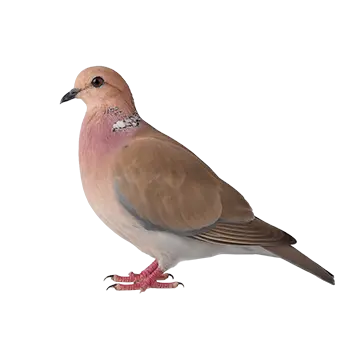

Enrichment for the Senegal Dove requires a fundamentally different approach than enrichment for parrots, and this distinction is one of the most important concepts for dove owners to grasp. Parrots are manipulative foragers with powerful beaks, dexterous feet, and intense curiosity about mechanical objects. Doves are ground-gleaning granivores with delicate beaks, limited foot dexterity, and a behavioral repertoire centered on walking, pecking, preening, and social interaction. Toys and enrichment strategies designed for parrots are not merely suboptimal for doves — they are often completely ignored, and in some cases can be frightening or physically dangerous to a species that lacks the anatomy to interact with them safely.
The core enrichment needs of a Senegal Dove revolve around foraging opportunity, bathing, social stimulation, and environmental novelty presented at a gentle pace. In the wild, these doves spend a significant portion of their day walking across open ground, pecking at small seeds and grit, and interacting with flock members. A captive enrichment program that channels these natural behaviors into structured activities provides the mental and physical stimulation the bird needs without demanding cognitive tasks that fall outside its behavioral range.
Environmental predictability matters more for doves than for many other companion birds. While parrots often thrive on novelty and challenge, doves can become stressed by abrupt changes to their environment. New enrichment items should be introduced gradually, placed at a distance from the bird's primary resting and feeding areas, and left in place long enough for the dove to investigate at its own pace. Forcing interaction with unfamiliar objects by placing them directly on favored perches or next to food dishes can trigger avoidance behavior rather than engagement.
Social enrichment is perhaps the single most impactful form of stimulation for a Senegal Dove. These are flock-oriented birds that form strong pair bonds and derive visible comfort from the presence of a companion. A single dove housed alone requires significantly more human interaction and environmental enrichment to compensate for the absence of a conspecific partner. Owners who spend several hours daily in the same room as their dove, talking softly, offering treats, and allowing supervised out-of-cage time, provide a form of social enrichment that no physical toy can replace.