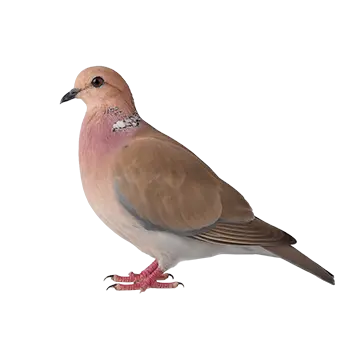

The Senegal Dove is a ground-oriented species that spends much of its active time walking, foraging, and resting on flat surfaces rather than climbing cage bars or swinging from elevated perches the way parrots do. This behavioral profile has direct implications for housing design. The ideal enclosure for a Senegal Dove prioritizes horizontal floor space and flight length over vertical height, giving the bird room to walk, flutter short distances, and engage in its natural ground-level activities without feeling cramped or confined.
Unlike hook-billed species that use their beaks as a third limb to navigate complex cage interiors, doves rely entirely on flight and walking to move through their environment. This means the enclosure must be long enough to permit at least a few wingbeats of sustained flight between perches. A dove that cannot fly inside its cage will gradually lose flight muscle tone and cardiovascular fitness, leading to health problems over time. For a single Senegal Dove, the absolute minimum cage length should be thirty-two inches, though longer enclosures are always preferable.
Temperature stability is another important housing consideration. Senegal Doves originate from the warm climates of sub-Saharan Africa and the Middle East, and while they are reasonably adaptable, they are sensitive to cold drafts and sudden temperature fluctuations. The enclosure should be positioned away from exterior doors, single-pane windows, and air conditioning vents. Indoor temperatures between sixty-five and eighty degrees Fahrenheit suit the species well, with the lower end of that range tolerable as long as the bird has access to a sheltered, draft-free resting area.
Noise and light exposure factor into placement decisions as well. Senegal Doves are not particularly noise-sensitive, but they do benefit from a regular light-dark cycle that approximates natural day length. Placing the cage in a room with natural light, supplemented by full-spectrum artificial lighting if necessary, supports healthy circadian rhythms, hormonal regulation, and feather condition. The cage should be partially covered or positioned so the bird has access to both lit and shaded areas throughout the day.