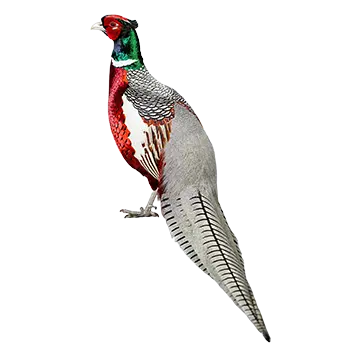

Enrichment is not a luxury for captive Lady Amherst's Pheasants. It is a management essential that directly influences physical health, psychological stability, and breeding success. In the wild, these birds spend the majority of their waking hours engaged in complex foraging behavior, navigating dense undergrowth, responding to environmental stimuli, and managing social interactions within their home range. A captive environment that provides food in a bowl and nothing else eliminates nearly all of this behavioral complexity, leaving the bird with surplus time and energy that it cannot direct toward any productive activity.
The behavioral consequences of inadequate enrichment in pheasants are well documented in avicultural literature and zoo management protocols. Feather picking, pacing, excessive startle responses, aggression toward enclosure mates, and reproductive failure are all associated with under-stimulated captive environments. Lady Amherst's Pheasants are particularly susceptible to stereotypic pacing behavior, in which the bird walks the same circuit along the aviary perimeter repeatedly, wearing visible paths into the substrate. This behavior is a reliable indicator that the bird's environment lacks sufficient complexity to occupy its attention and energy.
Effective enrichment for this species must be understood through the lens of the bird's natural behavioral repertoire rather than borrowed from enrichment strategies designed for parrots or other perching birds. Pheasants are ground-oriented, visually driven, and motivated primarily by foraging and predator-avoidance instincts. A hanging puzzle feeder designed for a macaw is irrelevant to a Lady Amherst's Pheasant, which will ignore it entirely. Enrichment that works for this species engages ground-level foraging behavior, provides novel visual and structural complexity, and creates opportunities for the bird to exercise choice and control over its interactions with the environment.
The enrichment program should be viewed as a rotating system rather than a fixed installation. Any enrichment item, no matter how effective initially, loses its behavioral value as the bird habituates to it. A log that provokes intense investigation on the first day becomes invisible scenery within a week. Maintaining enrichment effectiveness requires regular rotation, with items being introduced, removed, and reintroduced on a schedule that keeps the environment unpredictable and interesting. The goal is an aviary that is never quite the same two days running, challenging the bird to reassess and explore its space continuously.