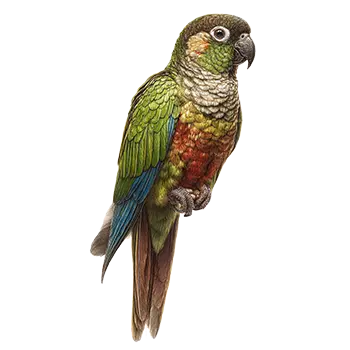

Green-Cheeked Conures are compact but intensely active parrots that require more space than their ten-inch body length might suggest. These birds spend their waking hours climbing, swinging, hanging upside down, and exploring every surface within reach, and a cage that merely fits the bird's body fails the bird entirely. The enclosure must accommodate not just the bird but its full range of natural movements, including wing stretching, short flights or hops between perches, and vigorous play with toys hung at various heights.
The minimum recommended cage size for a single Green-Cheeked Conure is twenty-four inches wide by twenty-four inches deep by thirty inches tall, though larger is always better. Many experienced owners and avian veterinarians advocate for cages in the thirty-by-eighteen-by-thirty-inch range or larger as a practical minimum, particularly for birds that spend significant portions of the day inside the cage while their owners are at work. A flight cage, which prioritizes horizontal length over height, allows short flights between perches and represents a meaningful quality-of-life improvement over a standard upright cage.
Cage shape matters as much as size. Rectangular cages with flat tops are strongly preferred over round or domed cages. Round cages lack the corner spaces that conures use as security positions, eliminate usable wall surface for mounting toys and perches, and can create disorientation in some birds. A flat-topped cage provides an additional play surface on top, which many Green-Cheeked Conures use as a favorite hangout during supervised out-of-cage time.
Placement within the home also affects the bird's wellbeing. Position the cage in a room where the family spends significant time, as Green-Cheeked Conures are social animals that become anxious and behaviorally disturbed when isolated. At least one side of the cage should be against a wall to provide a sense of security, while the remaining sides offer visibility into the room. Avoid placement near windows with direct sun exposure, in kitchens where cooking fumes and temperature swings pose health risks, or in high-traffic hallways where the bird is constantly startled.