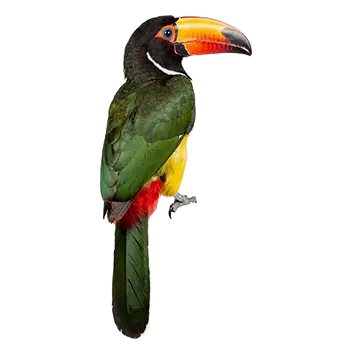

Understanding Aracari Play Behavior

Green Aracaris interact with toys and their environment in ways that are fundamentally different from parrots, and understanding these differences is essential for selecting enrichment that the bird will actually use. Parrots are manipulators. They grip objects with their zygodactyl feet, hold items against a perch, and use powerful curved beaks to tear, shred, and dismantle. Aracaris are not built for this kind of manipulation. Their long, serrated bills are precision tools designed for plucking fruit, probing cavities, and catching insects, not for crushing and shredding. Their anisodactyl foot arrangement provides excellent perching grip but limited dexterity for holding objects.

This means that the entire category of destructible chew toys that dominates the parrot enrichment market is largely irrelevant for aracaris. A Green Aracari will not spend hours demolishing a wooden block or shredding a palm leaf bundle the way a cockatoo or Amazon parrot would. Instead, aracaris engage with objects through tossing, poking, batting, and exploring. They use the tip of the bill to investigate textures, flip lightweight objects into the air, and probe openings and crevices. Enrichment products should accommodate this play style rather than forcing a parrot-centric interaction model.

Curiosity is the dominant driver of aracari play behavior. Green Aracaris are highly visual birds attracted to novel colors, shapes, and movements. They will investigate any new object introduced to their environment with cautious but persistent interest, probing it from multiple angles and testing whether it responds to interaction. This novelty response means that toy rotation is especially important for this species. An item that fascinates an aracari for three days may be completely ignored once the bird has thoroughly investigated it and determined that it holds no further surprises.

Social play is another significant component of Green Aracari behavior. In the wild, aracaris live in small flocks and engage in mutual grooming, bill fencing, and communal roosting. Captive birds that bond with their owners often incorporate their human companions into play sessions, offering objects, engaging in gentle bill sparring with fingers, and soliciting games of chase or peek-a-boo. Toys that facilitate interactive play between bird and keeper can strengthen this social bond while providing stimulation that solitary toys cannot.

Foraging Toys and Devices

Foraging enrichment is the single most valuable category of toys for a captive Green Aracari because it directly replicates the activity that occupies much of the bird's time in the wild. Wild aracaris spend hours each day searching for ripe fruit among the forest canopy, probing bark crevices for insects, and investigating potential food sources. In captivity, food is typically presented in an open dish that requires no effort to access, removing the search-and-discovery component that makes feeding behaviorally satisfying. Foraging toys reintroduce this cognitive and physical challenge.

Simple foraging devices that work well for aracaris include shallow trays or cups with fruit pieces hidden beneath crumpled paper, small balls, or wooden blocks that the bird must push aside with its bill to find the food. The hiding medium should be lightweight enough for the aracari to move easily, since these birds cannot grip and pull obstructions the way a parrot would. Wicker or palm leaf balls with fruit pieces wedged inside allow the bird to probe and extract food through the openings, a behavior that closely mirrors natural insect foraging.

Acrylic and plastic foraging boxes with removable lids or sliding doors offer more complex challenges for experienced foragers. The bird learns through trial and error that manipulating the access mechanism reveals food. These devices should be selected with attention to the aracari's bill dimensions. Many foraging puzzles designed for parrots feature access holes sized for a thick parrot beak, which may be too small for the aracari's longer, more slender bill. Choosing puzzles with wider openings or open-top designs avoids frustration and potential bill injury.

Skewered fruit and vegetable kabobs mounted on stainless steel holders serve double duty as both food delivery and foraging enrichment. The bird must work to remove pieces from the skewer, manipulating each item with its bill tip. Kabobs can be positioned at various heights and angles within the enclosure, encouraging the bird to reach, stretch, and balance while eating. This combination of physical effort and food reward closely approximates the energy expenditure of natural foraging and is one of the simplest and most effective enrichment strategies available.

Tossing and Manipulative Toys

The signature play behavior of most aracaris and toucans is tossing. These birds pick up small objects with the tip of their bill and flick them into the air with a quick head movement, catching them again or watching them fall with apparent amusement. This behavior is instinctive, deriving from the head-toss motion used to move food from the bill tip to the back of the throat for swallowing. Any lightweight, graspable object is a potential tossing toy, and many Green Aracaris will invent their own by picking up stray items from the cage floor or nearby surfaces.

Small plastic balls, particularly those with internal bells or rattles, are among the most consistently popular tossing toys for aracaris. Cat-sized jingle balls and wiffle balls are excellent choices, as they are lightweight enough for easy tossing, brightly colored for visual appeal, and produce sound feedback that rewards interaction. The balls should be large enough that the bird cannot swallow them but small enough to be grasped comfortably in the bill tip. A diameter of roughly one to two inches hits the sweet spot for most Green Aracaris.

Beaded chains and linked plastic rings provide a different manipulative experience. Aracaris enjoy picking up chains by one end and shaking them, creating sound and movement that sustain interest. Stainless steel quick-link chains with smooth, rounded links are safe and durable, while plastic link chains designed for bird toys offer a lighter-weight alternative. Ensure that all links are securely closed and that the chain length does not pose an entanglement risk. Short chains of six to ten links are generally safer than longer ones.

Leather strips and small fabric pouches appeal to the aracari's probing instinct. A small leather pouch containing a treat or a crinkly material invites bill exploration and shaking. Natural vegetable-tanned leather is safe for bird toys, while chrome-tanned leather may contain harmful chemicals and should be avoided. Fabric items should be inspected regularly for loose threads that could wrap around toes or be ingested, and replaced at the first sign of significant fraying.

Water and Bathing Enrichment

Green Aracaris are enthusiastic bathers, and providing opportunities for water play constitutes some of the most effective enrichment available. Bathing serves practical hygiene functions by keeping feathers clean and maintaining the waterproofing oils distributed during preening, but for aracaris it is also clearly a source of pleasure. Birds that have access to bathing opportunities typically display more relaxed body language, better feather condition, and increased preening activity compared to those without regular bathing access.

Shallow water dishes or trays large enough for the bird to stand in and splash are the simplest bathing setup. The water depth should be no more than one to two inches, allowing the bird to wade in confidently without feeling unstable. Many keepers place the bathing dish on the cage floor or on a low platform during supervised out-of-cage time, then remove it after the bird has bathed to prevent the enclosure from becoming excessively wet. Room-temperature water is appropriate; there is no need to warm or cool it.

Misting with a clean spray bottle provides an alternative bathing experience that many aracaris enjoy. A fine mist directed above and around the bird allows it to choose how much water exposure it wants, fluffing its feathers and opening its wings to catch the droplets or retreating to a dry perch if it prefers. Some keepers use pump sprayers or plant misters to produce a sustained gentle spray, and a few aracaris learn to position themselves beneath running kitchen faucets or shower heads during supervised out-of-cage time.

Drip systems and fountain-style water features add an auditory and visual dimension to bathing enrichment. The sound and movement of flowing water attract the aracari's attention and often stimulate bathing behavior in birds that are indifferent to still water dishes. Small recirculating fountains designed for pets can be adapted for bird use, provided they are cleaned frequently to prevent biofilm accumulation. Any water enrichment device should be easy to disassemble for thorough cleaning, as the warm, moist environment of a fountain is ideal for bacterial and algal growth.

Swings, Ladders, and Climbing Structures

Swings are among the few parrot-oriented toys that translate well to aracari use. A swing provides a dynamic perching surface that moves in response to the bird's weight and activity, offering vestibular stimulation and balance challenges that a static perch cannot. Green Aracaris often perch on swings for extended periods, gently rocking themselves or actively pumping the swing into wider arcs. A swing made from a natural wood dowel suspended by stainless steel chains or bird-safe rope accommodates the aracari's perching needs while providing the motion they enjoy.

Ladders are used differently by aracaris than by parrots. A parrot climbs a ladder rung by rung using its beak and feet in coordinated alternation. An aracari is more likely to hop onto a ladder, use it as a series of perches, or investigate it by probing between the rungs with its bill. Wooden ladders with widely spaced rungs can serve as interesting perching structures, and some aracaris learn to hop up them in a bounding motion. The primary enrichment value of a ladder for an aracari lies in its novelty and its potential as a route between different areas of the enclosure rather than as a climbing exercise.

Branching structures and platform perches create a three-dimensional environment that encourages natural hopping and short-flight movement patterns. Connecting multiple perch levels with angled branches allows the bird to choose different routes through its enclosure, varying its movement pattern and maintaining physical fitness. Cork bark platforms and natural driftwood pieces add textural variety and create visual barriers within the cage that simulate the broken sightlines of a forest canopy.

Rope boings and spiral perches offer flexible, bouncy surfaces that some aracaris find appealing. These coiled rope structures compress and spring back when the bird lands on them, providing an interactive perching experience. However, rope products carry inherent risks. Frayed fibers can entangle toes or be swallowed, causing crop impaction. If rope perches or boings are used, they should be made from natural cotton or sisal rather than synthetic materials, inspected daily for fraying, and replaced immediately when wear becomes apparent.

DIY Enrichment Ideas

Some of the most effective enrichment for Green Aracaris costs nothing and can be assembled from household items and natural materials. The key principle is novelty. Aracaris are stimulated by new objects, textures, and configurations, so a rotating selection of homemade enrichment items can sustain the bird's interest as effectively as purchased toys, often more so because the homemade items can be changed more frequently without significant cost.

Paper and cardboard provide safe, disposable enrichment materials. Small paper cups or muffin liners with a fruit treat hidden inside give the bird a quick foraging challenge. Crumpled balls of plain paper become tossing toys. Cardboard tubes from paper towel rolls can be folded closed at the ends with treats inside, creating a simple foraging puzzle that the bird punctures and tears open with its bill. Avoid printed or glossy cardboard, and use only paper products free of adhesives, staples, and tape.

Natural materials from safe, pesticide-free sources offer texturally interesting enrichment. Cleaned pine cones with treats wedged between the scales provide probing challenges. Bundles of clean, pesticide-free leaves or non-toxic flowers give the bird something to investigate and shred lightly. Short sections of non-toxic wood branches with bark still attached can be mounted in the cage for the bird to explore, peel, and probe for imaginary insects. Research any plant material carefully before introducing it, as many common decorative plants are toxic to birds.

Environmental changes within the enclosure constitute enrichment even without new objects. Rearranging perch positions, changing the location of food dishes, or draping a clean cloth over part of the cage to create a new visual boundary all stimulate the bird's exploratory behavior. Some keepers play nature recordings featuring forest sounds or bird calls at low volume to provide auditory enrichment, though care should be taken that alarm calls from predatory bird species do not cause stress. The overarching goal is to prevent the bird's environment from becoming static and predictable, which is the primary enemy of psychological wellbeing in intelligent captive birds.

Safety and Toy Maintenance

Every toy or enrichment item introduced to a Green Aracari enclosure must be evaluated for safety before the bird has access to it. The most common toy-related injuries in captive birds involve entanglement, ingestion of foreign materials, and entrapment. Aracaris are particularly vulnerable to toe entanglement because their long, slender toes can slip into loops, gaps, and frayed fibers more easily than the thick, muscular toes of parrots. Any item with loops, rings, or fibrous strands should be examined critically for entanglement potential.

Material safety extends beyond obvious toxins to include considerations specific to ramphastids. Zinc, lead, and copper are toxic to all birds and are found in some hardware, wire, and metal toy components. Quick links, chain links, and carabiners should be stainless steel or verified zinc-free. Painted items should use only bird-safe, non-toxic paints or dyes. Plastic toys should be made from food-grade materials without small parts that could break off and be swallowed. The aracari's tossing behavior means that toys are frequently dropped and struck against hard surfaces, so brittleness and breakability are more significant concerns than they would be for a bird that primarily manipulates toys while perched.

Regular inspection of all toys and enrichment items is a non-negotiable aspect of responsible aracari ownership. Check every item at least weekly for signs of wear, breakage, loose components, or contamination with droppings and food residue. Toys that have become soiled should be cleaned with hot water and bird-safe disinfectant or replaced. Wooden and natural-material items eventually deteriorate beyond cleaning and should be discarded rather than allowed to become sources of bacteria or mold.

Toy rotation keeps enrichment effective while reducing wear on individual items. Maintain a collection of toys and introduce two or three into the enclosure at a time, swapping them out every few days. Items that have been out of the cage for a week or more regain some of their novelty value when reintroduced, extending their useful life. This rotation system also ensures that if a toy develops a safety issue, it is discovered during the off-cycle inspection rather than after the bird has been exposed to it continuously.

Always consult a qualified professional before making any health-related decisions. This content is provided for informational reference only and should not replace professional guidance specific to your animal.