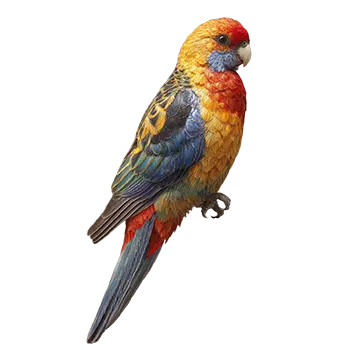

The Golden-Mantled Rosella is an active, flight-oriented parakeet that requires significantly more horizontal space than many companion birds of comparable body size. In the wild, rosellas cover considerable distances during daily foraging flights, and captive housing must accommodate their strong drive to fly rather than climb. Unlike hookbill species that spend much of their time scaling cage walls and hanging from perches, rosellas are horizontal flyers that move in swift, direct lines from one end of their enclosure to the other.
The absolute minimum cage dimensions for a single Golden-Mantled Rosella are approximately thirty-six inches in length, twenty-four inches in depth, and thirty-six inches in height, though these measurements represent a baseline rather than an ideal. Experienced rosella keepers and avian veterinarians consistently recommend enclosures at least four feet long to allow meaningful flight movement. For a pair of rosellas, dimensions should increase substantially, with six to eight feet of length considered appropriate for comfortable cohabitation.
Temperature tolerance is an important consideration when planning rosella housing. As Australian natives, Golden-Mantled Rosellas are adapted to a climate that includes warm summers and cool winters. They tolerate temperatures between forty and ninety-five degrees Fahrenheit reasonably well, provided they have access to shade in heat and shelter from drafts in cold. This broad temperature tolerance makes them candidates for outdoor aviary housing in many temperate climates, a setup that offers exercise and enrichment benefits that indoor caging struggles to match.
Placement of the enclosure within the home or property affects the bird's stress levels and overall wellbeing. Rosellas tend to be more anxious than domesticated parakeet species like budgerigars, and they benefit from having their enclosure positioned at chest height or above, against a solid wall on at least one side. This arrangement provides a sense of security by eliminating the possibility of unexpected approaches from behind while keeping the bird at a height where it does not feel vulnerable to ground-level threats.