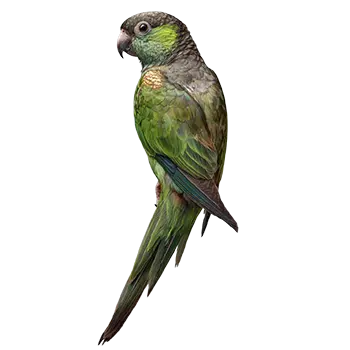

Understanding Enrichment Needs

The Bronze Winged Parakeet is an intelligent and physically active bird that requires consistent mental and physical stimulation to maintain behavioral health in captivity. In the wild, Brotogeris chrysoptera spends the majority of its waking hours engaged in complex behaviors: foraging through tropical canopy vegetation, manipulating fruit and seed pods with its feet and beak, socializing with flock members, and navigating through dense forest. Captivity removes nearly all of these activities, and without deliberate replacement through toys and enrichment, the bird's energy and cognitive drive turn inward, manifesting as feather destructive behavior, stereotypic movements, excessive screaming, or withdrawn apathy.

Enrichment is not a supplementary nicety for this species. It is a core husbandry requirement on par with nutrition and housing. A Bronze Wing without adequate stimulation is a Bronze Wing on a trajectory toward behavioral and psychological deterioration, and the resulting problems are far more difficult to resolve than they are to prevent. The investment in a thoughtful toy rotation and enrichment program pays returns in the form of a confident, engaged, and physically healthy bird that is a genuine pleasure to live with.

The enrichment needs of this species break down into several categories: destructive play, which satisfies the beak's need to chew and shred; manipulative play, which engages the feet and problem-solving intelligence; foraging, which replicates the food-finding work that consumes hours in the wild; physical exercise, which includes climbing, swinging, and short flights; and social interaction, which for a bonded pet bird often means direct engagement with the owner. A well-rounded enrichment program addresses all of these categories, rotating through different toys and activities to prevent habituation and boredom.

Scale is a critical consideration when selecting toys for a Bronze Wing. Products designed for large parrots such as macaws and cockatoos are too heavy, too large, and often made of materials too dense for a small Brotogeris to engage with meaningfully. Conversely, toys designed for finches or budgerigars may be flimsy and too easily destroyed to hold the Bronze Wing's interest. The sweet spot is typically products marketed for cockatiels, lovebirds, or small conures, which provide appropriate resistance and physical dimensions for a bird in the sixty-gram range.

Foraging Toys and Puzzle Feeders

Foraging enrichment is arguably the single most impactful category of toys for a captive Bronze Winged Parakeet. Wild parrots spend an estimated forty to seventy percent of their active time foraging, but a captive bird with food presented in an open dish can consume its daily intake in minutes. This massive disparity in time spent on food acquisition creates hours of unstructured time that the bird's brain is not equipped to fill passively. Foraging toys restore a measure of that natural time budget by requiring the bird to work for its food.

Entry-level foraging toys include simple devices like foraging cups with lids, paper-wrapped treats, and lattice balls stuffed with food. These require minimal prior experience and are ideal for introducing the foraging concept to a bird that has always eaten from an open dish. Wrapping a favorite treat in a small piece of plain paper and placing it in the cage gives the bird a problem to solve, crumpling and tearing the paper to reach the reward inside, and the success reinforces the behavior for more complex challenges later.

Intermediate foraging devices introduce mechanical elements: sliding doors, rotating covers, pull-out drawers, and stacked compartments that require multiple steps to access the food inside. These are where the Bronze Wing's intelligence truly engages, and many individuals develop sophisticated problem-solving strategies that become more efficient over time. The challenge for the owner is to stay ahead of the bird's learning curve, gradually increasing complexity or changing the device entirely when the bird solves a puzzle too quickly for it to provide meaningful occupation.

Advanced foraging systems can be as elaborate as the owner's creativity allows. Some keepers build foraging walls from pegboard with interchangeable cups and covers, while others use commercially available modular systems that can be reconfigured endlessly. The key principle at every level is that the bird should succeed often enough to stay motivated but struggle enough to stay engaged. A foraging toy that never yields its reward is as useless as one that gives it up immediately.

Chew Toys and Destructible Items

The Bronze Winged Parakeet's beak is a versatile tool that requires regular use to maintain its condition and satisfy deeply rooted behavioral drives. In the wild, the beak is employed constantly for manipulating food items, stripping bark, hollowing out nest cavities, and preening flock mates. Captive birds deprived of appropriate chewing outlets redirect this drive toward cage bars, perches, clothing, furniture, and sometimes their own feathers. Providing a steady supply of chew toys channels this energy constructively.

Soft wood toys are the staple of the chew category for small parrots. Balsa, yucca, sola, and cork are all soft enough for a Bronze Wing's beak to destroy satisfyingly without posing a risk of beak injury from excessive resistance. These materials are typically assembled into hanging toys with multiple pieces strung on stainless steel wire or vegetable-tanned leather cord. The bird works through each piece over hours or days, reducing it to splinters and fragments that fall to the cage floor, and this systematic destruction is exactly the point.

Paper and cardboard provide inexpensive, endlessly renewable chewing material. Toilet paper rolls, small cardboard boxes, unbleached coffee filters, and plain paper can be folded, stuffed, or woven into cage bars for the bird to shred. This is disposable enrichment at its most practical. Many Bronze Wing owners keep a supply of paper-based chewing material on hand and replenish it daily, treating it as a consumable rather than a durable toy. The key safety consideration is avoiding printed, glossy, or coated paper products, which may contain inks or chemicals unsuitable for ingestion.

Natural fiber materials including palm leaf, seagrass, coconut husk, and untreated wicker offer textures that differ from wood and paper and engage the beak in different ways. Woven grass mats attached to the cage wall give the bird a surface to pick apart strand by strand, a slow-paced activity that many Bronze Wings find absorbing enough to occupy extended periods. Coconut shell halves provide a harder surface for beak conditioning while also serving as hiding spots or foot toys when they reach the cage floor.

Owners should expect to replace chew toys frequently and should view this ongoing expense as a normal part of keeping this species. A cage full of pristine, untouched toys is a sign that the toys are wrong for the bird, either in material, size, or placement. A cage scattered with fragments and debris means the enrichment program is working.

Interactive and Social Toys

Bronze Winged Parakeets are social birds that bond intensely with their human companions, and this social drive creates opportunities for interactive play that simultaneously enriches the bird and strengthens the human-animal relationship. Interactive toys are those that require or encourage participation from the owner, turning play into a shared activity rather than a solitary one.

Small balls, particularly lightweight plastic wiffle balls and jingle balls sized for cats or small parrots, make excellent fetch and chase toys for Bronze Wings that enjoy floor time outside the cage. Many individuals learn to push a ball back toward their owner or chase it across a table surface, and this kind of active play provides both exercise and social engagement. The ball should be too large to swallow but small enough for the bird to grip and manipulate with its foot, roughly one to one and a half inches in diameter for this species.

Teaching tricks is a form of enrichment that uses the bird's intelligence and its desire for social interaction simultaneously. Bronze Wings are capable learners that can master a range of behaviors including step-up on command, waving, turning around, targeting a stick, and retrieving small objects. The training process itself, with its rhythm of cues, responses, and rewards, provides structured mental exercise that many birds find deeply satisfying. Short sessions of five to ten minutes work best for maintaining focus without causing frustration.

Swings, ladders, and climbing nets encourage physical activity while providing the kind of dynamic, unstable perching surfaces that challenge balance and coordination. A swing mounted at the top of the cage becomes a preferred resting spot for many Bronze Wings, who enjoy the gentle motion and the elevated vantage point. Rope ladders connecting different levels of the cage encourage vertical movement that exercises leg muscles and provides an alternative to flying in the confined space of a cage.

Mirrors are a topic of some debate in avian enrichment. For a single Bronze Wing without avian companionship, a mirror can provide apparent social stimulation, but it can also foster obsessive attachment, hormonal behavior, and regurgitation directed at the reflected image. If a mirror is offered, the bird's response should be monitored carefully. Healthy, casual interaction is acceptable, but if the bird begins spending excessive time at the mirror, neglecting food and other activities, the mirror should be removed.

Foot Toys and Manipulatives

Foot toys occupy a unique niche in the enrichment landscape for Bronze Winged Parakeets. These are small objects designed to be held in one foot while the bird manipulates them with its beak, replicating the way wild parrots handle seed pods, fruit, and other food items. The Brotogeris genus is notably dexterous for its size, and Bronze Wings take readily to foot toys that other small parrots might ignore.

Classic foot toy designs include small wooden blocks, vine balls, plastic chain links, rawhide-free leather knots, and miniature wicker baskets. The common thread is that each item is small enough to grip comfortably in one foot, approximately one-half to one inch in diameter, light enough to lift and hold without strain, and interesting enough in texture or structure to reward extended manipulation. A vine ball stuffed with a small treat combines foot toy engagement with foraging motivation, doubling the enrichment value of a single item.

Acrylic and hard plastic foot toys offer a different sensory experience from natural materials. Small acrylic beads on a ring, plastic nuts and bolts that unscrew, and miniature pacifier-shaped toys provide smooth, durable surfaces that click and rattle satisfyingly when manipulated. These hard toys complement the softer, destructible items in the bird's rotation by offering something that persists rather than being consumed. The contrast keeps the bird's play repertoire varied.

A collection of ten to fifteen foot toys, rotated in groups of four or five at a time, prevents habituation while keeping each individual toy novel when it reappears. Scattering foot toys on the cage floor or on a play surface outside the cage encourages the bird to move, select, and carry items, adding a physical dimension to what is primarily a fine-motor activity. Some Bronze Wings develop clear preferences for specific foot toys and will search for favorites among a scattered collection, a sign of cognitive engagement that indicates the enrichment is working at a meaningful level.

Safety screening for foot toys is essential because their small size means they are thoroughly mouthed, chewed, and sometimes partially ingested during play. Avoid items with sharp edges, loose paint, small removable parts that could be swallowed, or materials that splinter into sharp fragments. Zinc-plated hardware, lead-containing metals, and soft rubber or foam that tears into swallowable pieces have no place in a parrot's foot toy collection.

Toy Rotation and Placement Strategy

How toys are managed within the cage matters as much as what toys are chosen. A cage crammed with every toy the owner has ever purchased creates clutter that reduces usable space, overwhelms the bird with choices, and paradoxically decreases engagement. Research in animal behavior consistently shows that novelty drives exploration and play, and a toy that has been sitting in the same spot for weeks becomes invisible to the bird, functionally equivalent to a piece of cage furniture rather than an object of interest.

The rotation principle addresses this directly. Rather than presenting all toys simultaneously, maintain a working set of four to six toys in the cage at any time and swap two or three of them out every few days. The toys removed go into storage and reappear weeks later with renewed novelty. This approach means that even a modest toy collection of fifteen to twenty items can provide months of varied stimulation, and each rotation day triggers a burst of investigative behavior as the bird discovers and re-engages with the new additions.

Placement within the cage should be varied with each rotation. Moving a familiar toy to a new position changes the bird's spatial relationship with it and can renew interest that might have waned in its previous location. Hanging toys at different heights, attaching foot toys to different perches, and repositioning foraging devices away from their previous spots all contribute to environmental complexity that challenges the bird to adapt and explore.

Toy placement should also account for the bird's behavior patterns and preferences. Most Bronze Wings have preferred activity zones within their cage, often the upper third for active play and the middle levels for resting and preening. Placing the most stimulating toys in the active zone maximizes engagement, while quieter enrichment items like soft rope preening toys can be positioned in the resting zone where the bird retreats between bouts of activity. Observing where the bird spends its time and which toys see the most use provides ongoing feedback that refines the enrichment strategy over time.

New toys should be introduced thoughtfully rather than simply hung in the cage without preparation. Some Bronze Wings are neophobic and react to unfamiliar objects with alarm rather than curiosity. Placing a new toy near the outside of the cage for a day or two, then moving it just inside the cage at a distance from the bird's primary perches, allows gradual acclimation. Most individuals will investigate the new item within a day once they have observed it from a safe distance and determined it poses no threat.

DIY Enrichment and Budget-Friendly Options

Commercial bird toys fill an important role, but some of the most effective enrichment for Bronze Winged Parakeets costs little or nothing. The bird does not distinguish between a handmade toy and a store-bought one. What matters is whether the item engages the bird's beak, feet, brain, or body in a satisfying way, and many household materials and simple crafting techniques produce enrichment items that rival or exceed commercial offerings in bird appeal.

Paper-based enrichment is the simplest starting point. A cupcake liner folded around a small seed treat becomes a foraging challenge. A stack of index cards threaded onto a leather cord and hung from the cage ceiling provides hours of shredding satisfaction. Toilet paper and paper towel rolls can be folded closed at the ends, filled with treats and shreddable material, and offered as disposable foraging tubes. Plain brown paper bags, crumpled into loose balls with food hidden inside, combine foraging and destructive play in a single item that costs virtually nothing.

Natural materials gathered from safe, pesticide-free outdoor environments expand the enrichment palette at no cost. Small pine cones, thoroughly cleaned and dried, are engaging chew items. Bundles of safe-species twigs tied together with untreated cotton string create a natural chewing and peeling toy. Clean, dried seed heads from flowers like sunflowers or coneflowers provide a foraging experience that closely mirrors wild feeding behavior.

Kitchen items offer surprisingly effective enrichment possibilities. Stainless steel measuring spoons on a ring make a durable, shiny foot toy that Bronze Wings often find fascinating. Dried pasta shapes like penne or wagon wheels can be strung on a cord for a chewable, crunchable hanging toy. Small stainless steel cups or shot glasses placed on a play surface become containers for foot toys, treats, or water, encouraging the bird to explore and forage through a series of small vessels.

The only firm rule with DIY enrichment is safety. Every material must be non-toxic, free of sharp edges, free of small removable components that could be swallowed and cause obstruction, and free of strings or fibers long enough to entangle the bird's toes, wings, or neck. When in doubt about a material's safety, choose a known-safe alternative. The savings from DIY enrichment are never worth a veterinary emergency.

Always consult a qualified professional before making any health-related decisions. This content is provided for informational reference only and should not replace professional guidance specific to your animal.