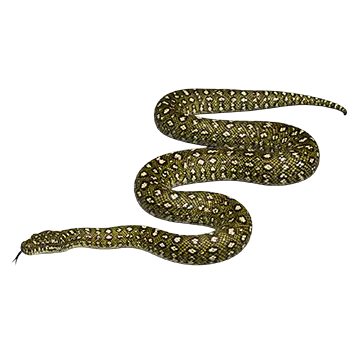

Diamond Pythons commonly live twenty to thirty years in captivity, and well-managed individuals occasionally exceed that. As a working definition, an animal is entering its senior years somewhere around eighteen to twenty-two, though chronological age is a crude guide. A python that was cooled annually, fed conservatively, and housed with generous climbing space may still be behaving like a prime adult at twenty-two, while one raised hot and overfed may present as geriatric at fifteen. Assess the individual animal rather than the number on its records.
The earliest changes are usually behavioural and easy to dismiss. The snake climbs a little less, chooses lower perches, and spends more time on or near the substrate. It takes longer to settle after handling and moves with less decisiveness across a branch network it once crossed without hesitation. Basking sessions may lengthen, since older animals often thermoregulate less efficiently and rely more heavily on external heat to drive digestion. None of these on its own is alarming, but together they mark the transition into a stage that calls for a modified environment.
Physical changes follow. Muscle mass declines gradually, most visibly along the dorsal musculature and toward the tail, so that the spine becomes more prominent even in an animal at a stable weight. Skin loses some of its elasticity and may appear looser through the neck and flanks. Shed cycles become less frequent, sometimes dropping to two or three times per year, and more likely to come away in pieces rather than a single intact tube. The colour of an old Diamond Python often deepens and dulls slightly, with the yellow of the rosettes taking on a more muted, sometimes orange or bronze cast.
The most important skill in this stage is distinguishing normal ageing from disease, because the two overlap. Gradual, proportionate decline across several years with maintained appetite and stable weight is ageing. Rapid change over weeks to months, weight loss exceeding ten percent, sudden loss of climbing ability, new tremors or head posture abnormalities, or a shed that fails badly after decades of clean sheds all point toward a clinical problem. Senior animals also deteriorate faster once they do become unwell, so the threshold for seeking veterinary assessment should drop as the animal ages.